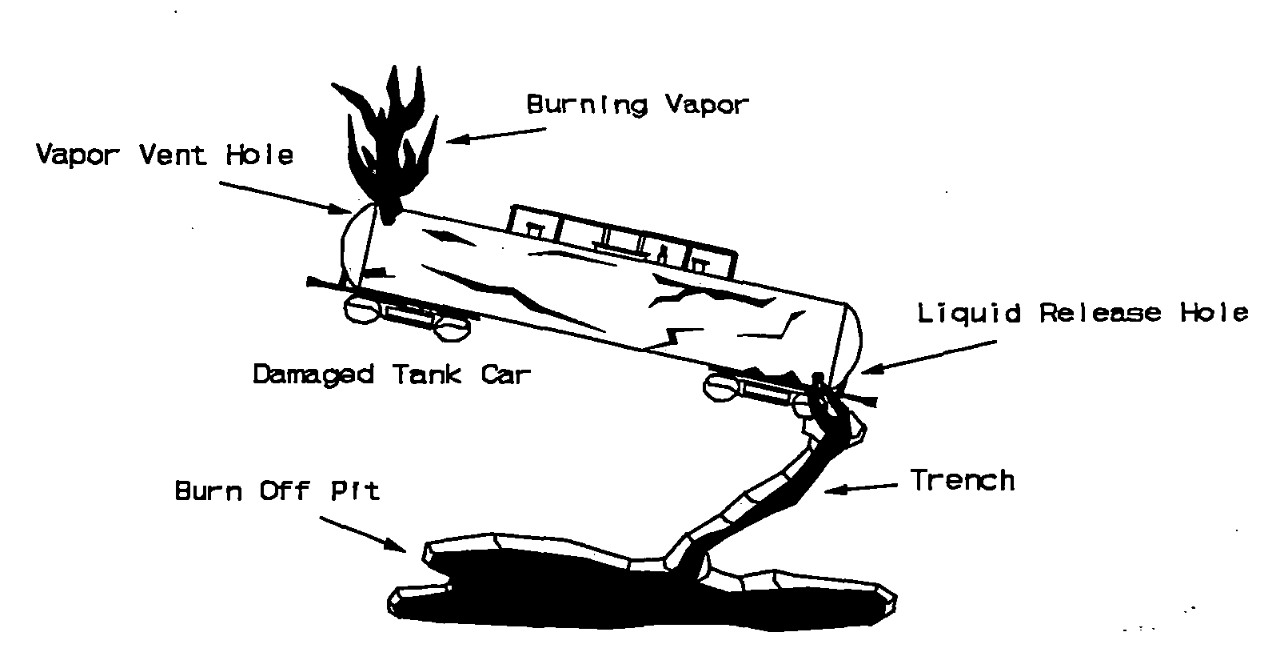
The derailment in East Palestine, OH, was a classic need for a Vent & Burn operation (as shown in the video). There was some indication that one or more of the Vinyl Chloride railcars had begun its polymerization reaction, which could result in catastrophic consequences for many people and property. This indication also eliminates the option of transferring the VCM to other containers. So the decision was made to perform the vent & burn, eliminating the uncontrolled catastrophic failure of the VCM railcar(s).
This exercise involves two charges being placed on the railcar(s): one creating a vent in the headspace and the other creating a larger opening at the lowest point on the car. The vent is blown first, seen as the gaseous vertical plume in the video, and then the second charge blows a hole in the bottom of the car for the liquid to drain out into an earthen dike constructed by responders. Inside the earthen dike, road flares or some other ignition source are placed to ignite the flammable gas, shown as the larger explosion in the video. I am not sure who performed this vent and burn, but it went off perfectly and did exactly what they hoped it would.
Vent and Burn is NOT some wild cowboy stunt; it is a very structured and calculated exercise, recognized as a last resort effort to control a potentially catastrophic event. As the FRA manual states…
|
Vent and Burn is an emergency response procedure designed to quickly and effectively release railroad tank car internal vapor pressure and liquid products to avoid disastrous, uncontrolled tank rupture and environmental contamination. During derailment accidents, tank cars may become structurally compromised by denting, crack initiation, or puncturing and/or subject to external heating and the associated increase in internal pressure. The Vent and Burn procedure is applied to damaged tank cars only when all other emergency product removal methods have been considered and rejected, and the consequences of not relieving the internal tank car pressure are determined to be greater than using this procedure. The Vent and Burn procedure involves the use of two explosive charges to cut holes in the tank car. The first charge is placed at the highest point of the tank car, over the product vapor space. Its detonation relieves the tank’s internal vapor pressure. A second charge is placed at the lowest point of the liquid space to allow drainage of the product into a containment pit, where it is burned in a controlled setting, both neutralizing its environmental hazard and removing the potential for uncontrolled explosion. |
The Vent and Burn method may be used when the following conditions exist:
- The tank car tank has been exposed to fire resulting in elevated internal pressure and possible tank damage.
- The tank car body has been structurally weakened to the extent that it cannot be safely rerailed and moved to an appropriate unloading point.
- Site conditions prevent the use of cranes or other rerailing equipment.
- Conditions do not allow the safe transfer, venting, or flaring of the tank car.
- Damage to leaking valves and fittings cannot be repaired.
To the extent possible, the following conditions should exist, or be met, before using the Vent and Burn method. These conditions are considered optimal but do not have to be met in all cases. Each incident is unique.
- Nearby cars containing hazardous materials will not be affected adversely by the operation.
- Suitable Vent and Burn equipment is available.
- Personnel experienced with the Vent and Burn method is available.
- Appropriate precautions can be taken to protect people and property in the event of an accidental detonation during the Vent and Burn application.
- An adequate collection area is available for the burning operation.
- Cryogenic tank cars should NOT be considered due to the physical state of the products and the construction of the car itself.