
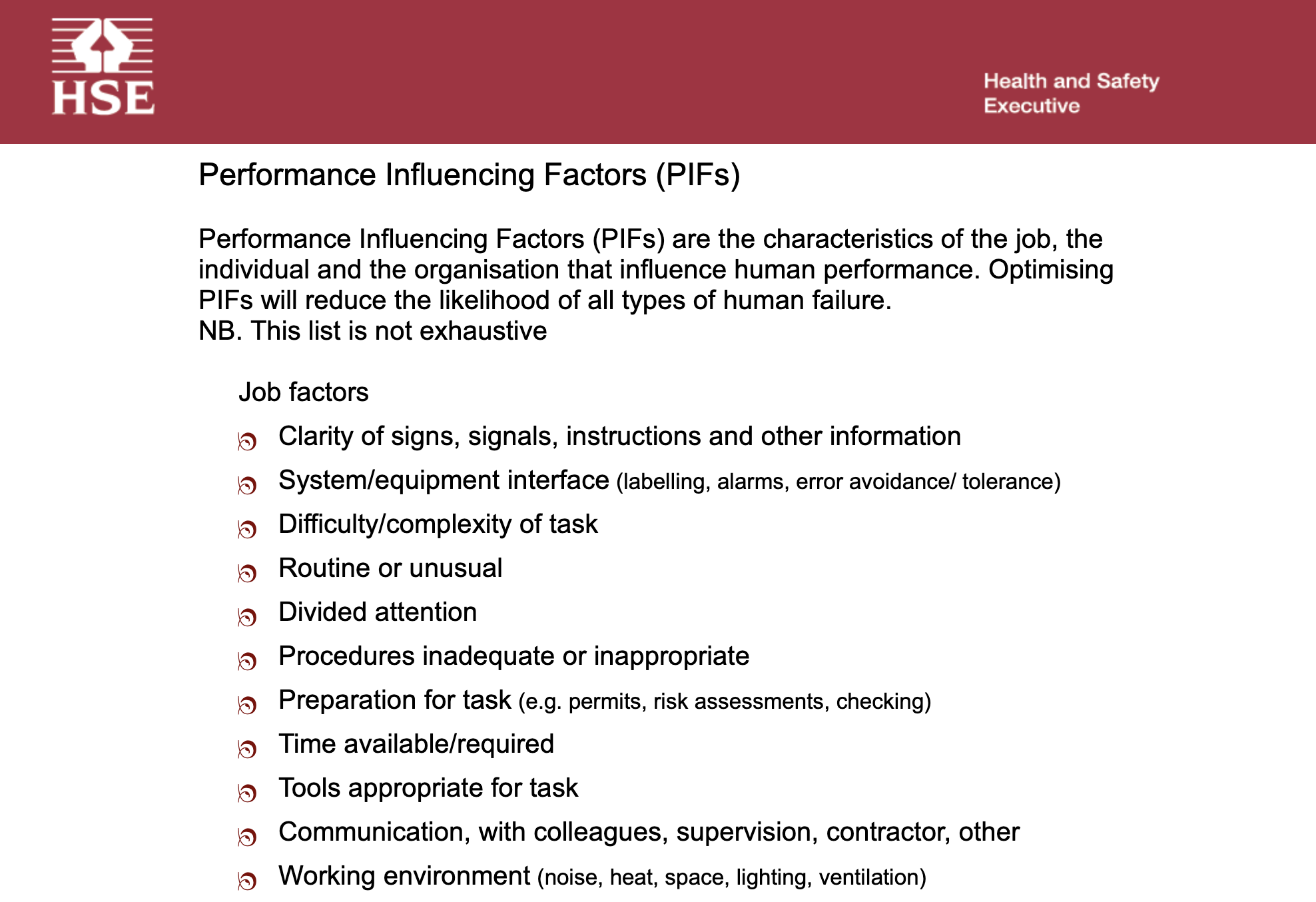
 Performance Influencing Factors (PIFs) is another term, from across the pond, for error traps. You will see me use these terms interchangeably in my HF postings, as I was formally trained to use the term PIFs, but these days it seems we use the term trap.
But after spending a year working with an organization that performed many MANUAL HIGH-RISK tasks daily, I found the UK’s HSE infographic on PIFs very telling. Their #1 listed PIF was:
Clarity of signs, signals, instructions, and other information
I know that almost all organizations could list this item as their #1 opportunity, but this business fell into this trap much deeper than most.
As you know, I am a big believer in DEFINING and QUANTIFYING safety expectations. In process safety, we do this with our Process Safety Information (PSI). Outside of process safety, it is still critical that “engineering standards” be established for the physical workplace. From a human factors perspective, these engineering standards must match what the employees see in the field. Auditing can play a significant role in this validation; however, the business needs a means/method to IDENTIFY these deviations (i.e., hazards) from the standard BEFORE an audit.
One such organization I worked with had an engineering standard. Employees were trained on the official signs, signals, instructions, and other information. The problem lay in this business being made up of smaller businesses it had bought over the years. Each of these smaller businesses had very different signs, signals, instructions, and other information. Thus, employees saw different signs, signals, instructions, and other information in the field from what they were trained on. This is a SERIOUS error trap/PIF. These error traps/PIFs impacted all workers regardless of years with the company.
Think back to my example using STOP signs in earlier posts. Imagine if every town in the USA used its own SIZE, COLOR, SHAPE, and TEXT for their STOP signs and drivers were expected to recognize and respond to STOP signs that they had never been trained to recognize or respond to. How effective will these STOP signs be in serving their critical safety need?