
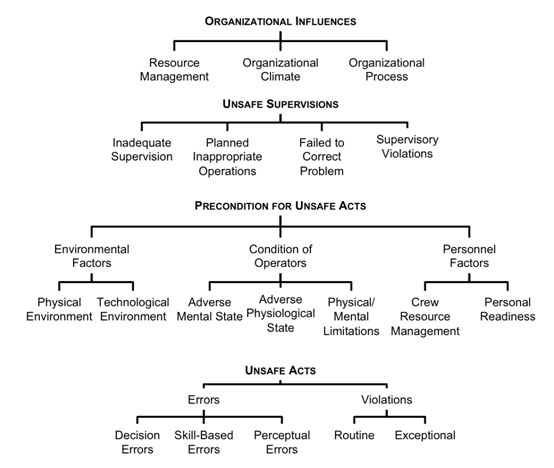
 The HFACS model was designed to be a classification tool rather than a predictive tool. However, since its initial development, there has been a lot of interest on whether it can also be used as a predictive tool. That is, can it be used to inform us about which factors in preconditions for unsafe acts, unsafe supervision, and organizational influences predict factors within unsafe acts?
A major assumption underpinning the HFACS model is that there is a causal or, at least, a predictive relationship between factors in the upper levels to those in the lower levels. For instance, organizational influences are presumed to affect the likelihood of unsafe supervision, which in turn influences preconditions for unsafe acts, which in turn influences the likelihood of unsafe acts. Another assumption is that all factors within a level are independent of each other.
There is little evidence of whether HFACS (or other similar models based on the Reason (1990) accident causation model) can be used to predict relationships between contributing factors.
One major disadvantage of establishing predictive pathways to unsafe acts using accident data is that factors in the higher levels are only recorded on the occasions when they contribute to unsafe acts and negative consequences (accident or incident). This represents only a small fraction of the time these factors are likely to actually occur because accidents and incidents are relatively rare and these factors are often successfully dealt with on a regular basis.
All that can be established about the relationships between factors using accident data is whether one factor predicts another with no allowable inference about causal status. Establishing causality is not possible because accident data are from real-world events and do not allow for controlled experiments. This report, therefore, evaluates predictive models only.
This study sought to improve the available information on the predictive relationships between HFACS levels and categories.
CLICK HERE for the report