
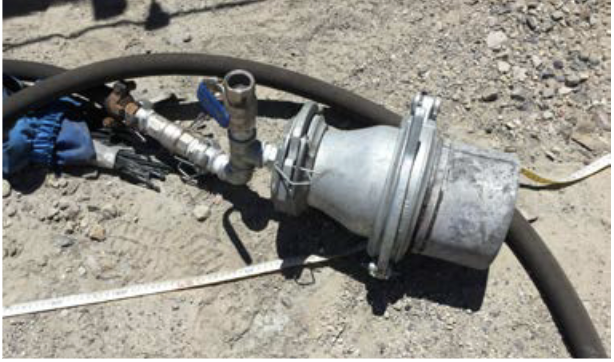
 While performing a pressure test on a length of plastic pipe, a pipe blanking cap struck a worker after the crimped connection between the ferrule and pipe failed. The injured worker suffered severe leg and hand injuries and was taken to hospital by ambulance. The incident occurred on the night of 26 November 2015 at about midnight and the conveyor adjacent to the test area was in operation at the time.
The incident occurred while testing the integrity of nitrogen delivery pipes after a load haul dump vehicle dragged them from underground to the surface of the mine. Each pipe assembly was approximately 50-60 meters (~200′) long and 150 mm (6″) in diameter. The pipe assembly consisted of 5 meter (15′) lengths of plastic tubing connected via crimped metal joiners. Ferrules were crimped to the ends, allowing pipe assemblies to be connected by Ø150 mm pipe clamps.
The test procedure was to cap both ends of the pipe assembly and pressurize the assembly with compressed air to approximately 800kPa (116 psi). Ball valves were used to prevent the air from escaping while a pressure gauge was fitted to the other end. Leaks were detected by a pressure loss over a 15-minute period.
Another incident involving a failed pipe joiner and a different plastic pipe has been reported by another mine since this incident.
RECOMMENDATIONS
Pressure equipment integrity is the sole engineering control in preventing the uncontrolled escape of a pressurised substance. As such, pressure equipment integrity is crucial in
preventing injuries.
When pressure testing the integrity of pressure equipment (including pipe assemblies), consideration should be given to:
- establishing safe work systems that protect workers in the event of the pressure equipment failing the test in a catastrophic manner. Where possible consider engineer controls such as guards or remove people from the test area.
- all reasonably foreseeable failure modes of the pressure equipment and how workers may be harmed.
- pressure pipe and other pressure equipment not being tested by using compressible gasses. Pressure testing should be carried out using a liquid, where possible. Compressible gases store more potential energy than incompressible liquids.
- test equipment and safe work procedures for pressure equipment being confirmed by a competent mechanical engineer, to ensure all hazards and risks have been identified and adequately controlled.
- the selection of appropriate and fit-for-purpose test and measuring equipment, including pressure rating of components.
- a work environment that is free of obstacles and other hazards.
When a pressure pipe is being towed after completion of a pressure integrity test, consideration should be given to the potential damage to the pressure pipe and its fittings.
Note: For plastic pipe, additional hazards may be created when towing pipes as scoring or damage to the pipe surface may expose inner pipe material that may have reduced fire resistant properties.