
Since gas use was integral to the UH accident and since compressed gas cylinders present serious safety issues, several specific examples of improper gas and gas cylinder usage are detailed here.
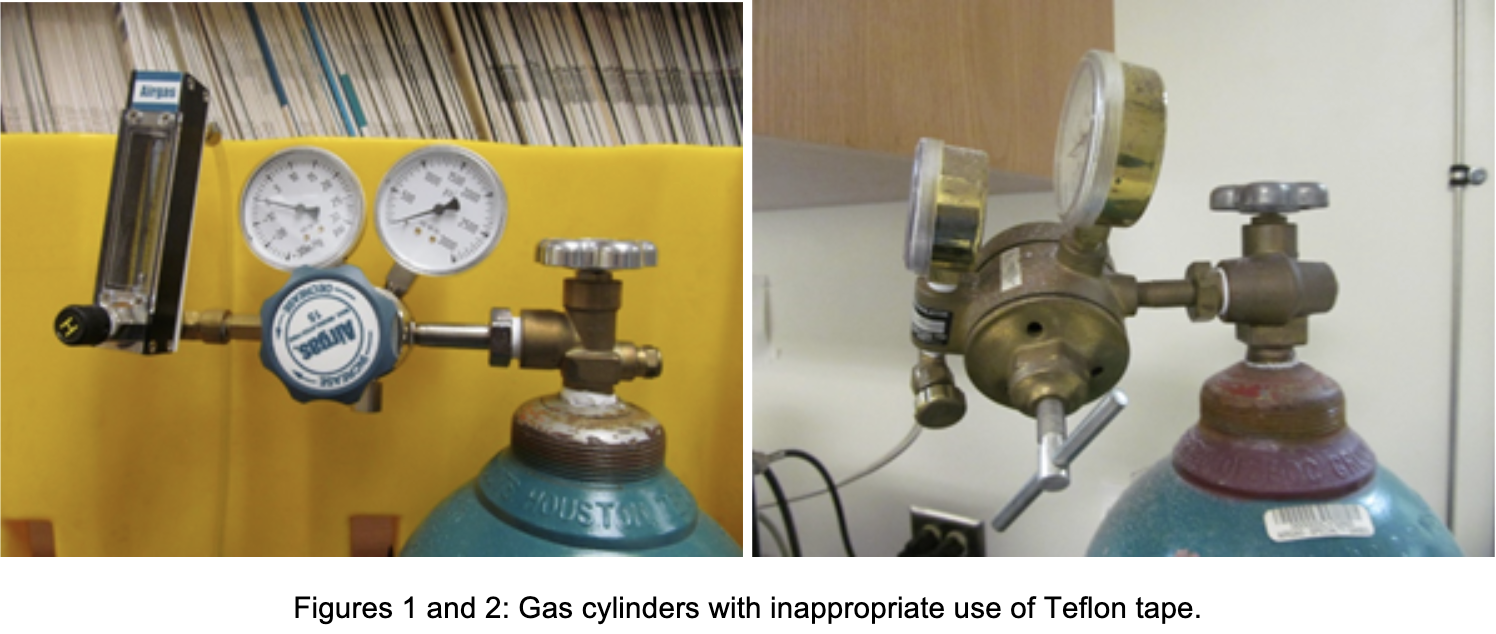
1. Cylinders in the laboratories adjacent to POST 30 as well as in several laboratories located in different buildings, contained Teflon tape on the CGA connection threads to the cylinder valve
outlet (Figures 1 and 2). This is a standard safety problem noted at many user locations. Users mistakenly believe Teflon tape is required to seal the threads, which are straight rather than
tapered, but it provides no advantage and might leak the connection. Instead, Teflon tape serves as a lubricant to provide a better fit. Teflon tape should never be used for straight-threaded connections such as CGA.
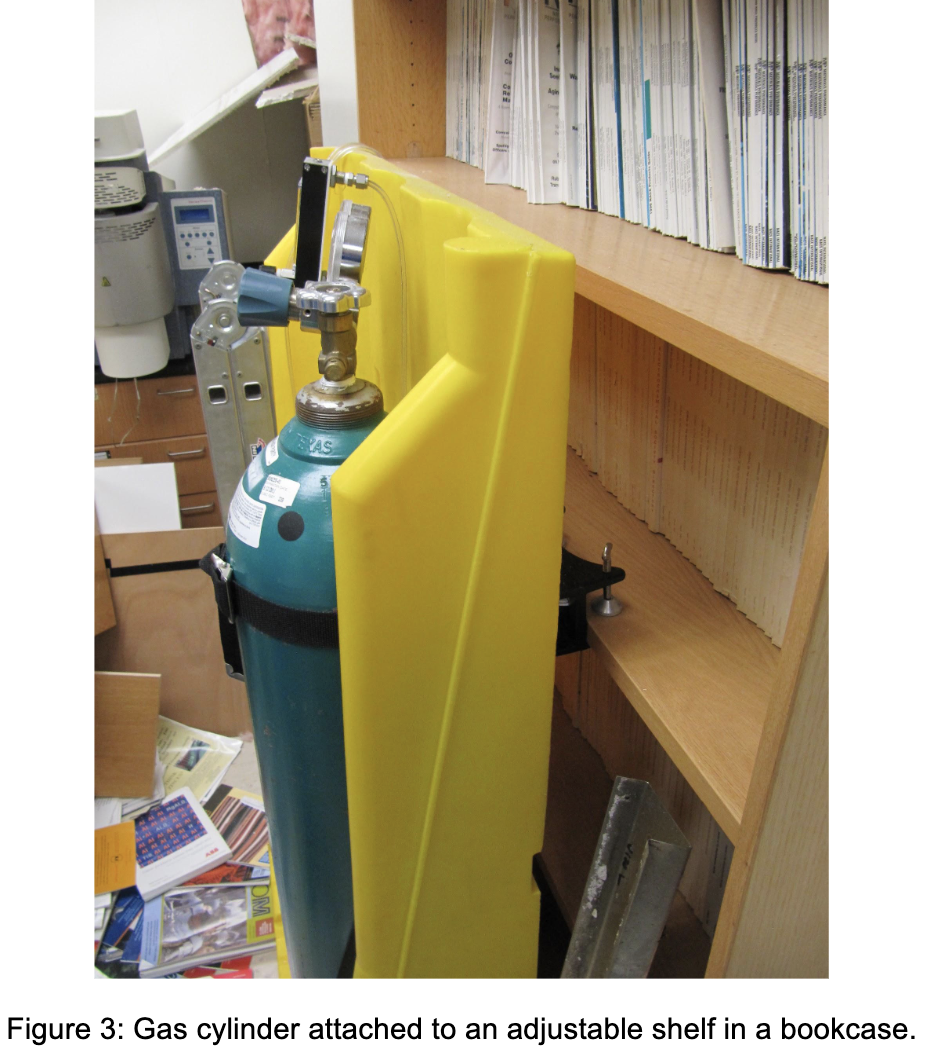
2. A gas cylinder in POST 37 was improperly secured as shown in Figure 3. Instead of being firmly attached to the wall or an immovable object, it was secured to an adjustable shelf in a bookcase. Other examples of substandard cylinder restraint were observed in various labs.
3. A cluster of cylinders in the Post 30 lab showed two other common examples of improper gas cylinder restraint and storage. First, ten cylinders were grouped together and held by two cloth
straps as seen in Figure 4. The typical gas cylinder clamp with cloth strap is only designed to support a single cylinder. Thus, a cluster of ten cylinders should be in a dedicated gas rack. Second, only cylinders of similar size should be secured together. Securing large and small cylinders together results in one cylinder size being secured at the wrong height.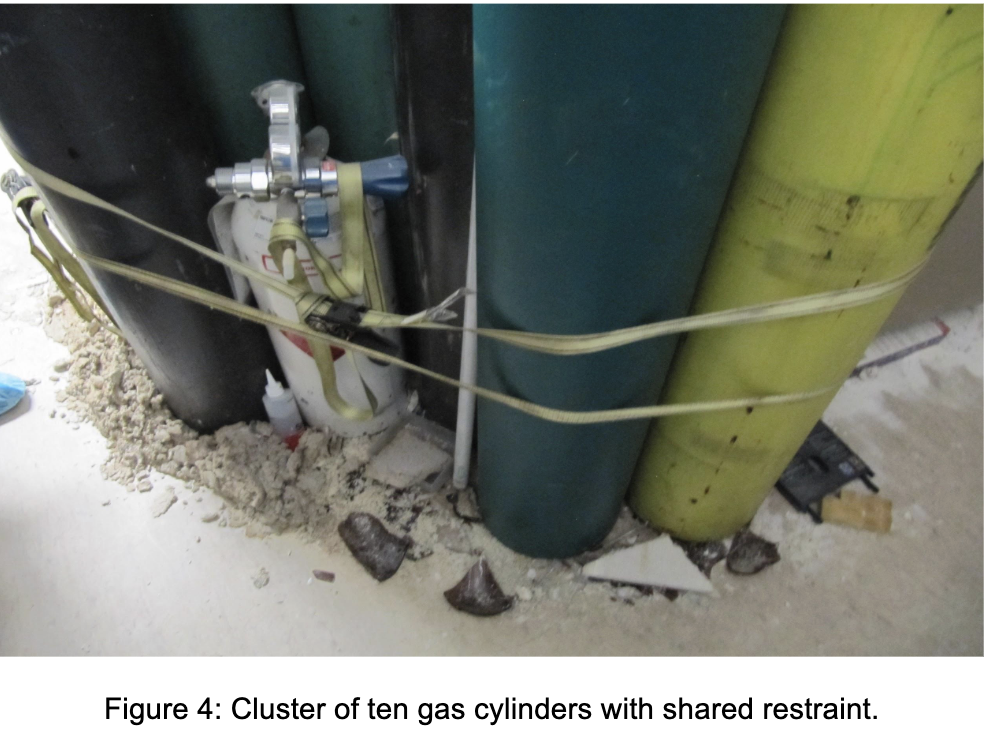
4. Another gas cylinder storage issue observed in several laboratories was storing cylinders without the valve protection cap in place or storing unused cylinders with regulators attached. These are not uncommon problems, but they require vigilance by laboratory safety inspectors and the education of researchers.
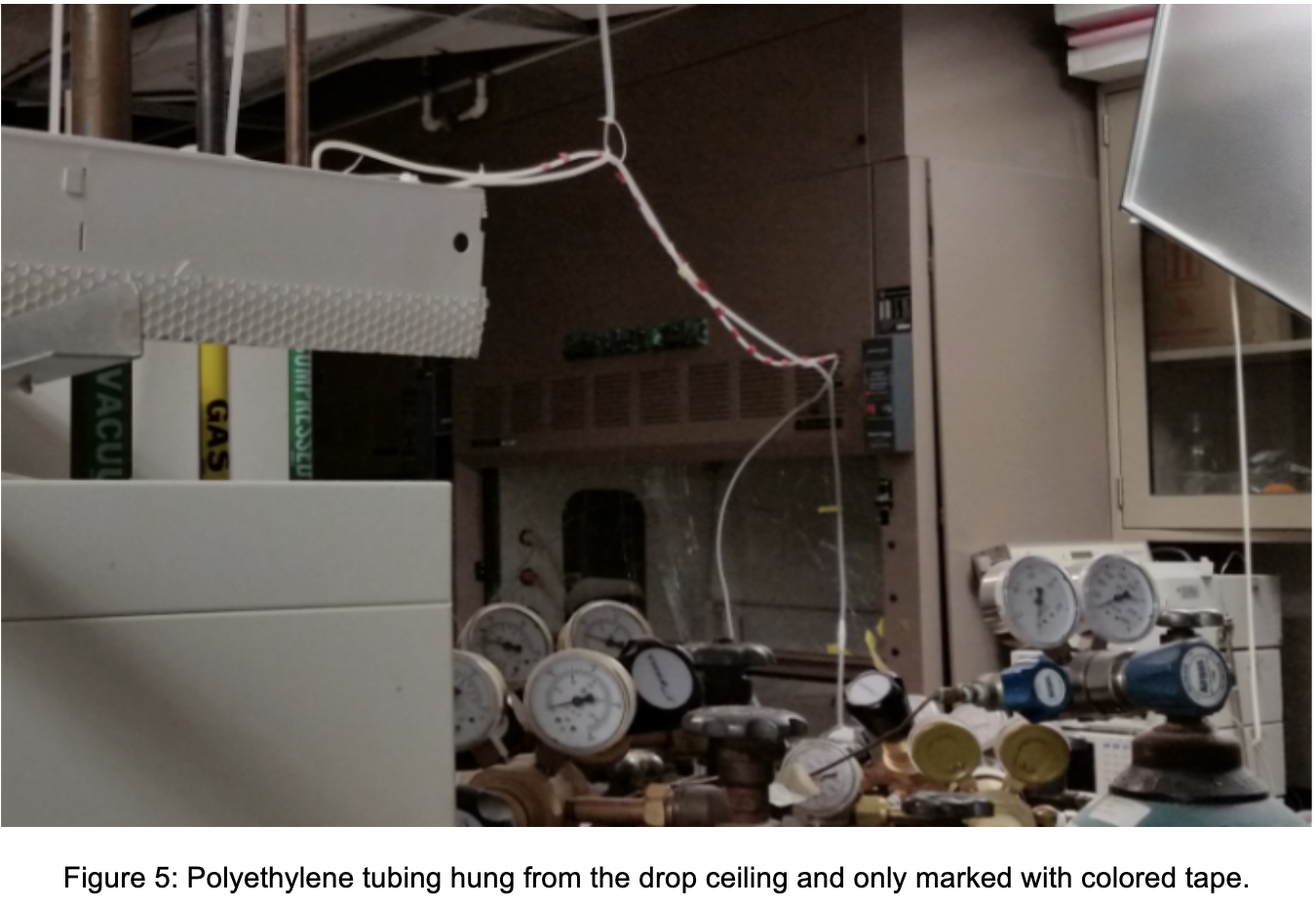
5. Problems with use of gas cylinders that were observed in several laboratories included inadequate gas tubing, unsupported, unlabeled gas lines (Figure 5), and leaking, aged regulators.
6. Using plastic tubing such as polyethylene (PE) is unsafe for hydrogen gas as it can diffuse through the wall. In addition, PE is a material that demonstrates poor compatibility in oxygen as it
exhibits a low spontaneous ignition temperature and a high heat release when burning. Therefore it ignites easily as compared to other more compatible materials and exhibits a high
ignition consequence. ASTM G04 recommends that non-metallic materials for oxygen systems be chosen that exhibit compatibility opposite to PE (high spontaneous ignition temperature and
low heat of combustion) and minimize ignition energy exposure for all non-metallic materials.
7. The gas storage tank contained an O2 enriched mixture and was not properly cleaned as combustible oil was found on the threaded fittings. OSHA defines O2 enriched to be concentrations greater than 23.5%.
Source: Report-2-University-of-Hawaii