
A worker was preparing to mix chemicals in a large in-floor vat in order to make lacquer. After removing the bungs from a steel barrel of toluene, the worker lowered the barrel onto its side and placed it on the lip of the in-floor mixing vat. As the toluene was being poured into the vat, a static discharge was produced that caused the toluene vapour to ignite. This in turn caused the toluene liquid to explode, fatally burning the worker.
A worker was preparing to mix chemicals in a large in-floor vat in order to make lacquer. After removing the bungs from a steel barrel of toluene, the worker lowered the barrel onto its side and placed it on the lip of the in-floor mixing vat. As the toluene was being poured into the vat, a static discharge was produced that caused the toluene vapour to ignite. This in turn caused the toluene liquid to explode, fatally burning the worker.
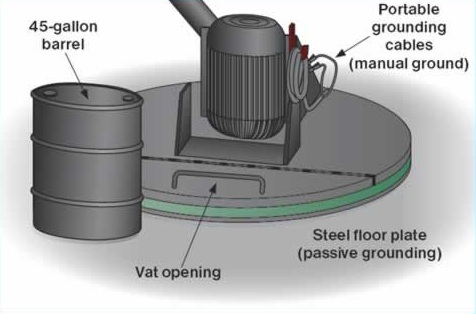
At the time of the incident, there were two grounding systems in place that could have prevented the static discharge. One was a manual grounding and bonding system (grounding clamps), and the other a steel floor plate passive grounding system. The grounding clamps were available at each in-floor vat for the worker to apply when transferring flammable liquids. The passive grounding system consisted of a steel floor plate at the vat openings. The plate was attached to a ground wire. The passive ground system was reportedly put in place approximately four years earlier when a similar incident occurred. The purpose of this system was not to replace the grounding/bonding clamps, but to add another line of defense to the process. However, in order for this passive ground system to be effective, there MIUST BE direct contact. The evidence indicates that the worker had not manually attached the grounding/bonding clamps to the vat and drum before transferring the chemical. The subsequent explosion showed that the secondary measure (passive grounding plate) was ineffective. Why did it fail?
For the passive grounding system to have prevented the incident, the barrel needed to touch the steel plate. On the day of the incident, investigators saw flattened cardboard boxes in the facility. Interviews disclosed that the cardboard was used to help workers manipulate the drums and to keep the floors clean. Cardboard was placed under the drums as they were lowered to their sides to provide traction with the floor. The worker in this incident was 56 years old and weighed approximately 185 lbs. The 45 gallon drum he was handling weighed upwards of 400 lbs. The cardboard rendered the passive grounding system ineffective!