
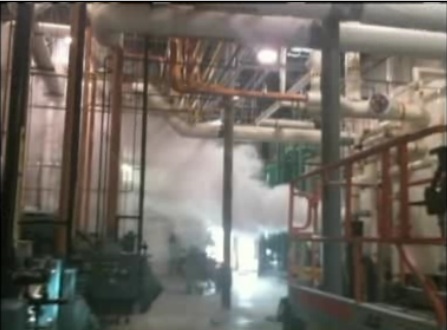
UPDATE on 5/10/12… Explosion damages New Smyrna Beach ice plant (fire officials blame ammonia leak in off-hours blast – a steel door landed about a 100 feet from the opening following a very early morning explosion at the ice plant – while the cause is still being investigated, New Smyrna Beach Fire Marshal said a preliminary review seems to point to a slow ammonia leak filling part of the building before finding an ignition source – “We are not sure how it happened,” he said, although it is suspected the explosion may have been sparked by one of the numerous electric motors operating in the building almost around the clock – officials estimated the blast caused $300,000 damage to the building, including a 30-by-30-foot hole in the roof as well as forcing out roll-up and standard doors – the building’s south wall also was blown out)
Last week I wrote about how many Ammonia Refrigeration facilities use “mechanical ventilation” in place of designing, constructing, and managing their engine rooms to a Class I Division 2 Group D Hazardous Location (HAZLOC) and the potential issues with using this allowable exception. This week I want to touch on the same topic, HAZLOCs and NH3 Engine Rooms, and discuss the code changes that goes along with this HAZLOC exception.
Would you be shocked if I told you that when it comes to electrical classifciation for hazardous locations that ammonia is in the SAME GROUP as gasoline, acetone, benzene, butane, cyclopropane, ethanol, hexane, methanol, methane, vinyl chloride, natural gas, naphtha, and propane? Ammonia is in the same group as propane?!?! It is true… but in a crazy turn of events, some codes were revised in the past couple of years that allow ammonia areas some exemptions that propane processors would NEVER EVEN begin to think about using!
Here is one change that really puzzles me and concerns me. IIAR Bulletin 110 – states the following about Electrical Power Shutdown in the event of a leak…
3.5.2 Emergency Shutdown
Machinery rooms should be designed with emergency electrical power shutdown capability. The electrical power shutdown should disconnect power from the entire machinery room with the exception of ventilation exhaust fans (with non-sparking type motors) and any equipment that is Class I, Division 2, Group D compliant. The recommended machinery room concentration to initiate machinery room electrical shutdown is 15,000 ppm. Lower threshold concentrations to initiate electrical shutdown can also be considered. The electrical shutdown concentration should not exceed 25% of the LFL (i.e. 40,000 ppm).
Now in 2009, several codes have changed that impact this requirement/suggestion from IIAR 110. The International Fire Code (IFC) – section 609 and Uniform Mechanical Code (UMC) – Section 53.2.3.4.5, were revised and now specifically call for ONLY refrigerant compressors, refrigerant pumps and normally closed automatic refrigerant valves be tied into the electrical feed shut down. So this means that although the atmosphere is on it’s way to the LEL of 160,000 ppm (or 16%) and our ventilation system can not manage the load of vapors that we will have plenty of ignition sources for the vapor.
The older code was not so specific in what equipment was to be shut down, but just required all electrical to be dropped from the room, except the ventilation power feed – which was required to be on a separate feed so that it would continue to operate. It is my belief that the older code was correct, in that it was the last layer of defense should the ventilation system become compromised in some way and the concentration in the room exceeded the LEL of ammonia. Call it a fail-safe design… remove all electrical ignition sources from the room when 25% of the LEL is achieved since reaching 25% of the LEL is an indication our ventilation design has been overwhelmed (e.g. the system is designed to ensure that the room never reaches 25% of the LEL).
Why was the code revised to remove this critical path? I have no idea why, but the fact of the matter is that this was removed and is no longer required for all equipment, ONLY refrigerant compressors, refrigerant pumps and normally closed automatic refrigerant valves. Will the updated IIAR Bulletins and Codes reflect this new design? I would bet my left leg they will!
So where does this leave us? We still have Ammonia classified as a Class I Group D flammable and we still have the IIAR and ASHRAE ventilation design that allows the areas protected by the mechanical ventilation to not be managed as a hazardous location. But without the critical fail-safe design in place, what happens when we have the release from the 3″ liquid ammonia line inside the engine room and the ventilation system is overwhelmed. When we reach the 160,000 ppm (LEL of NH3) will there be ample ignition sources in the room for the explosion to occur?
The one saving grace, and most likely the rationale for the revisions to the code (although I do not agree with it) is that Ammonia has a large Minimum Ignition Energy (MIE) of 680 milliJoules (mJ). In comparison to the other chemicals in Group D, those chemicals all have MIE’s well below 1.0 mJ. To give us some idea of how little 680 mJ is: we know that the energy released as heat by a person at rest every 1/60th of a second is about 1.0 joule. Keep in mind the MIE is expressed in MILLI JOULES (one-thousandth of one joule), so as we can see 680 mJ is NOT a very large energy source. But when compared to other flammables it is a HUGE difference. Lastly, when I teach my flammable liquids 101 course, I discuss static electricity in detail. Many students are shocked to learn that static electricity is a large enough charge to set off vapor and dusts clouds. For example, walking across a plush carpet with sock feet and getting shocked by the door is around 25 mJ. This means the shock we get from the doorknob in the winter time is 100X’s what we need to ignite many of the Group D chemicals, but NOT enough energy to ignite ammonia vapor.
But what about all the other equipment in an engine room? Is this equipment not capable of being an ignition source? How about the ventilation fan being used to exhaust the Ammonia, does it not need to be rated for Class I Div 2 Group D HAZLOC?
For those that have the 15,000 ppm (or 40,000 ppm) electrical shunt/dropout, be careful in feeling too confident! Think about the following…
- Does the engine room have battery operated emergency lights designed to come on when the power goes out – are these emergency lights rated for a HAZLOC? Keep in mind, these lights are often installed high up on walls, exactly where ammonia is going… UP!
- How many extension cords are being run through wall openings, doors, and windows from power sources outside the room that would still be powered when the shunt trips the power to the room? BTW… running electrical cords through walls, doors and windows is a violation of 1910.305(g)(1)(iv)(C), but we still see it quite often.
- How about the outlets in the room? Are they on the shunt and will lose power when the shunt is tripped? This would mean that all your outlets in the room are on the same circuits and these circuits are tied into the shunt.
- Does the facility have a response team and is ALL the equipment the response team uses rated for a hazardous location? Radios, flashlights, fans, etc.????
The idea behind dropping the power to the room (except to the ventilation system) is that we are REMOVING ALL ignition sources from the area; thus we can not turnaround and introduce them back into the atmosphere during our response activities. We must also ensure that ALL ignition sources are removed from the room; of course, now, code requires us to remove ONLY refrigerant compressors, refrigerant pumps and normally closed automatic refrigerant valves!
Remember that the ONLY way we can be in 160,000 ppm of Ammonia is in a Level A suit! But also REMEMBER that ammonia with oil entrained can have a LEL as low as 10%, not 15-16% as it normally does. Lower Explosive Limits are NOT an exact science, but when working with them we should design our process areas and response plans using the lower ends of the chemicals flammable capabilities!
As a safety engineer, I will continue to “suggest” to those who want to listen that they utilize the fail-safe design of the electrical drop out. There are just too many issues with improperly designed ventilation systems and the fact of the matter that the design is based on a vapor release and not a liquid release from the largest pipe in the room (another fact that amazes me). This electrical drop-out is there for that one event where the ventilation system is overwhelmed and can not exhaust the ammonia fast enough to ensure that the LEL is not achieved. I will also “suggest” that 1910.119(d)(3)(i)(C) does apply to a refrigeration process. Although it is not specifically called for in refrigeration RAGAGEPs, the ventilation fan and the conduit going to it should at least be installed per hazardous location standards. I find it hard to believe that the fan we are using to remove the flammable vapor from the room is not required to at least be rated for a flammable atmosphere. My position contradicts OSHA’s Position on Fans being Intrinsically Safe Fans. But when you think about the design, it makes no sense to have the device moving the flammable vapor not be intrinsically safe. When I asked OSHA, it was stated that if the system is designed properly then the LEL will never be achieved, thus no need for intrinsically safe equipment. However, if the fan is still powered when the LEL is achieved, what happens?
Your thoughts, challenges?