
 When we use the phrase “cascading failures,” this event is nearly a perfect example.
1) A gas station employee attempted to fill a propane tank without the required training. This led to the uncontrolled release of approximately 1500 liters (396 gallons or 1,600 pounds) of liquid propane and evacuated nearby homes.
2) When the staff went to use the emergency shut-off, poor labeling resulted in the wrong switch being used.
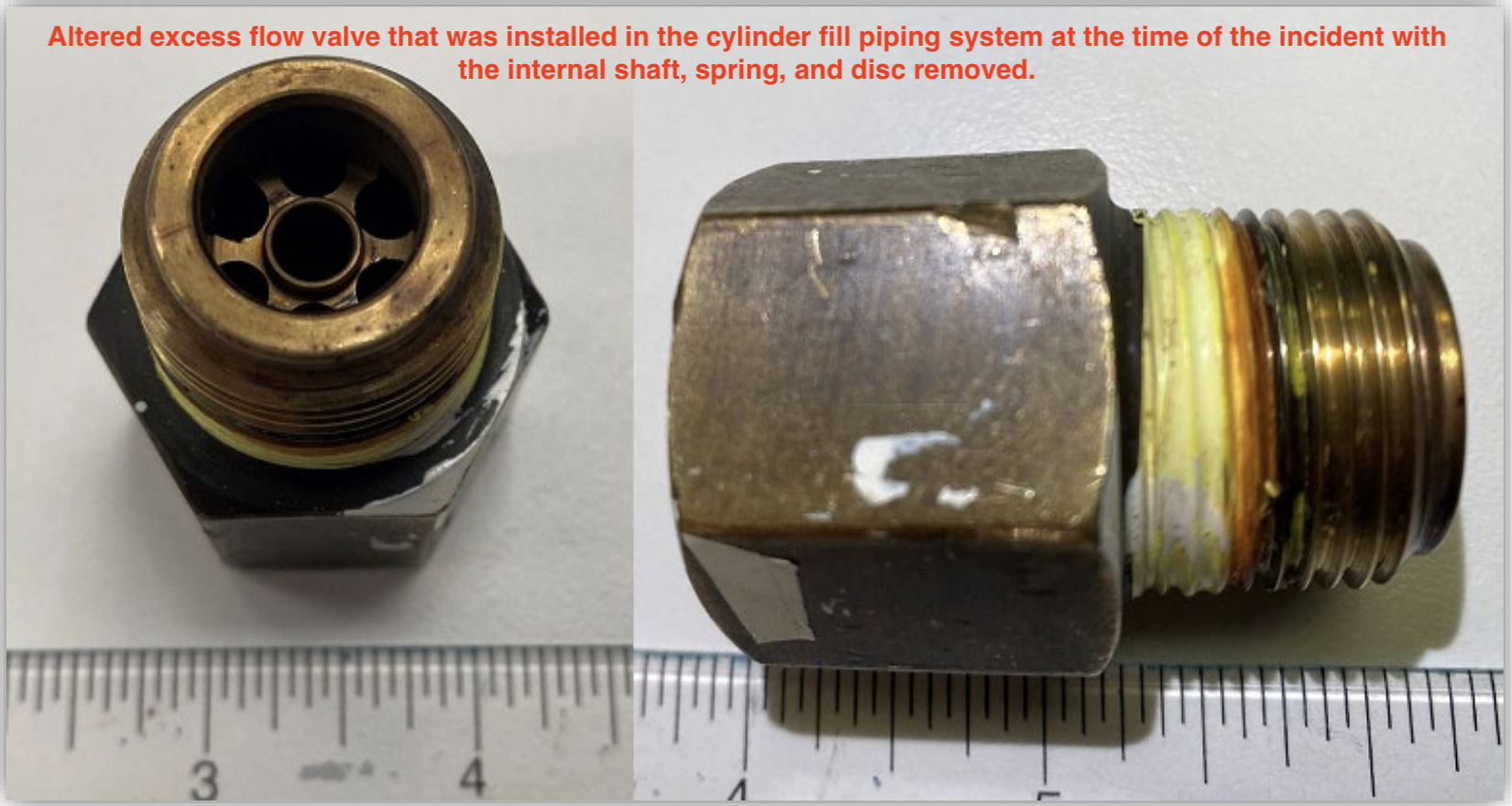
3) In addition, the excess flow valve, a safety mechanism meant to limit the flow automatically, had previously been altered and made ineffective.
An employee without the required training certificate mistakenly removed the cylinder fill nozzle from the cylinder without first closing the quick-acting cylinder fill valve. A leak began and the nozzle was dropped, and the employee ran into the store and unclear switch labeling may have led them to shut off the incorrect switch. The leak continued until power was shut off to the entire station due to the ISC valve remaining open, the digital meter allowing propane to flow through it while the pump was off, and the excess flow valve not activating due to its alteration.
Contributing factors to the incident and severity of the propane leak were:
Training:
- The employee was filling the cylinder without receiving certified training and was unfamiliar with the propane filling procedure and emergency protocols.
System design:
- The orientation, wiring and labeling on the emergency stop and propane operation switch likely caused confusion of which one to shut off in an emergency.
- The operation and wiring of the nitrogen solenoid allowed the ISC valve to remain open, allowing the fuel to escape until the station’s power was disconnected. If the nitrogen solenoid had been wired to operate only when the dispensing system was activated, the leak would have stopped after the pump was turned off.
- The mechanical meter was replaced with a digital cylinder meter, which allowed fuel to flow through it without the need for an increased pressure differential from an operating propane pump. A mechanical meter would have stopped fuel flow and only allowed fuel downstream of the meter to leak after the pump was shut off.
- The physically altered excess flow valve was ineffective and failed to activate. The full-flow leak may have activated the excess flow if it had not been altered and reduced the leak to only the fuel which was in the cylinder fill hose.
The propane dispensing system at the fueling station had an emergency stop button installed under the cashier counter inside the store. The emergency stop button was labeled “EMERGENCY FUEL PUMP SHUTOFF.” The button was wired to shut down all of the fuel pumps at the station, including propane, gasoline, diesel, and the electronic nitrogen solenoid that actuates the underground propane tank’s ISC valve, shutting off the main liquid valve from the tank. A propane operation switch was also installed under the counter which was labelled “PROPANE SHUTOFF”. It only controlled power to the propane pump but, when turned off, would not shut off the main ISC valve and would allow liquid propane to flow from the tank.
The day of the incident, an employee from the fueling station went to the cylinder fill station to fill a customer’s 30# propane cylinder. The employee had been working at the station for approximately four (4) months but did not hold a valid training certificate for dispensing propane. The employee connected the nozzle and filled up the cylinder. When the cylinder was full, they turned off the propane pump and removed the nozzle from the cylinder without shutting off the quick-acting valve on the hose. When the nozzle released from the cylinder, it began leaking liquid propane into the atmosphere.
The digital flow-through meter and altered excess flow valve did not stop the leak of liquid propane into the atmosphere.
The employee dropped the nozzle and ran into the store, and switched off the “PROPANE SHUTOFF” switch but did not engage the “EMERGENCY FUEL PUMP SHUTOFF” button. This ensured the propane pump motor would not activate but failed to close the nitrogen solenoid holding OPEN the propane storage tank ISC valve. With the dispensing valve and the ISC open in the tank, liquid propane continued to leak into the atmosphere. Emergency services were contacted, and the fire department attended the scene and evacuated the immediate area. The liquid propane continued to leak for around 2 hours, releasing approximately 1500 liters (396 gallons or 1,600 pounds) of propane until the electrical utility company was able to disconnect power to the site. The disconnection of power de-energized the nitrogen solenoid, closing the storage tank ISC valve and stopping the leak.
CLICK HERE for the full report