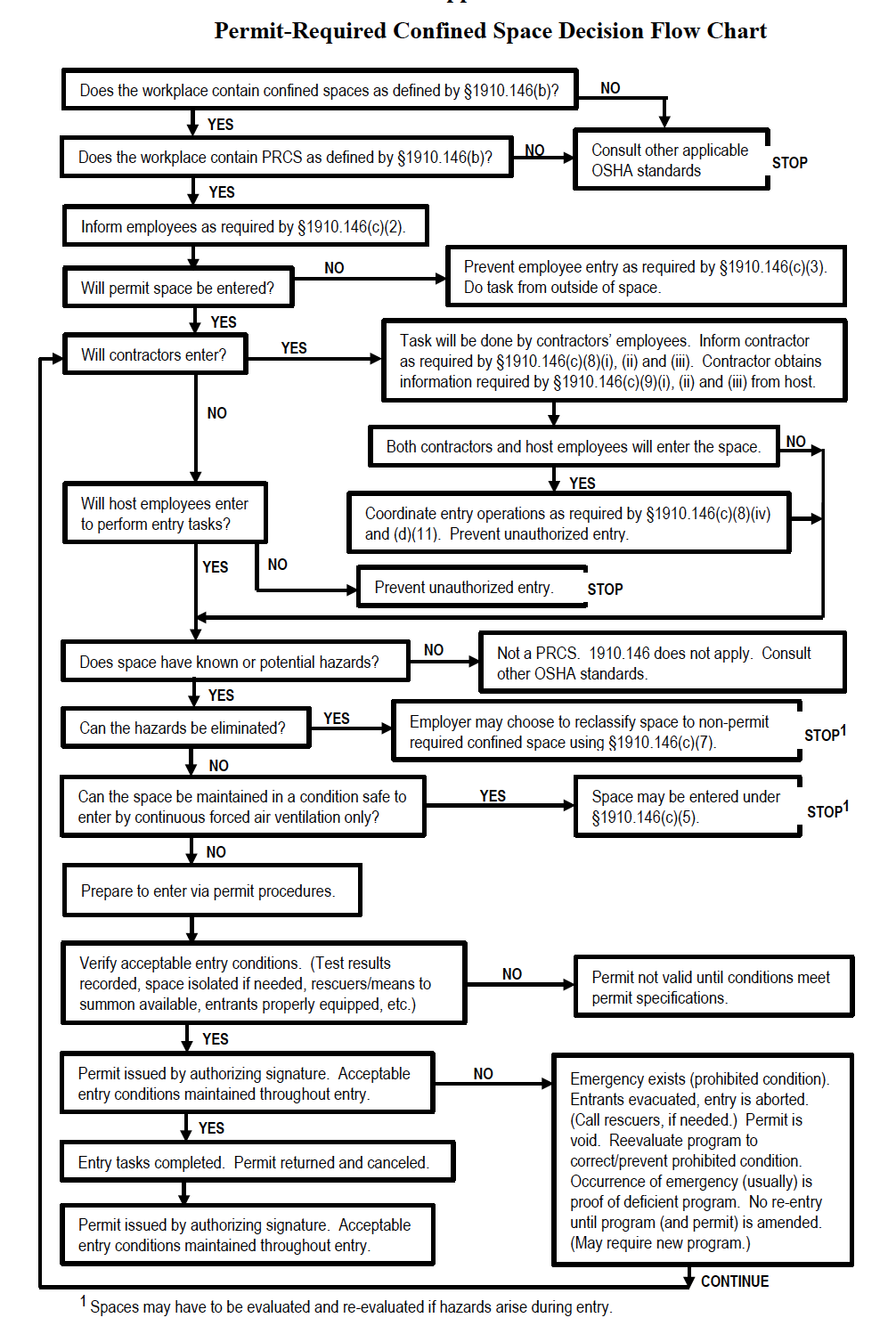
I was working on another PRCS Entry program this week and thought I would offer some tidbits I include in my programs regarding:
- Space Isolation
- Atmospheric Monitoring
My programs are lengthy and are intended to include every aspect of managing the risks associated with working around and inside PRCSs.
SPACE ISOLATION
ALL connections to a confined space that can convey a hazard to the space MUST be isolated using one (1) of the four (4) acceptable methods of Energy Isolation: (see definition section)
- Double Block & Bleed (e.g., for piping)
- Disconnect & Misalignment (e.g., for ductwork, hoses, tubing; but rolling a piping spool piece fits into this method)
- Blinding/blanking (e.g. for flanged piping)
- Electro-mechanical lockout (e.g., internal physical hazards such as mixing blades, augers, unguarded electrical, etc.)
Group Lockout procedures can be used (See Site LOTO Program).
- Each entrant and attendant MUST be part of the energy isolation plan for the space (e.g. they will have a personal LO lock on the lockbox).
- The Entry Supervisor will be vested with primary responsibility for the Group Lockout.
The Entry Supervisor is RESPONSIBLE for “walking down” the energy isolation control plan BEFORE he/she authorizes entry into the space.
ALL entrants and attendants have the “right” to “walk down” the energy isolation control plan; however, they are NOT required to do so.
NOTE: The entry Supervisor can NOT be the same Authorized employee who performed the energy isolation of the space; this “walk down” requires a “fresh set of eyes.”
When using Double Block and Bleed on piping conveying an HHC, the bleed MUST be at least 25’ from any confined space opening and any intake of a fan being used to ventilate the space.
- A chemical hose rated for the Hazardous Material can be used to “convey” the hazardous material from the bleed to a “safe distance” (e.g., 25’ at a minimum).
- OPENING a bleed valve, a flange to insert a blind, or disconnecting a hose/tubing/ductwork involves OPENING a hazardous process, which exposes personnel to grave DANGER and will REQUIRE at least:
- a line break/equipment opening permit
- an energy isolation control plan for each location where the process/equipment is being OPENED.
Any energy source associated with a space that personnel do NOT believe to be a hazardous form of energy (as defined by the Site LOTO program) must be approved by the EHS manager. Otherwise, ALL sources connected to the CS MUST be isolated using one of the approved means stated above.
AIR MONITORING
The Department Managers are responsible for obtaining and managing their inventory of Atmospheric Monitors approved by the EHS Department.
The air monitor being used to evaluate the (potential) atmospheric hazards of a confined space MUST be
- within its stated CALIBRATION schedule AND
- bump tested within 24-hrs of its use
The Entry Supervisor is SOLELY RESPONSIBLE for ensuring these requirements BEFORE using the meter.
- Meters out of calibration must be provided to those responsible for calibration.
Air Monitors MUST be used within the limitations assigned by the Manufacturer.
- This means Entry Supervisor(s) MUST be trained in the proper operation and limitations of the meter they are using.
- Air Monitors MUST ALWAYS be turned OFF, then back on, carrying out the FRESH AIR SET UP in a controlled atmosphere – NOT outside of the space.
The Entry Supervisor is responsible for understanding:
- The normal use of the space and the atmospheric and physical hazards it possesses during NORMAL operation.
- The atmospheric hazards include the Vapor/Gas Density of the potentially hazardous atmosphere.
- The configuration of the space and the means and location(s) for entry/exit
The Entry Supervisor will take adequate samples at THREE (3) levels within a vertical space:
- Top
- Middle
- Bottom (at least 6” from the bottom of space).
CAUTION! Do NOT pull water or debris into the sample tube.
At EACH level of sampling, the Entry Supervisor will evaluate the atmosphere in the following order:
- Oxygen is between 20.0% and 22.0% (e.g. Normal O2 is 20.8%)
- LEL is no greater than 2% reading (i.e. we want to achieve 0% LEL)
NOTE: We use tighter ranges than OSHA for scientific reasons; do NOT refer to the OSHA standard for acceptable atmospheric conditions!
The Entry Supervisor should encourage entrants to observe the sampling of the atmosphere.
At NO TIME can an entry supervisor prohibit entrants from observing the sampling of the space.
WARNINGS!
- A direct-reading instrument will ONLY read the chemicals the instrument is equipped to read. Usually, this is ONLY Oxygen, LEL, Carbon Monoxide (CO), and Hydrogen Sulfide (H2S). If the space was known to contain other chemicals, A separate sampling PLAN using ADDITIONAL instruments will have to be approved by the EHS Department. Also, suppose the work that will take place within the space could generate a hazardous atmosphere that the meter is NOT equipped to read. In that case, AN ADDITIONAL SAMPLING PLAN using different instruments will have to be approved by the EHS Department.
- ALL air monitoring instruments used to evaluate an atmosphere within a Confined Space MUST be equipped with a calibrated pump and approved sample tube. NEVER lower the meter into the space to obtain a “passive sample.” ALL samples MUST be drawn through the calibrated sample pump provided by the instrument’s manufacturer and the proper diameter, length, and material sample hose.
- NEVER perform the initial sampling while the space is being ventilated, other than natural ventilation. Turn OFF all fans that are blowing INTO and OUT OF the space during the time the initial sample is being taken.