
One of the great things about being a consultant is that I get to see things that I would have never been able to see working for a single company. Traveling the world doing PSM/RMP work has given me the opportunity to see how other businesses and cultures do safety and this has enriched me more than I could have ever expected (and it has been a blast doing it)! But sometimes I come across things that just blow me away (right and wrong things). Recently I came across a situation that I had never seen before and need the wisdom of this 20,000+ network of safety professionals and engineers to help me with!
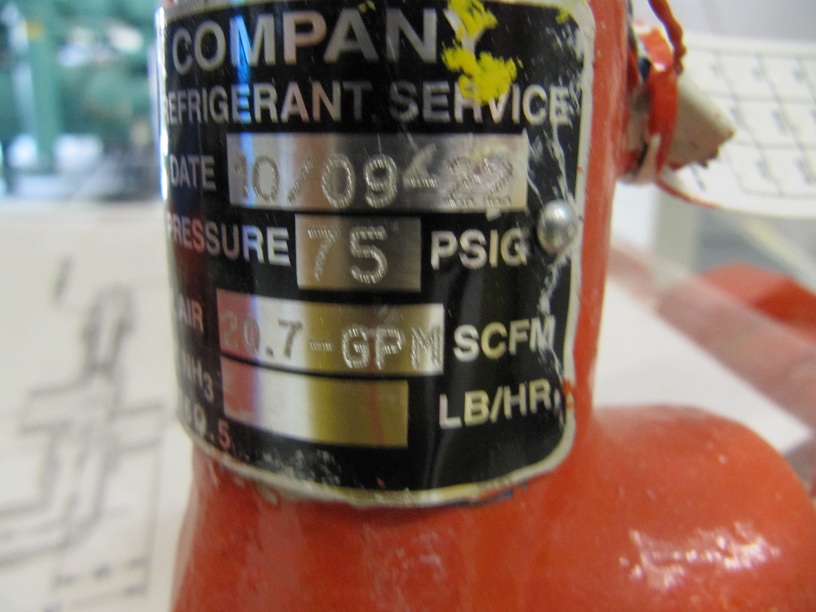
In my worldly travels I came across a relief valve that in all appearances (see photo below) looks like a vapor relief valve, name plated with a vapor relief valve nameplate, and is on a pressure vessel; but, this valve is being used as a hydrostatic relief valve on an oil pot in a refrigeration process. Instead of me loading the deck in my favor and telling you what I think is wrong, I am going to share with you the photo of the name plate on these valves and you tell me if you see anything confusing (or wrong), or explain to me that this is a common practice for “relief valves” and I am just showing my lack of experience in relief valves. PLEASE provide me some reference documents (e.g. RAGAGEP) to support your position if you find this to be an acceptable set-up. By the way, the nameplate on the RV has a part number that references a hydrostatic valve made by this company. This RV company is also a highly respected company with countless number of RV’s in service world-wide. I am sharing this as a “learning experience” (maybe for me only) and BOTH the RV company and the company where these valves are in service will remain NAMELESS! I have already received a couple of e-mails from trusted engineers and refrigeration experts that I seeked advice from, that this is being done on RV’s and appears to be acceptable; however, the vast majority of those asked asked stated they would view this as a “concern” that would require more discussion and evidence that a RAGAGEP is being followed and met by the facility.
A little background on PSV’s and RV’s: typically a hydrostatic relief valve will be nameplated with “_______ GPM” (gallons per minute of liquid flow) and a vapor relief valve will be nameplated with “________ SCFM” (standard cubic feet per minute of air flow). Here is the photo of the nameplates in question:
By the way, I would like to add that 7 of the 10 engineers that I seeked advice from pointed out several other issues that I was so happy they noticed… 1) it appears the PSV was painted safety orange (painting a PSV is a major NO NO-unless done by the manufacturer), 2) the nameplate appears to have been hit (major concern) from the apparent indentations and scratches, and 3) the yellow paint on the nameplate is another concern that may be a reflection on the quality control efforts of the facility with regards to the handling of their PSVs. It was nice to see there are other “radicals” out here that expect near PERFECTION when it comes to our last line of defense for an overpressure event!!
One such radical is a friend that shared a very serious incident when I was a safety manager in the chemical industry and I will relay onto the group. We had a fixed oxygen system that generated pure oxygen for a process. One of our maintenance personnel replaced some relief valves with “dirty hands” (i.e. he/she must have just finished an oil/lube job somewhere before hand). We had a small fire (cause never determined – but presumed electrical) which caught a wall of insulation on fire. Before the sprinkler could put out the fire, it heated one of the oxygen vessels to a point the PSV lifted and when it did, we had a flame shoot out of the vent pipe about 10′! So yes, we revised our PSV maintenance procedure and checklist to ensure that those handling relief devices do so with CLEAN hands and gloves! It is to this level of detail that we MUST get to in our “critical equipment” maintenance practices!