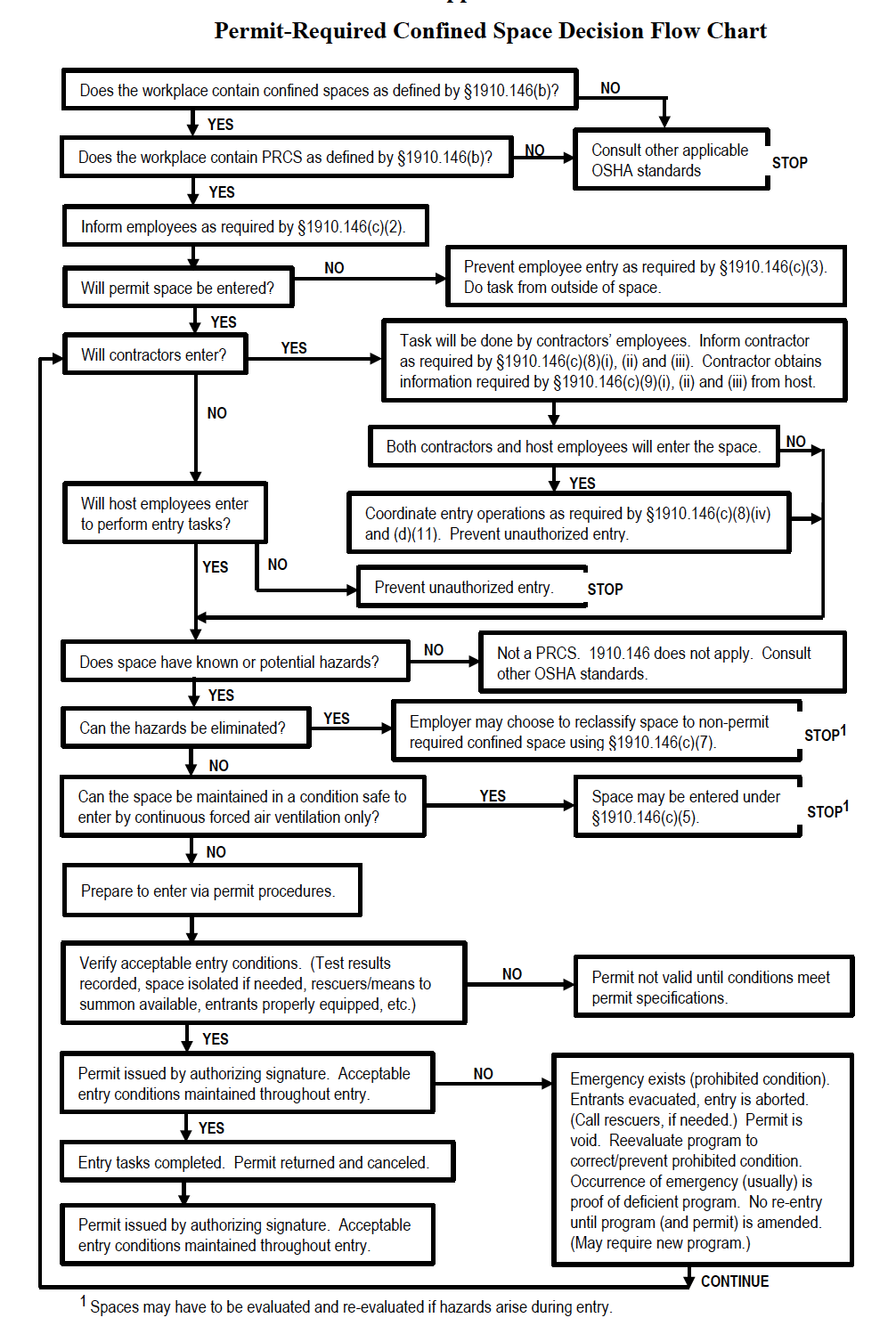
This information should open some eyes as to OSHA’s expectations for how our PRCS Entry Programs are managed and by WHO! Take time to “read between the lines” in this information. Could your facility, and more specifically could your facility personnel, pass this level of inspection?
INITIAL INFORMATION
A. To what degree is the employer familiar with the standard and its contents? (Does the employer understand the key terms defined in the standard?)
B. Request identification of those confined spaces evaluated and determined to require a permit, their locations, along with any documentation as to the permit space determination (memos, contract, report, etc.) and when the determination was made.
How does the employer meet the standard’s requirement of paragraph (c)(6) for review of existing non-permit confined spaces for hazards which would convert them to a permit space?
C. Evaluate the process by which the employer identified any confined spaces, as follows:
NOTE: If an employer elects not to have its employees enter the confined space, a thorough evaluation of each space is not required.
- Analyze the evaluation method and equipment used.
a) Was the determination made based upon historical data? If so, how reliable is that data?
b) Were the substance’s hazards appropriately identified and evaluated to comply with 1926.1203(a) or 1926.1204(b) of the standard? All the hazards that can affect the safety and health of entrants must be determined; e.g., gasoline is flammable but also contains benzene which can be a health hazard.
c) Were the sampling methods and/or testing equipment appropriate for each substance?
d) Are mechanical and other non-atmospheric hazards, for the space or for the work to be performed in the space, addressed in the employer’s evaluation method? - If the employer has arranged to have some other party (consultant or insurance carrier) evaluate the workplace, request a copy of the report presented to the employer in order to assess the adequacy of the evaluation.
D. Are contractors performing permit space entries? If so, determine who they are and their work location.
- Are these spaces multi-employer worksites?
- Did the contractor develop the PRCS program in use? If not, whose program is being used or followed by the contractor? If so, how was their program coordinated with the host employer’s or general contractor’s program?
- What measures have the employers taken to facilitate coordination and safety for multi-employer worksites? Examples of these measures might be communications systems, postings, assignments of liaison personnel, or contractual agreements.
PRCS PROGRAM
A. Obtain a copy of the employer’s written policies and procedures.
- Where is the written PRCS program normally kept?
- Who is in charge of the PRCS program?
- Does the written PRCS program or procedures provide for compliance with the applicable elements listed in 1926.1204 of the standard?
B. Does the PRCS program provide appropriately for employee input regarding the classification of spaces, the identification of hazards, training, the adequacy of entry procedures and precautions, and other areas where employee knowledge and experience would be pertinent?
TRAINING
A. Employees.
- What is the employer’s policy with regard to employee entry referenced in 1926.1207 and how are the employees informed of the policy?
- How are the affected employees referenced in 1926.1207 identified? Who are they?
- How are affected employees informed of the employer’s policies on confined space entry?
- How and when are new or reassigned employees informed of the existence and locations of confined spaces?
- Is the employer’s PRCS program used in employee training?
B. The trainer.
- Who are the individuals conducting the training, and what training are they providing?
- For the training being presented, is the trainer knowledgeable about the subject matter in general and with the particular permit space situations at the workplace?
C. The employer.
- How does the employer verify that the training has been provided?
- How does the employer evaluate employee proficiency in the duties required by the PRCS program?
- What criteria does the employer use to decide if retraining is necessary?
ENTRY PROCEDURES
A. Obtain a list of entrants or identify the employees who have been assigned the duties of “authorized entrant,” “attendant,” or “entry supervisor,” and determine who is authorizing entry. During the inspection interview a sufficient number of employees in each category to evaluate the training provided and the PRCS program’s effectiveness.
B. Determine the name, position, and training of the person(s) responsible for authorizing or in charge of entry under the permit system.
C. Review all data relating to each 1926.1203(e) “Alternate Procedure” entry undertaken. The following are some examples of questions the SO/IH may consider useful:
- What is the size (volume) and configuration of the permit space?
- How have the physical properties (molecular weight, vapor pressure, etc.) of the atmospheric hazards been considered in the design of the ventilation plan?
- What is the capacity of each piece of ventilation equipment being used? Does capacity match requirements of the space(s)?
- What is the air exchange rate required to maintain acceptable entry conditions under a worst-case scenario?
- What are the procedures the employer uses to determine acceptable entry conditions?
- Where and how is the data maintained?
- Do the entrants know what the “safe for entry” conditions are and where the supporting data is maintained?
- How does the employer demonstrate that the only hazards in the permit space are atmospheric?
- How did the employer demonstrate that continuous forced air ventilation would maintain the space safe for entry?
- How did the employer collect and document the monitoring and inspection data used to support the classification of the space?
- How does the employer make the documentation of determinations and supporting data available to permit space entrants?
- How does the employer determine that the operations or activities being performed within the permit space (for example: mucking, cleaning, etc.) do not contribute to the atmospheric hazard?
D. Identify the equipment to be used for sampling and monitoring the permit space to comply with 1926.1204(d).
- Determine if the equipment is being maintained and calibrated in accordance with the manufacturer’s recommendations.
- Have air sampling, monitoring plans and procedures been developed which take into consideration any sampling equipment limitations?
- Do sampling plans include measuring exposure at the employee locations as well as other locations in the space?
E. Who has the employer authorized to certify that the pre-entry measures required under 1926.1203(e) have been taken?
- What does the certifier know about the confined space being entered?
- How is the certification made available to each employee entering the space?
- Are there any entry procedures used beyond those required by 1926.1204-1208 to inform entrants of entry conditions and how they relate to the acceptable entry conditions that have been determined?
- How does the employer notify entrants of the need to exit the space when a hazardous atmosphere is detected?
RESCUE
Review the employer’s policy to determine which rescue procedures are being employed. If non-entry rescue has been ruled out, ascertain which of the entry rescue options has been implemented.
A. Non-entry rescue.
- If non-entry rescue is being practiced, what equipment is used?
- If non-entry rescue is not being practiced, what are the employer’s reasons for not using it?
- Does the employer review each space to be entered to determine whether to employ or not to employ non-entry rescue?
- If entry was made through a top opening, was an approved hoisting device or similar means used to lift workers out of the space?
B. On-site rescue services (an employer’s own employees).
- Determine the number of employees assigned to perform rescue, verify training for each member of the rescue service, and find out which of them have a current first-aid and cardiopulmonary resuscitation (CPR) certification.
- Review the rescue procedures as they compare with the written PRCS program.
- Note the work shifts of the rescuers and compare them to the permit entry times.
C. Non-employer rescue employees (off-site).
- Who provides the off-site rescue service and where is the service located?
- How is the arrangement between the employer and the off-site rescue service documented (contract, letter of agreement, verbal agreement)?
- How does the employer decide, given the identified permit space hazards, that the off-site rescue service’s response time, experience, and training are adequate?
- Have the rescue training requirements in 1926.1211(b) been met?
- What method is used to summon rescuers?
- Are rescue services on-call or on-site when permit space entry is underway?
- What is the response time for rescue service?
- How does the entry supervisor verify that the rescue service will be available during the time of employee entry?
- Has the rescue service agreed to notify the employer immediately in the event that the rescue service becomes unavailable?
D. Combinations.
If combination of on-site and off-site rescue services is employed:
- Obtain a copy of the rescue plan which describes the roles of each party, and
- Verify that the on-site and off-site rescue services employees have trained together as a team.
- Determine if the combined rescue services enable the employer to comply with the requirements for rescue services.