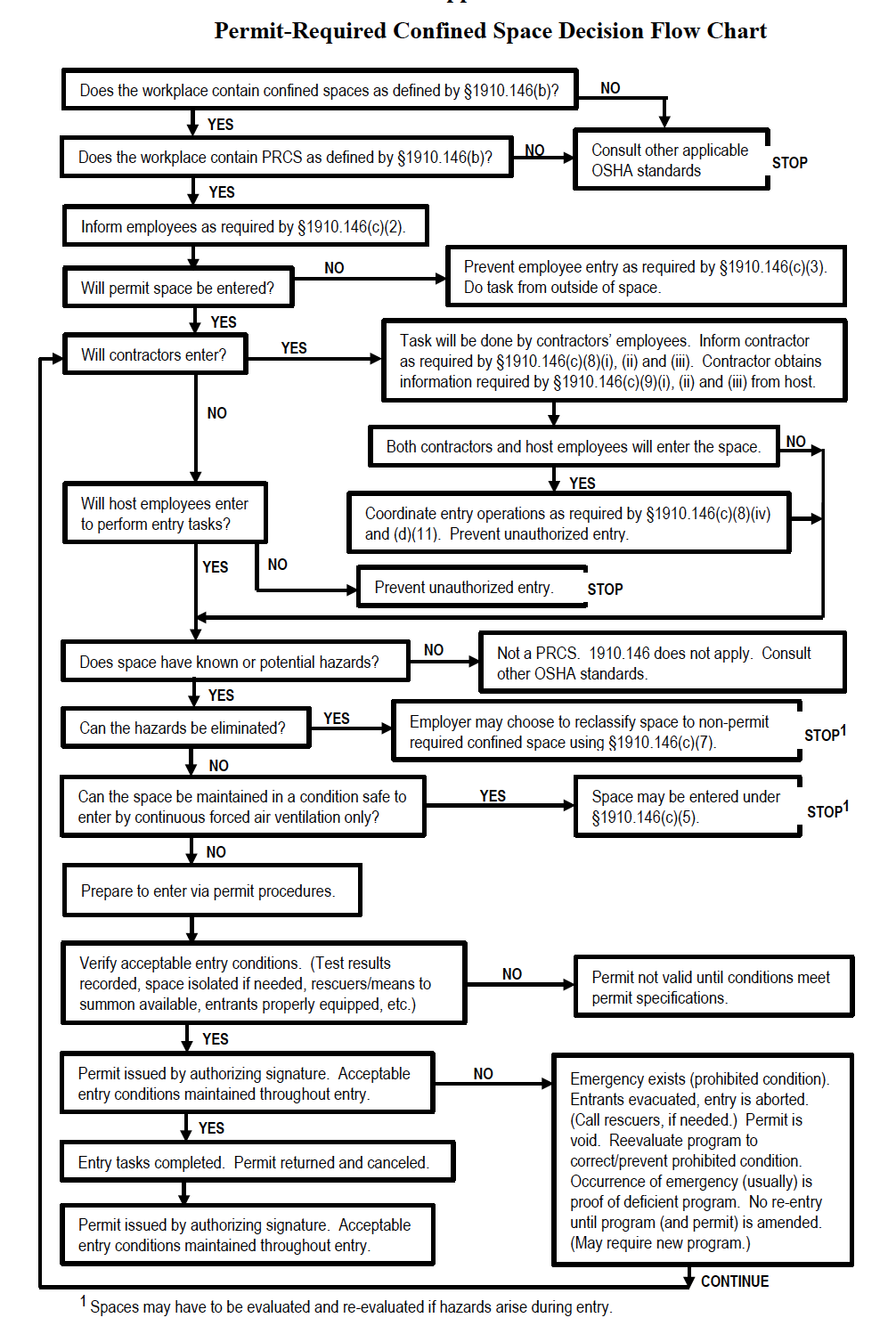
Oregon OSHA has adopted a new rule, OAR 437-002-0146 Confined Spaces, which replaces 1910.146 Permit-Required Confined Spaces. This new standard expands the rule’s scope to include the construction industry. This new standard expands several requirements and clarifies several others found in 1910.146. The new appendices clarify how to evaluate a CS and a PRCS…
- revising and including several definitions,
- language for closing permits,
- ensuring employee access to written materials,
- ensuring all actions required by the permit are followed, and
- clarifying when alternate entry cannot be used
Other areas amended for clarification include:
- Permit Space Program
- Changed the requirement to catalog all confined spaces.
- If the permit program needs to be revised, the language was changed that prohibiting entry into any space; to any space that is affected by that revision until the revision is complete.
- Evacuation
- Added language on what to do if entrants need to evacuate a permit space.
- Decontamination
- There was language requiring patient decontamination. The group consensus was to move this language to the appendix on rescue. In its place, language was added requiring MSDSs and providing them to the medical providers.
- Rescue
- For non-entry rescue – modified the language to include a rescue person, as the rescue “team” may only consist of the attendant retrieving the entrant from the space.
- For entry rescue – language change from ensuring the rescue team can proficiently perform rescues to ensuring rescue teams can efficiently perform rescues.
- Added language requiring that, if a third-party rescue service is used, that the agreement is in writing.
- Changed the language in the exception for alternate entry.
- Added language to specify which parts of the rule don’t apply when one uses alternate entry.
- Added a condition on when the space must be evacuated during alternate entry (new hazard or conditions change).
- Training
- Moved the awareness training piece to the bottom of the training section to avoid confusion and clarified that it is only for employees who work around permit spaces.
- Records
- Modified the record retention section to refer back to the rule that requires a review of the permit program.
Alternate Entry.
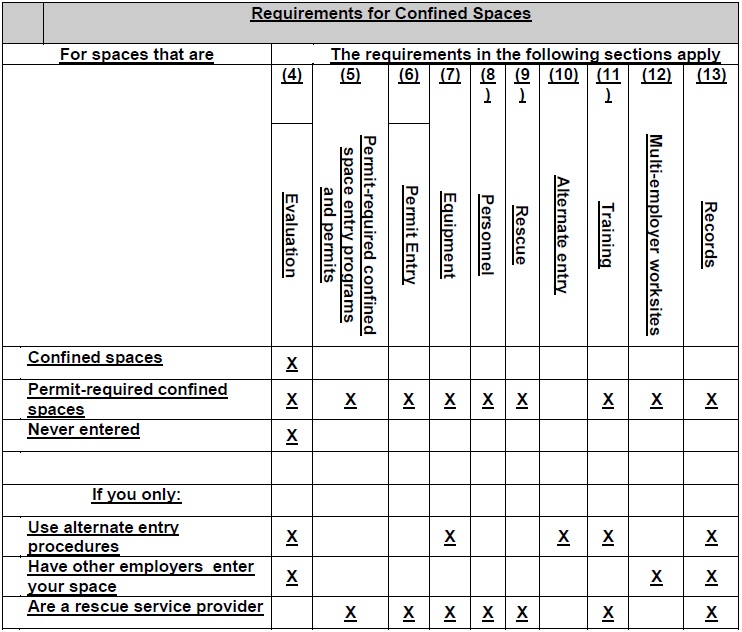
The new standard also includes a table to help employers apply the proper sections of the standard to their activities.(pdf)
Here is some of the other “new” or revised requirements from OR-OSHA’s new PRCS standard as compared to the federal OSHA std (1910.146).
Inventory of all PRCSs
On fixed sites, ensure this program also includes:
(A) The location of all permit spaces.
(B) The reason for the classification of each permit space or each type of permit space.
Note: Where there are multiple permit spaces of the same type that have the same hazards, such as sewers, water vaults, or valve pits, the exact location of each space does not need to be identified so long as there is enough information so that employees can readily identify each type of space and its hazards at each location.
Program Review
(g) Review the permit program when there is any reason to believe that employees are not adequately protected, and revise it as necessary.
(A) Situations that require this review include:
(i) Unauthorized entry of a permit space.
(ii) A previously unrecognized hazard is discovered.
(iii) A condition prohibited by the permit or permit program exists.
(iv) An injury or near-miss occurs during entry.
(v) An employee reports concerns about the effectiveness of the program.
(vi) Any other condition that affects employee safety or health.
(B) When revising the permit program to correct hazard-related deficiencies, do not allow entries into affected permit spaces to be made until the revisions are complete.
Rescue
(9) Rescue.
(a) Before employees enter a permit space, develop and implement procedures to remove entrants in the event of an emergency or when they are unable to self-rescue. These procedures must include:
(A) The process for summoning rescue services.
(B) The process for summoning emergency medical services or transporting injured entrants to a medical facility.
(C) If an injured entrant is exposed to a substance for which a Safety Data Sheet (SDS) or other similar written information is required to be kept at the worksite, that MSDS or written information must be made available to the medical facility treating the exposed entrant.
(ii) Ensure the rescue team:
(I) Can respond to a rescue call in a timely manner. Timeliness is based on the identified hazards of the space. Rescuers must be able to reach potential victims within an appropriate time frame based on the identified hazards of the permit space.
(II) Can efficiently rescue employees from permit spaces.
(III) Has the appropriate equipment to rescue employees from all permit spaces employees enter.
(vi) Use and maintain all equipment according to the instructions from the manufacturer.
(x) When a third-party rescue service is used, ensure that the service is:
(I) Aware that they are so designated and agree to it in writing prior to entry.
(ii) When activated to perform a rescue, without entering the space and using the entry permit, evaluate the space to:
(I) Identify all physical and atmospheric hazards.
(II) Determine the precautions and procedures to follow for entry into the space.
Alternate Entry Procedures
(10) Alternate Entry.
(a) Permit spaces may be entered without a permit when:
(A) All hazards have been eliminated; or
(B) All physical hazards, if any, have been eliminated and all atmospheric hazards are controlled with continuous forced-air ventilation.
Note: For purposes of this rule, “hazard elimination” means that the conditions which caused the hazard no longer exist within the space.
Note: Continuous forced-air ventilation does not eliminate atmospheric hazards. It only controls the hazards.
(b) Exception: Alternate entry cannot be used to enter a continuous system unless you can positively isolate the area to be entered from the rest of the space or can demonstrate and document that the conditions which caused the hazard no longer exist within the system during the entry.
(c) When employees enter permit spaces under alternate entry, you do not need to comply with the requirements of paragraphs (5), (6), , (8), (9), and (12) of this rule for those entries.
(d) Develop and implement procedures for each space that can be entered with alternate entry procedures. These procedures must address:
(A) The hazards of the space.
(B) The methods used to eliminate hazards.
(C) The methods used to ensure that the hazards have been eliminated.
(D) The methods used to test the atmosphere within the space, where applicable, for all atmospheric hazards.
(E) The methods used to determine if unsafe conditions arise before or during entry.
(F) The criteria and conditions for evacuating the space during entry.
(G) The methods for training employees in these procedures.
(H) The methods for ensuring employees follow these procedures.
Evaluation Flow Charts & Explanations
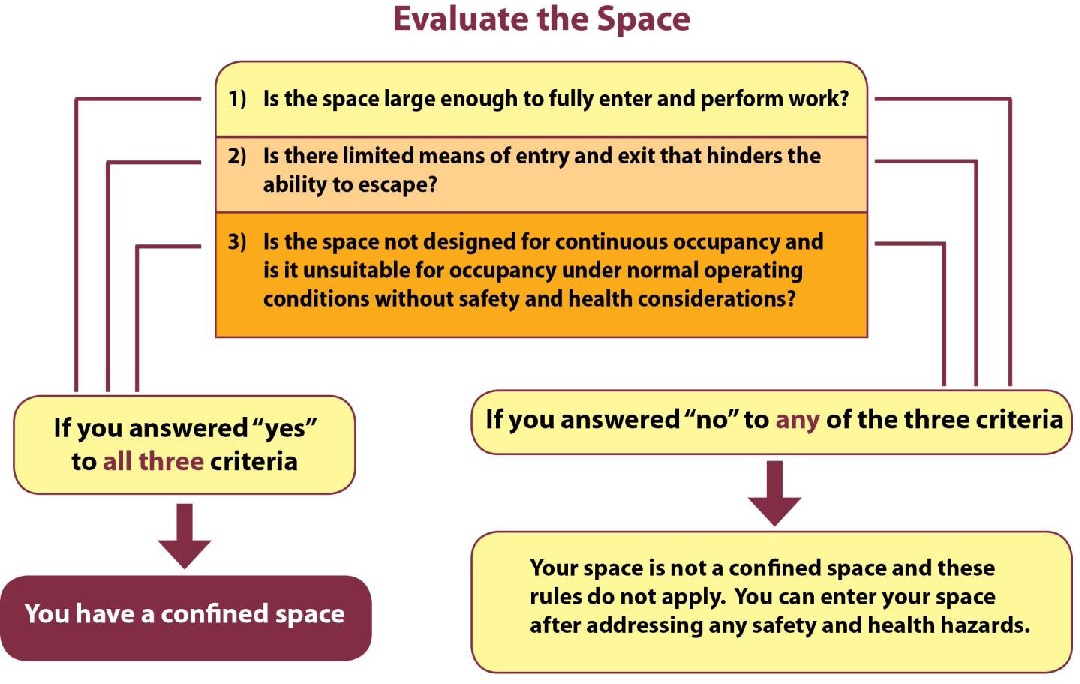
A confined space is defined as having three distinct characteristics.
It must meet ALL three in order to be a confined space.
1 – It must be large enough to enter.
First, it must be large enough and so configured that an employee can fully enter and perform work. A space that is just large enough that an employee could just barely squeeze into, but cannot perform any work does not meet this definition. Similarly, a space that is large enough that an employee can only get part of their body into, but can’t fully enter, does not meet this definition. While there may be hazards associated with these types of spaces, they are not addressed with this particular rule.
2- It must have limited means of entry and exit.
Second, it must have a limited means for entry and exit. Typically, if you must contort your body to enter a space it may be limited means of entry and exit. Examples of this include having to climb through a porthole, climb up a ladder, or crawling through a tunnel in order to exit.
Another way of measuring limited means of entry and exit is to determine how difficult it would be to extract an injured person from the space. If there is a need for any type of technical rescue operation to remove an immobilized person from the space then you likely have limited entry and exit. It is important to recognize that each space should be evaluated on a case by case basis and a limitation in one set of circumstances may not be a limitation elsewhere.
3- It is not designed for continuous occupancy.
Third, it is not designed for continuous human occupancy. This particular characteristic can cause a certain amount of confusion and discussion. A space that is designed for periodic occupancy is not the same thing as a space that is designed for continuous occupancy. The presence of a fixed ladder, lighting, or ventilation does not automatically mean that the space was designed for continuous occupancy. One must look at the primary function and purpose of the space. A space may have lighting to facilitate periodic occupancy. This lighting may be needed to safely enter and exit, read gauges or perform maintenance or repairs to equipment in the space. Similarly, ventilation may be necessary to keep equipment from overheating or provide fresh air for temporary job assignments or tasks. In both cases the work required to be perform in these spaces is intermittent or temporary in nature. Was the space designed for an employee to be permanently assigned to perform work there or was the space designed to house and protect operating equipment that needs to be monitored or occasionally maintained?
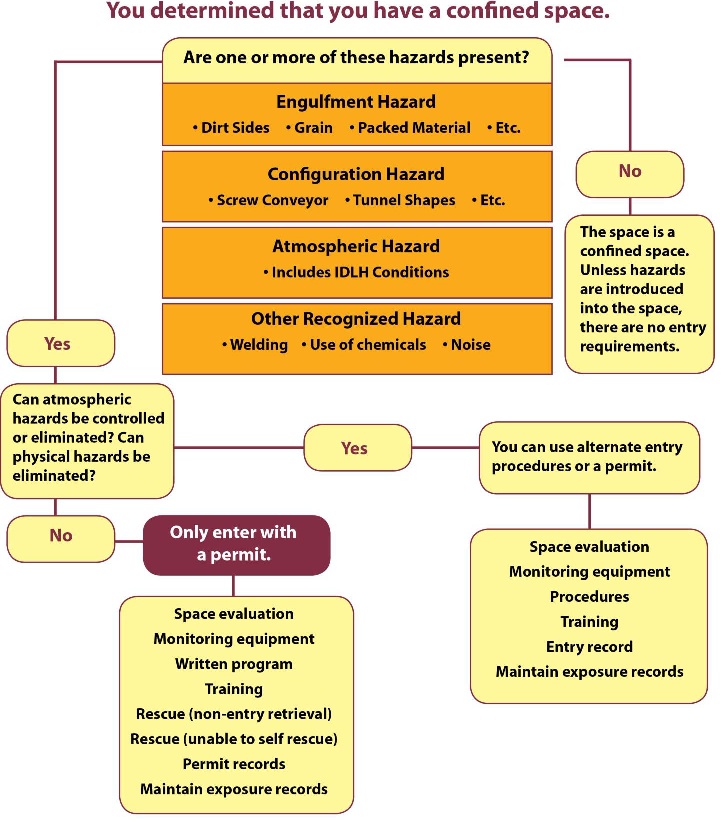
Evaluation of Permit-Required Confined Spaces
A permit space is a confined space with an actual or potential hazard that can inhibit an entrant’s ability to exit the space safely. Once a confined space is identified, the next step is to determine if it is a permit-required confined space (permit space). There are two types of actual or potential hazards.
1) Atmospheric hazards can include an oxygen-deficient or oxygen-rich atmosphere, a toxic one, or an explosive one.
2) Physical hazards can include entrapment, engulfment, electrocution, heat stroke, moving machinery, or any other serious hazard.
In evaluating the atmospheric hazards, it is important to include conditions within the space, systems connected to the space, conditions outside of the space, and anything that is brought into the space to perform assigned tasks. For example, workers may need to enter one part of a tunnel where there are no obvious sources of atmospheric hazards, but workers in another part of the tunnel may be creating an atmospheric hazard that has the potential to migrate to other parts of the system. These need to be identified by all affected parties. Another example of overlooked hazards can be with a space with a particularly small volume with several workers inside. In these situations the simple act of breathing can create an oxygen-deficient atmosphere.
Another consideration for evaluating atmospheric hazards is using air monitoring equipment to evaluate conditions within a permit space. Any air monitoring equipment must be used according to the manufacturer’s instructions, and employees using those meters must know how to use them. There have been several fatalities in permit required confined spaces where the air monitoring equipment alarms identified an unsafe condition but were ignored by the operator. If there is any indication of equipment failure all permit required confined space operations must stop until the equipment is repaired.
Also, there can be a tendency to oversimplify the results of oxygen testing when evaluating an oxygen-deficient atmosphere. While the rule clearly identifies 19.5% as an oxygen-deficient atmosphere that does not mean that nothing more needs to happen if the meter reads 19.6% oxygen. Typically, the normal atmospheric concentration of oxygen is around 20.8% to 21.5%. If your meter reads 20.9% outside of the space, and 19.9% inside the space that is telling you that something has displaced 1% of the oxygen inside the space, which equates to 10,000 parts-per-million of another gas. To place this into perspective, an atmosphere containing 1200 parts-per-million of carbon monoxide is considered to be immediately dangerous to life and health. It is vitally important to identify that other gas to truly identify all of the hazards of that space.
Physical hazards can come in many different forms. The hazard could be related to the configuration of a space, equipment inside the space or materials which can flow into a space and entrap an entrant. There are several ways of eliminating physical hazards through lockout/tagout, blanking and blinding or a physical separation on piping systems from the confined space.
In evaluating physical hazards, it is important to understand that the confined space must be evaluated as it normally operates. There can be a tendency to evaluate a space after protective actions, such as lockout/tagout, are taken, and then not designate it as a permit space. If any actions, such as lockout/tagout, are necessary to make the space safe for entry, then it is a permit space. While lockout/tagout is recognized as a elimination of hazards, it is only a temporary elimination that exists only as long as the lock is in place. Once the lock is removed, the hazard is no longer eliminated. Another consideration for using lockout/tagout is that all of the requirements for using lockout/tagout in 1910.147, where applicable, still apply. Any hazards that still remain after applying lockout/tagout must still be addressed.