
- Of 2,415 reported releases of hazardous substances, 107 (4.4%) involved ammonia.
- Of the 814 people injured during releases of hazardous substances, 61 (7.5%) were injured following ammonia events.
- Equipment failure caused 58% of the ammonia releases and injured 38 people.
- Most ammonia releases involved piping (44%).
- 44% of injured people were employees, 41% were members of the general public, and 15% were responders.
- 7 of the 9 injured responders sustained chemical burns.
- 39% of the ammonia releases required and hazmat response.
- More than 1,889 people were evacuated following 107 ammonia releases.
- Most ammonia releases occurred in food/beverage processing (29%) or chemical/metal/equipment manufacturing (27%).
Since 1993, the HSEES project has recorded information on 105 actual and two threatened ammonia releases (Table 1). A threatened release qualifies for inclusion in the project if it leads to a public health action that protects people (such as an evacuation or a road closing). Most ammonia events (101) occurred at fixed facilities; six releases were during transportation. The quantities of ammonia released ranged in volume from one to 850 gallons, and in weight from one to 4,000 pounds.
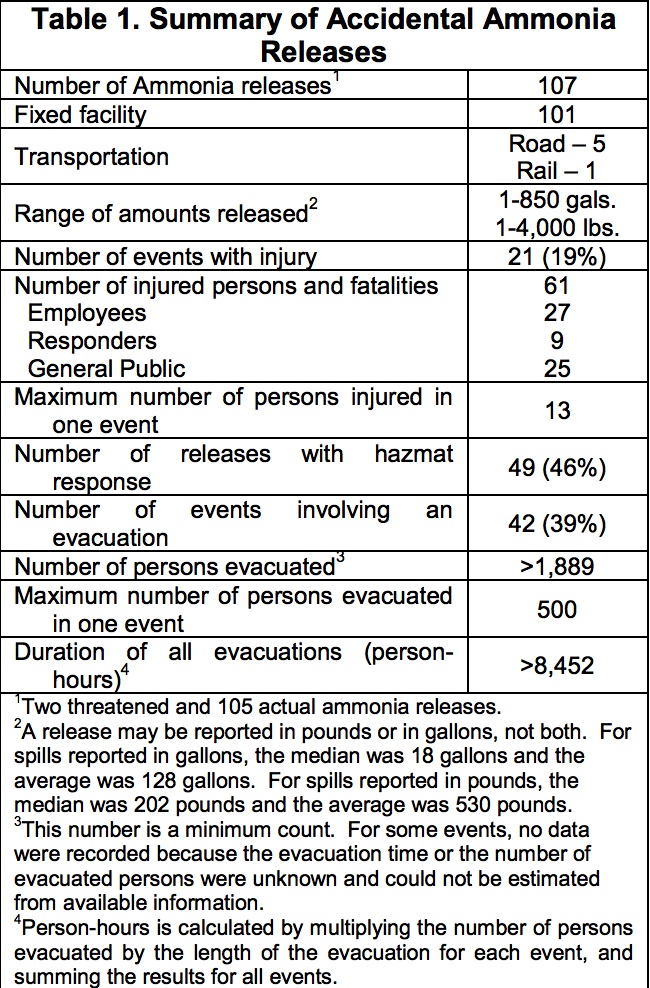
Figure 1. Location* of 101 Reported Ammonia Events at Fixed Facilities**
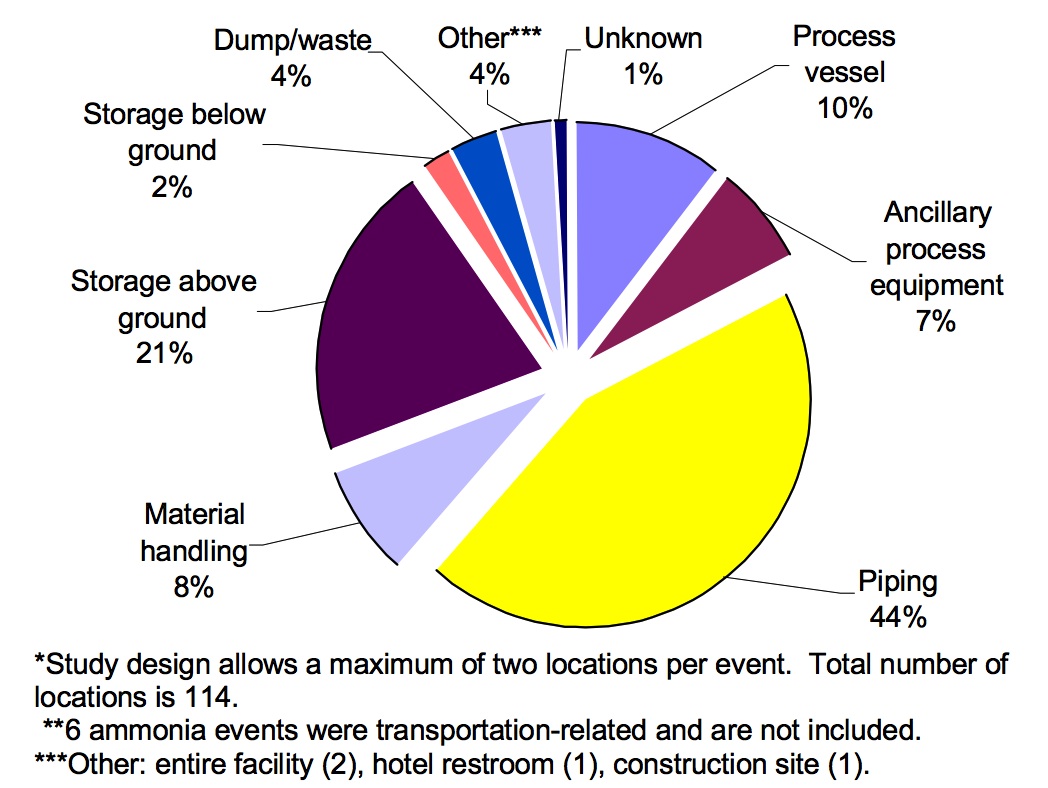
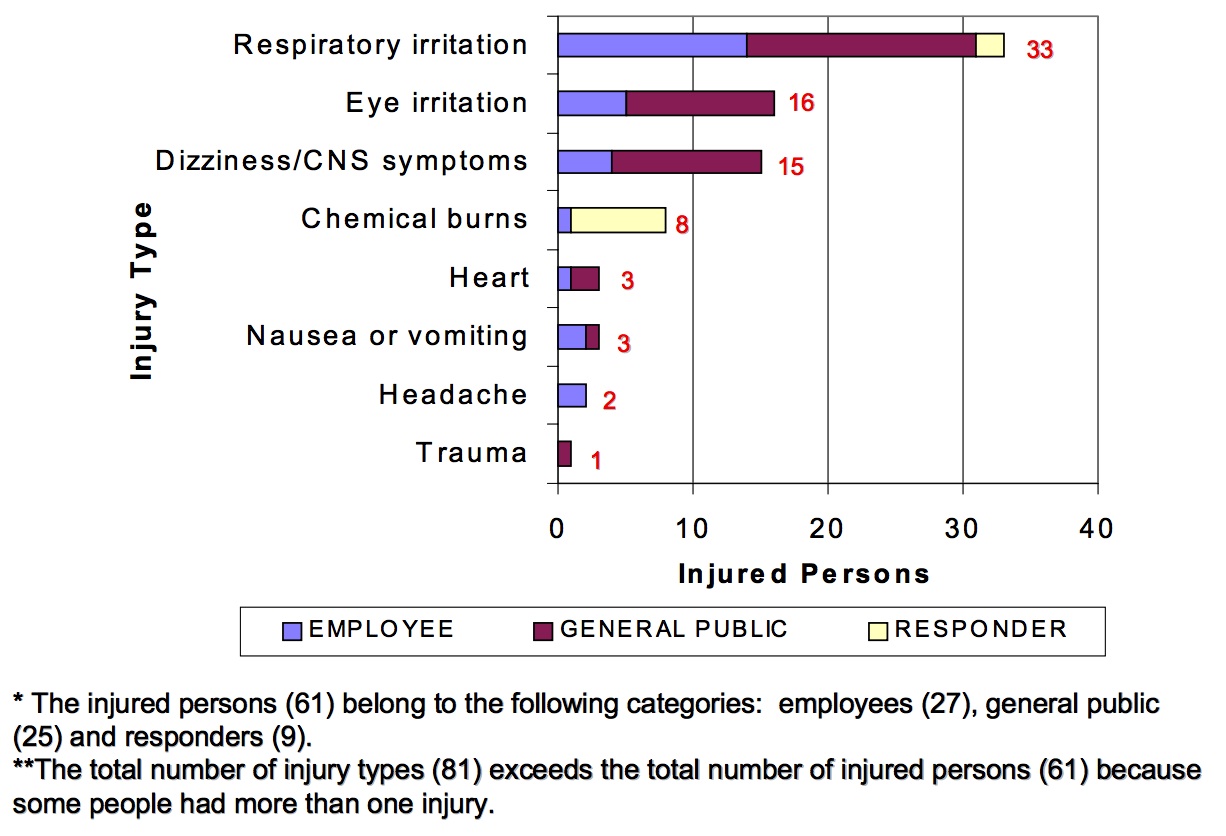
Figure 2. Injuries Following Reported Ammonia Events
Twenty-one events (19%) resulted in injuries to 61 people, one of whom died. The fatality was a forklift operator on the second floor of a produce cold storage facility. The forklift broke through the wooden floor and ruptured the ammonia pipes on the floor below. The trapped operator died from inhaling
ammonia. Forty-nine of the releases (46%) required a hazmat response. Forty-two events (39%) led to evacuations totaling more than 1,889 people. The
evacuation data are minimum numbers since only confirmed data are included. For example, if an evacuation involved more than 50 people but no one knew how much more, then staff recorded only 50 in the project database. Similarly, if the evacuation time was at least two hours but no one knew how much longer, then staff recorded the time as two hours. For some events, no data were recorded because the evacuation time or the number of evacuated
persons were unknown and could not be estimated. The duration of known evacuations totaled >8,452 person-hours.
ON-SITE LOCATIONS
The 101 ammonia events which occurred at fixed facilities are summarized in Figure 1. The total of locations (114) exceeds the number of events (101) because 13 events are described by two types of locations. The most frequently reported locations were piping (44%), storage above ground (21%), process vessel
(10%) and material handling (8%).
INJURIES and MEDICAL TREATMENT
Figure 2 summarizes the injury data collected for 61 people injured in 21 events. The injury total exceeds the number of injured persons because some people sustained more than one injury. The predominant injuries associated with releases of ammonia were respiratory irritation (54%), eye irritation (26%) and dizziness/central nervous systems effects (24%). Respiratory irritation was the most common symptom reported by both employees (52%, 14/27) and the general public (68%, 17/25); the symptom most frequently reported by responders was chemical burns (78%, 7/9).
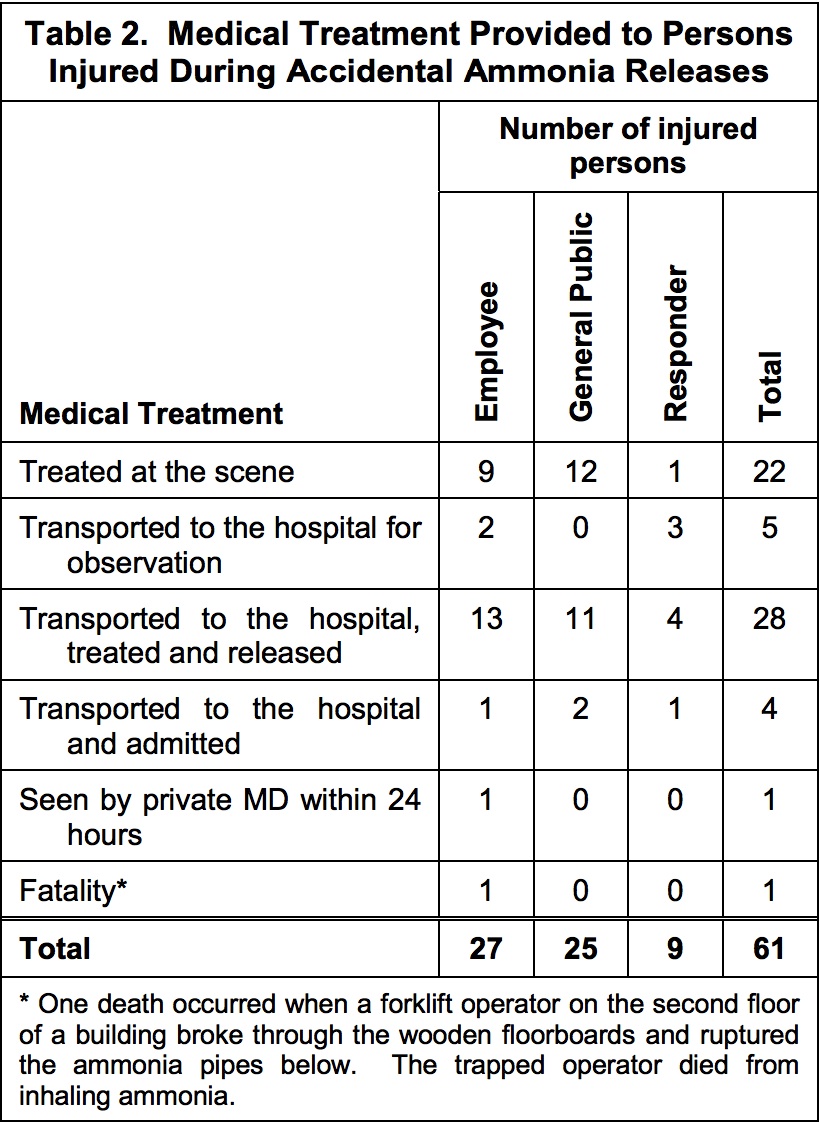
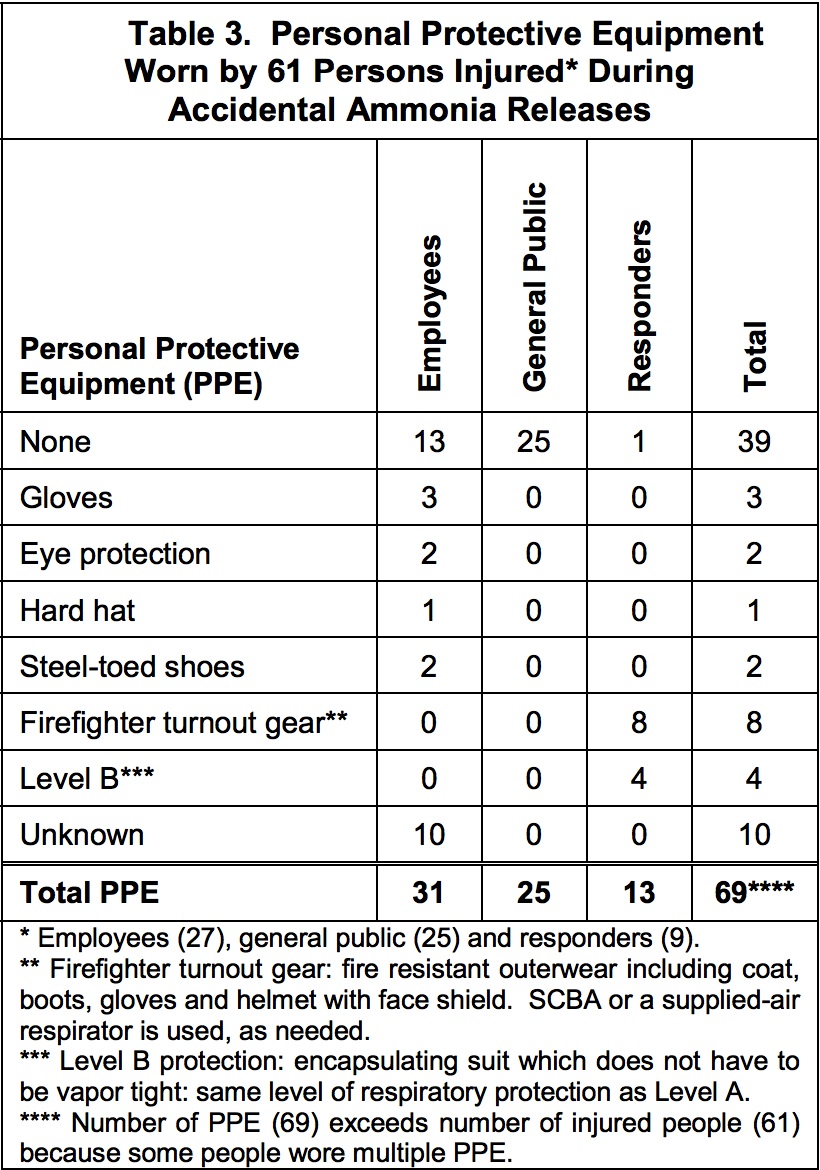
Data on medical treatment (Table 2) indicate that 46% of injured people (28/61) were transported to the hospital, treated and released and that 36% (22/61) were treated at the scene. Five people (8%) were released from the hospital after observation and 4 people (6%) were admitted. One fatality was caused by ammonia exposure following an accident in a cold storage facility. In the project, an injured person can be classified as using up to four different pieces of personal protective equipment (PPE). A review of PPE worn by people injured during accidental ammonia releases (Table 3) shows that the majority of injured people (64%, 39/61) wore no PPE. Among the injured people without any PPE, the majority were general public (25/39), but thirteen were employees and one was a responder. PPE worn by injured responders included Level B suits (4) and firefighter turnout gear (8). Four of the injured responders wore firefighter turnout gear and, later, Level B protection. This occurred in two events because members of the fire department were also members of the hazmat team. The responders first entered wearing firefighter turnout gear and then re-entered in Level B as part of the hazmat team. In one incident, the newly-established hazmat team was responding to its first event and one firefighter was burned by ammonia trapped inside his entry suit. In the other incident, three firefighters sustained burns to the groin (1), ears and earlobes (2). These injuries indicate the need for improved training and education of employees and responders on the hazards of ammonia and the importance of appropriate PPE. Of the 27 injured employees, nearly half (13/27, 48%) wore no PPE and others wore items such as gloves or steel-toed shoes that did not provide respiratory protection.
CAUSES
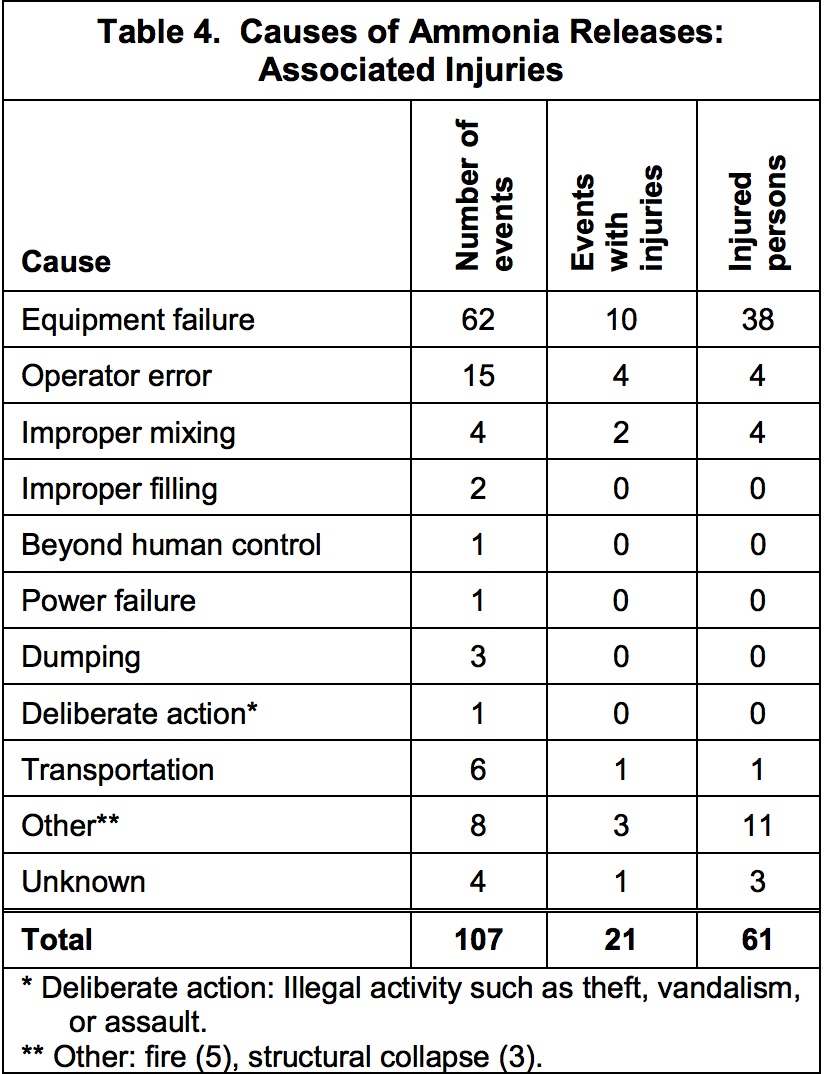
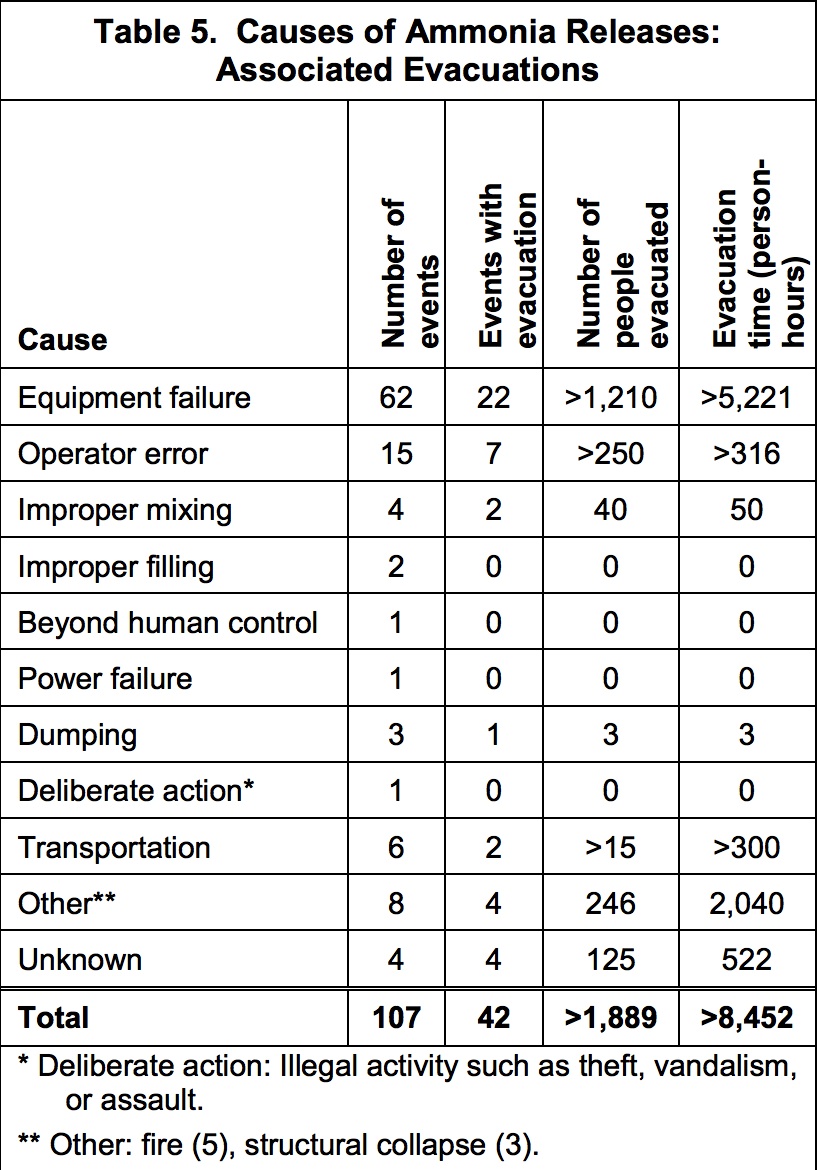
Table 4 summarizes the causes of ammonia releases and the associated injuries. The most commonly reported causes for ammonia releases were equipment failure (62 events, 58%) and operator error (15 events, 14%). Ten events with equipment failure as the cause resulted in 62% of the injured people (38/61). The eight events with cause listed as other (fire, 5; structural collapse, 3) resulted in 18% of the injured people (11/61). Table 5 summarizes the causes of
ammonia releases and associated evacuations. The most commonly-reported cause of ammonia releases was equipment failure (62 events, 58%) which resulted in more than half of the evacuations (22 events, 52%). These 22 evacuations displaced more than 1,210 people for more than 5,221 person-hours. Operator
error resulted in 17% of the evacuations (7 events) which affected more than 250 people for more than 316 person-hours.
INDUSTRY-SPECIFIC ANALYSIS
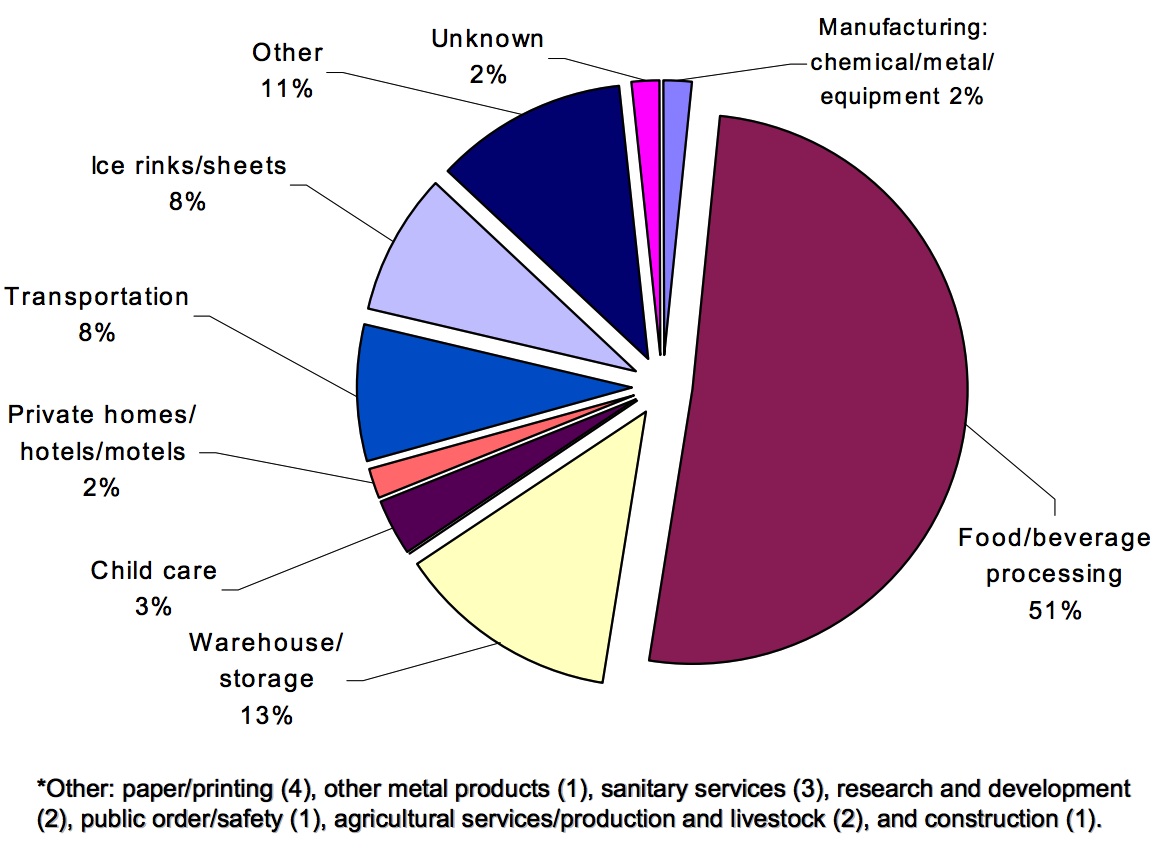
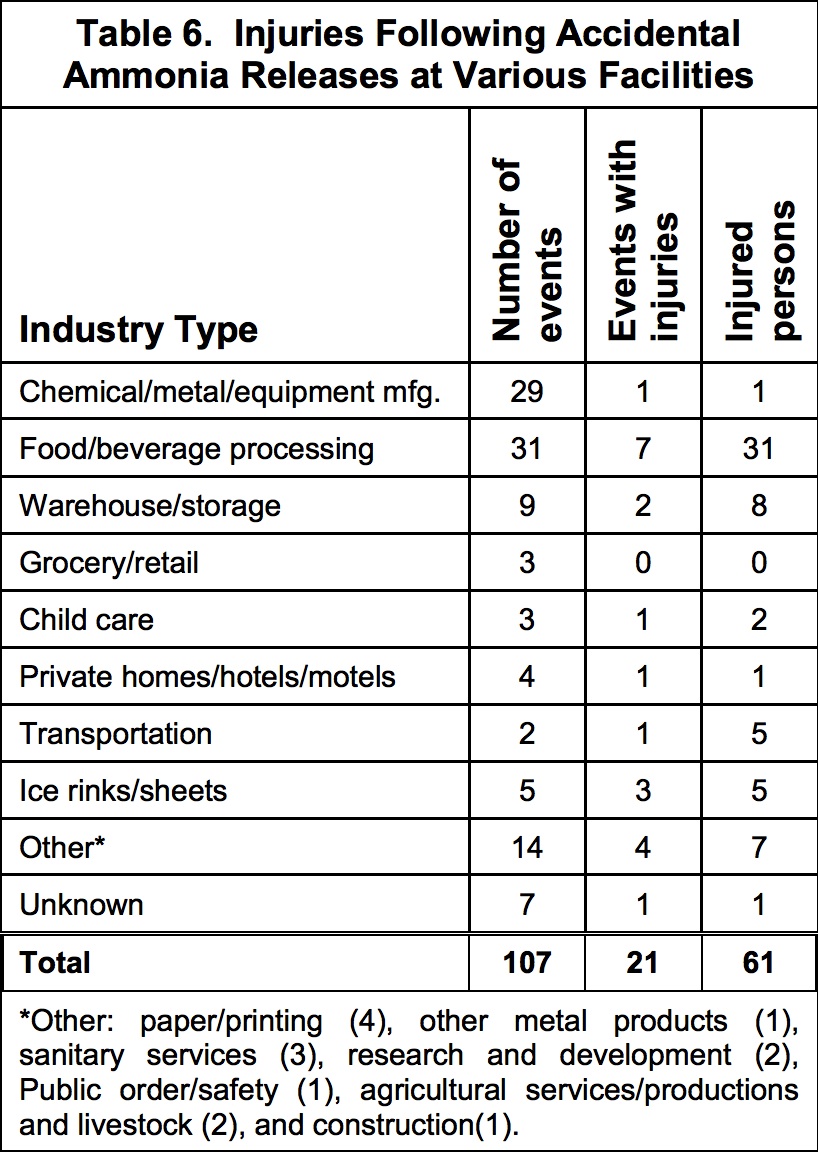
An analysis of the number of injured people by facility type (Figure 3) shows that most people (51%) were injured in food/beverage processing. Similar numbers of ammonia releases (Table 6) took place in the categories of chemical/metal/equipment manufacturing (29) and food/beverage processing (31), but the number of injuries was much lower in the manufacturing sector (1) than in the food/beverage processing industry (31).
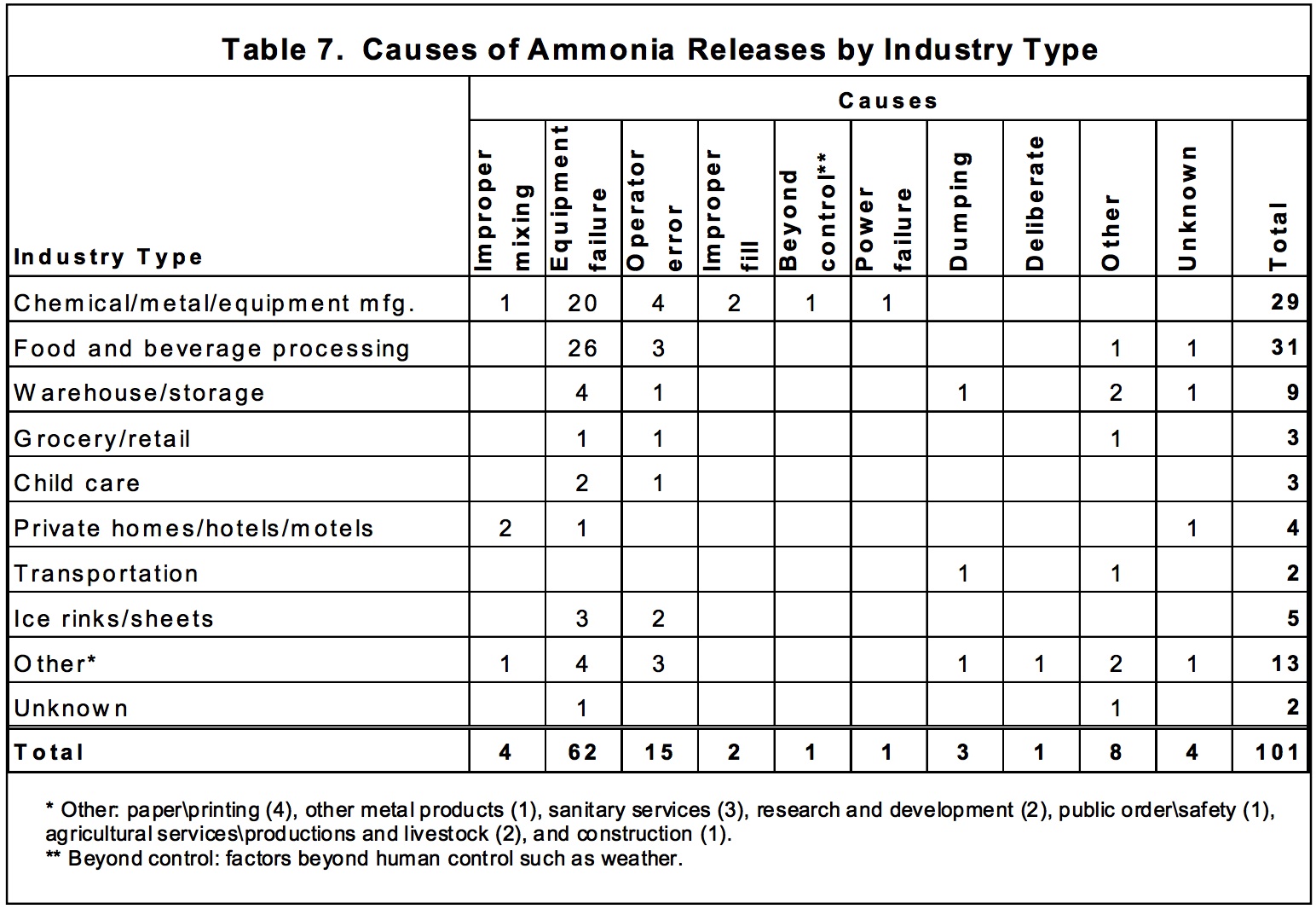
An examination of the causes of ammonia releases in these two industries (Table 7) shows that equipment failure was the major cause in each: 69% (20/29) in
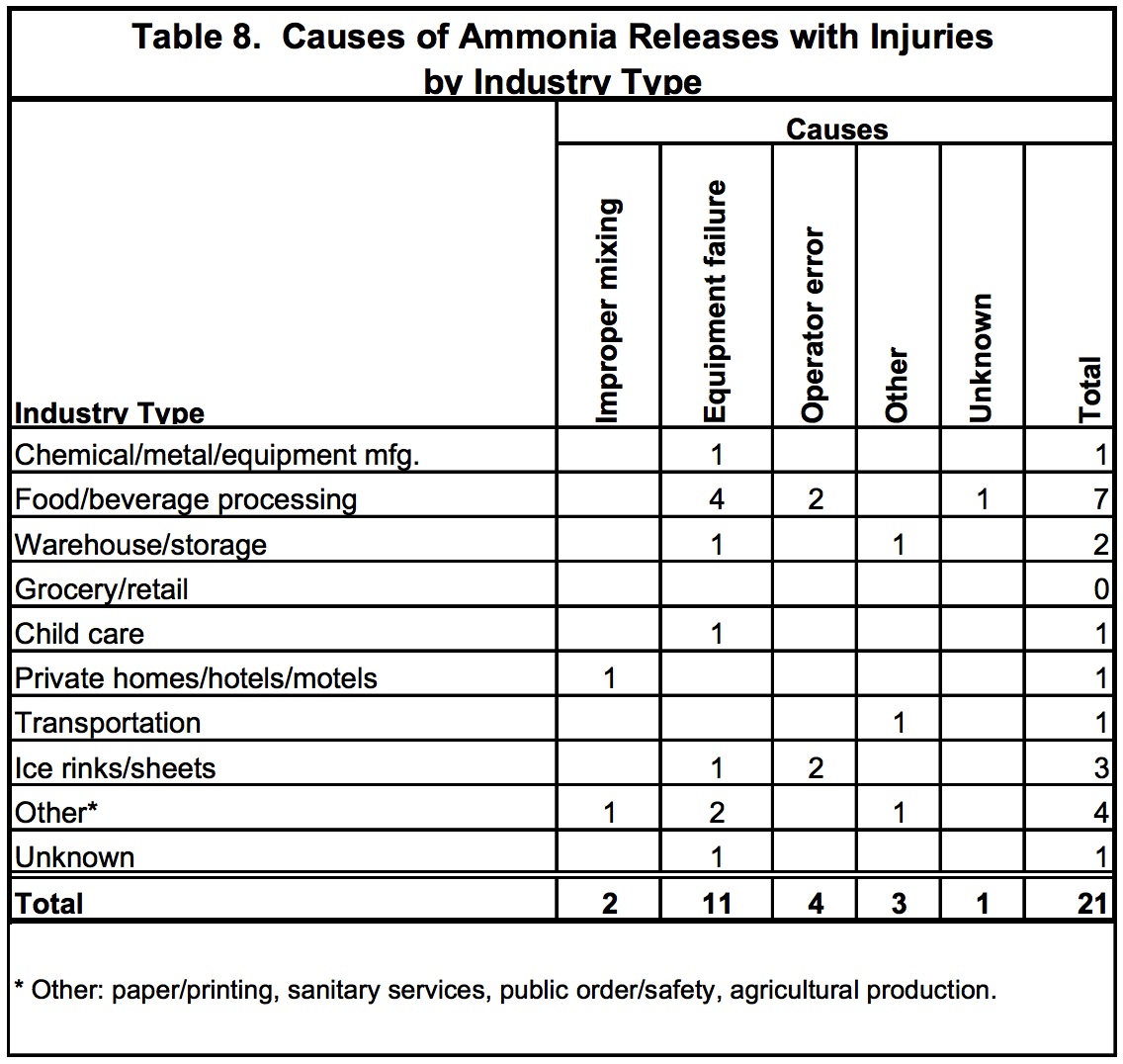
manufacturing and 84% (26/31) in food/beverage processing. Within the category of equipment failure, a significant number of releases involved piping: 12/29 in manufacturing and 17/31 in food/beverage processing. Far fewer releases were due to operator error: 14% (4/29) in manufacturing and 10% (3/31) in food/beverage processing. An analysis of causes by industry for the 21 ammonia events associated with injury (Table 8) shows that equipment failure was the predominant factor, particularly in the food/beverage processing sector.
Figure 3. Injured People Following Accidental Ammonia Releases by Facility Type
EVACUATIONS
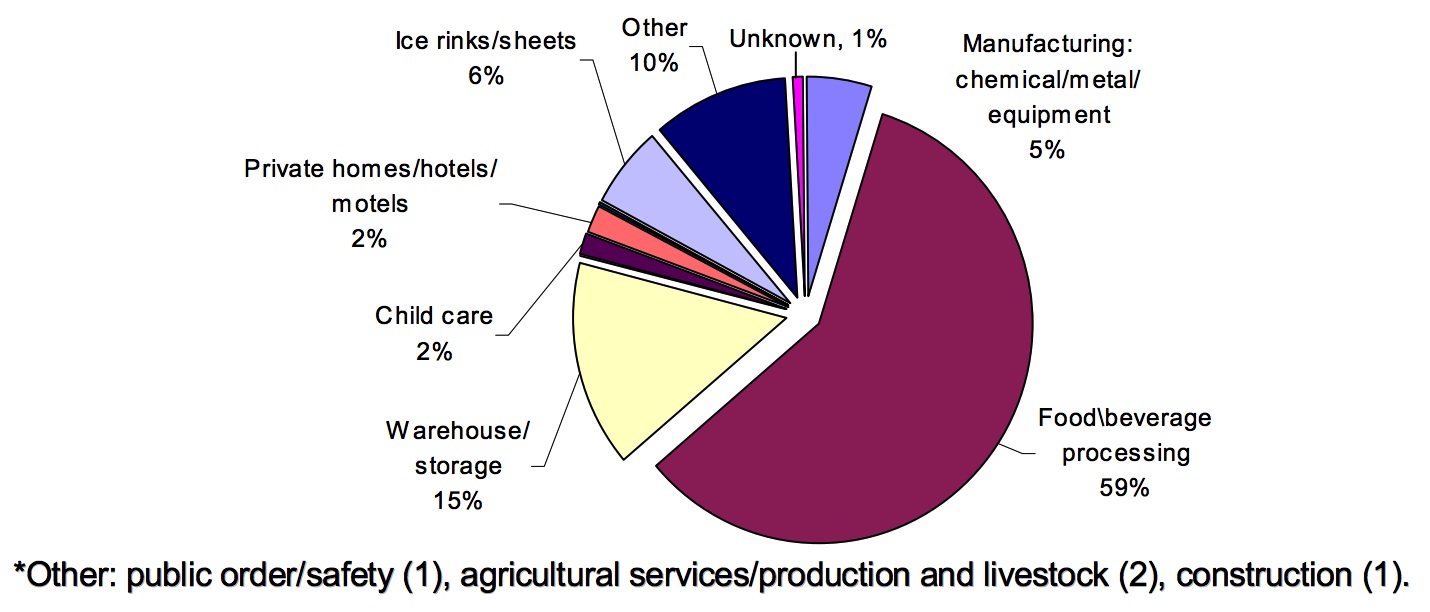
Table 9 summarizes evacuations by industry type. More than 60% of the evacuations following ammonia releases occurred in the food/beverage processing industry (40%, 17/42) and in grocery/retail (21%, 9/42). Nearly three-quarters of people evacuated due to ammonia (Figure 4) were in the food/ beverage
processing industry (1,112 people, 59%) and in warehouse/storage (285 people, 15%).
Figure 4. People Evacuated Following Accidental Ammonia Releases by Facility type**
CASE STUDIES
The following are examples of ammonia events that are included in the data:
- Late one Wednesday evening, a lone workman wearing no personal protective equipment was repairing a compressor at a college ice rink. After adding oil to the system, he accidentally punctured a line carrying anhydrous ammonia and 1,000 cubic feet of the liquid refrigerant was rapidly released. Hot oil contaminated with ammonia sprayed his face and caused eye injuries which required hospitalization. Firefighters who responded to the incident were concerned about the potential for an explosion and used large exhaust fans to vent the sports facility.
- Two young male employees were overcome by chemical fumes and the entire floor of an office building was evacuated (approximately 20 people for one hour) after a half gallon of ammonium hydroxide spilled in an engineering consultant’s office. The chemical was used to operate the company’s blueprint machine and spilled when a shelf broke. The injured men were treated at the hospital for respiratory irritation. Although the amount seems small, the chemical soaked the carpet and powerful fumes circulated throughout the floor. The fire and police departments evacuated all second-floor occupants including an oral surgery clinic. Firefighters cut the portion of the carpet where the chemical spilled and removed it in a metal container for disposal as hazardous waste.
- Twenty-five pounds of ammonia were released at a commercial blueprint shop when the protective domed cover on a 100-lb tank sheared the valve as it was being opened. During the evacuation, one woman fell down the stairs and broke her leg. As a result, she was exposed to the ammonia vapors, suffered dizziness and respiratory irritation, and required hospitalization. One hundred and fifteen people were evacuated for four hours.
- A relief valve on a refrigeration unit at a bottling plant malfunctioned in the open position and released 200 gallons of ammonia. Employees were exposed when they were evacuated from an area downwind of the plume. Eleven employees sustained injuries including eye and respiratory irritation, headache, chest tightness, sore throat and dizziness. Nine employees received on-scene first aid and two were transported to the hospital for treatment. Thirty-five people evacuated for about four hours from other facilities located downwind.
- An inmate at a correctional facility generated a noxious gas by mixing bleach and ammonia. The inmate and two facility employees sustained respiratory irritation. The employees were treated and released at a local hospital and the inmate was treated at the facility health clinic. Ten people were evacuated for about 1.5 hours.
CLICK HERE for the PDF version.