
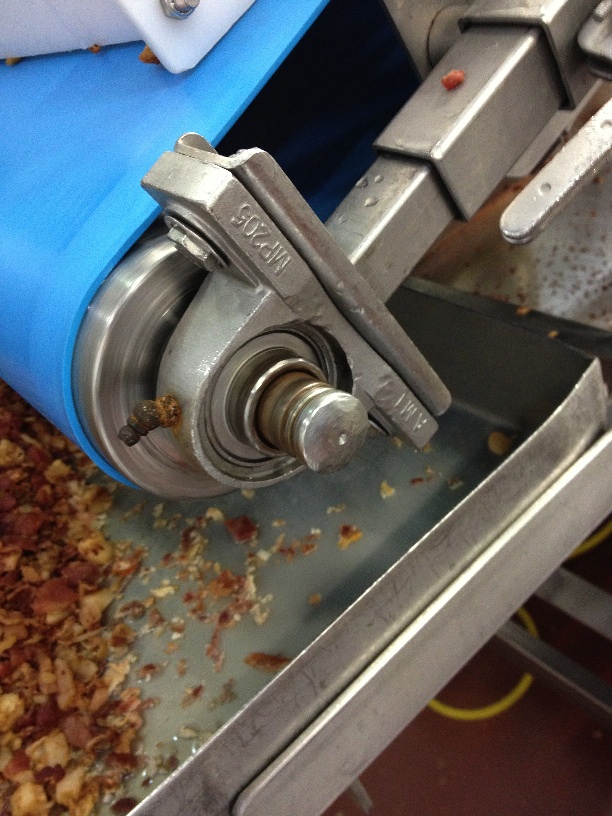
The photo below is a perfect example to demonstrate when a protruding shaft MUST be guarded.
Question: Does the shaft protusion shown below required to be guarded? If you answered “yes”, for a bonus, name the OSHA standard that you would use to issue a citation. Answer(s) below:
Here is some background on “shaft guarding”…
OSHA standard, §1910.219(c)(2)(i) states, “All exposed parts of horizontal shafting seven (7) feet or less from floor or working platform, excepting runways used exclusively for oiling, or running adjustments, shall be protected by a stationary casing enclosing shafting completely or by a trough enclosing sides and top or sides and bottom of shafting as location requires.” However, 29 CFR 1910.219(c)(5), provides guarding exemptions for all mechanical power transmission apparatus located in basements, towers, and rooms used exclusively for power transmission equipment. In addition, if the housing/mount is designed or constructed in such a manner as to prevent employees from having any part of their body, clothing, jewelry, or the like (such as neckties, scarves, and necklaces) contact the shaft, then it would be considered as guarded by location and would be compliant with the provisions of §1910.219(c)(2)(i). Otherwise, ALL rotating shafts seven (7) feet or less from a floor or work platform must be COMPLETELY enclosed as required by the standard.
As for the protruding shaft ends, we look to 1910.219(c)(4)…
1910.219(c)(4) Projecting shaft ends.
1910.219(c)(4)(i) Projecting shaft ends shall present a smooth edge and end and shall not project more than one-half the diameter of the shaft unless guarded by nonrotating caps or safety sleeves.
Here is this stated in plain language… a SMOOTH shaft can extend UNGUARDED 1/2 the distance of its diameter. The SMOOTH shaft shown above is 0.5″ in diameter which means it can extend UNGUARDED ONLY 0.25″; thus the shaft above is in violation of 1910.219(c)(4)(i).