
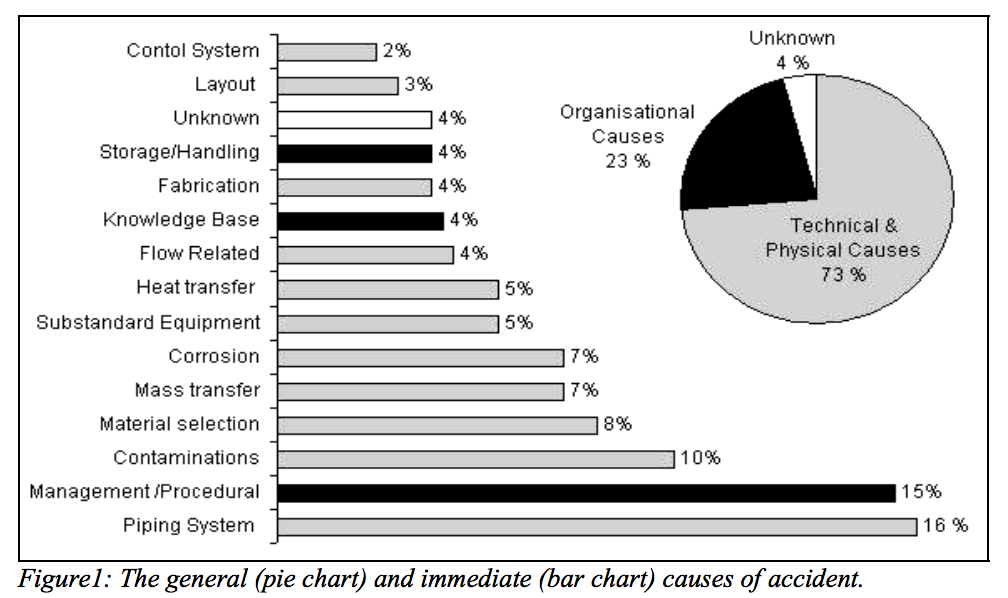
 A study of past accidents in the chemical process industry (CPI) has been carried out by Helsinki University of Technology, Plant Design, Department of Biotechnology and Chemical Technology. It is found that the majority (73%) of the accidents were caused by technical and engineering failures. Based on the causes of accident and types of equipment failures, five common features of an accident in the CPI were identified. The analysis reveals that the contribution of the design to accidents is significant and the advancement of knowledge/technology is not shared effectively by practitioners. Dependency on the add-on control strategy should be reduced and inherently safer or passive engineered must be considered as premier risk reduction strategy to lessen the safety load, for better design and to prevent accident effectively. Figure 1 shows the general (pie chart) and immediate (bar chart) causes of accidents in CPI based on Failure Knowledge Database. It clearly indicates that majority of the accidents are caused by technical failures (73%), followed by organizational (23%) and unknown (4%).
A study of past accidents in the chemical process industry (CPI) has been carried out by Helsinki University of Technology, Plant Design, Department of Biotechnology and Chemical Technology. It is found that the majority (73%) of the accidents were caused by technical and engineering failures. Based on the causes of accident and types of equipment failures, five common features of an accident in the CPI were identified. The analysis reveals that the contribution of the design to accidents is significant and the advancement of knowledge/technology is not shared effectively by practitioners. Dependency on the add-on control strategy should be reduced and inherently safer or passive engineered must be considered as premier risk reduction strategy to lessen the safety load, for better design and to prevent accident effectively. Figure 1 shows the general (pie chart) and immediate (bar chart) causes of accidents in CPI based on Failure Knowledge Database. It clearly indicates that majority of the accidents are caused by technical failures (73%), followed by organizational (23%) and unknown (4%).
In this work, special attention on ‘human engineering error’ is given for the accidents caused by human failures by asking questions such as “why did the operator make a mistake”; “why the operator did not follow the instruction/procedure”; “why the operator repeat the same mistake” etc. As a result, the majority of the human errors (under management/procedural category) are shifted to technical causes due to design error of work unit. Among typical examples related to the ‘human engineering error’ include wrong equipment/component labeling, confusing control panel display, wrong work instruction and standard operating procedure, wrong color coding, and poor visibility and accessibility to the equipment.
The bar chart from Figure 1 shows the root causes of accidents in CPI. The most frequent cause of accidents in the Failure Knowledge Database are the piping system failures (16% of 364 cases). Accidents related to the piping systems involved loss of containments or leakages that lead to toxic dispersion, fire, and explosion. From the analysis, typical problems associated with the piping system are
- poor layout,
- wrong specification,
- dead end or no flow arrangement,
- poor installation and finishing work,
- inadequate hot bolting, and blockage.
Technically, the piping system is complex due to multiple interactions between process equipment. The demand for higher process flexibility increases the complexity of the system. The likelihood of the piping failure is a function of the failure rate of its components. If the number of the components increases, the probability of the system failure will increase. Thus, designing a simpler piping system is the best way to prevent accidents in the CPI.
The second largest cause of accidents is contamination of the process stream with 36 cases (10%). In this category, impurities, by-product, and indirect or external contaminations are also considered. The basic problem of the contaminations is related to insufficient process hazard analysis at the process development and plant design. Contaminations also occur due to incomplete draining/cleaning/purging, reverse flow, pressure difference, blockage, leakages and condensation due to weather changes. In chemistry terms, the contaminant changes the quality of process stream and creates a lot of operational problems such as
- increase the corrosion rate,
- partial/full flow blockage,
- wall sticking,
- depositing or scaling,
- disturbed/delayed chemical reactions, etc.
If unstable or reactive material presents and the conditions are right (i.e. temperature and concentration), an unwanted reaction (i.e. polymerization and decomposition) may occur, resulting unwanted events such as fire and explosion.
Inappropriate selection of construction material (29 cases or 8%) is the third contributor to accidents in CPI. This is a design related error and normally connected to the physical and mechanical problems of process equipment such as cracking, corrosion, erosion, creep, fatigue, and shock. For example, selecting mechanically robust construction material as well increasing the wall thickness of process equipment can eliminate wall failures. Meanwhile selecting a chemically resistant construction material such as stainless steel or Teflon can minimize the corrosion issue.
The contribution of mass transfer and corrosion/erosion are also significant (26 cases or 7% each). Accidents resulting from poor or no mixing, excessive charging, and varied feed conditions are common factors related to the mass transfer category and consequently lead to uncontrolled reactions. Meanwhile, corrosion/erosion may result following operational scenarios, such as flow restriction, process condition deviations, and raw material variation. Among the factors that accelerate corrosion rates change in process conditions i.e. higher temperature and pressure, high pH value, and contaminations by specific materials from other process streams or from outside. Heat transfer is also a very usual contributor of chemical plant accidents, causing 20 accidents. Loss of cooling, wrong heating method, hot spots, and scaling in the piping system and process equipment are among the problems associated with heat transfer related accidents. Special attention should be given to thermal expansion phenomena and the reactivity hazard of heat transfer media to the process fluid.
The low fraction of accident causes should also be noted i.e. substandard equipment (5%), fabrication (4%), flow related (4%), layout (3%), and control system (2%). Still, even the small percentage cause, may generate big problems if not managed properly.
Based on the information available in 364 accident reports, the frequency of the equipment failures is examined and classified into 12 main categories. The resulting
categories of equipment failures and their respective percentage are:
- piping (25%),
- reactors (15%),
- storage tanks (14%),
- process vessel (10%),
- the heat exchanger (8%),
- separator (7%),
- general machinery (5%),
- other equipment (5%),
- drum (4%),
- warehouse (3%),
- a control system (3%), and
- cylinder (2%).
The result shows that piping is the most fragile component of chemical plant operations. In general, piping failures are caused by design error (i.e. unsuitable construction material); corrosion and erosion issues; poor operations and project implementation (i.e. fabrication/ installation).
CLICK HERE for the full study. A MUST READ for those who manage PSM/RMP programs.
CREDIT: Kamarizan Kidam, Markku Hurme, Mimi H. Hassim, Helsinki University of Technology, Plant Design, Department of Biotechnology and Chemical Technology and Universiti Teknologi Malaysia