
This is my second and probably the last post regarding this incident. This post will cover the Boston Fire Department’s (BFD) activities that took place at the facility AFTER the fatality. As you can see, these guys are true pro’s and they know hazardous materials as well as did a nice job using IIAR-2, American National Standard for Safe Design of Closed-Circuit Ammonia Refrigeration Systems as their basis for this inspection. One observation that I was able to make regarding this incident is that [the company] did not receive any citations related to the state of MA’s HAZMAT code, formerly called 527 CMR 33.00: Hazardous Material Process or Processing which became effective in 2013. [The company] was required to have their “Permit to Process Hazardous Material” by January 1, 2014, which is shown in these documents did NOT happen. I have submitted one last question via FOIA request as to why this 2012 state code was not enforced in this fatal 2016 accident. We will never know if this code could have prevented this fatal accident, but we do know that it was intended to! The state wrote this code in 2012 as a response to a Chemical Safety Board Recommendation stemming from the CAI / Arnel Chemical Plant Explosion. However, it appears that this code is a “toothless” code! I hope I am wrong and that [the company] was cited for not obtaining their “Permit to Process Hazardous Material” nor maintaining their process per 527 CMR 33.00: Hazardous Material Process or Processing.
Here are the activities that took place along with their timeline and a list of code violations discovered by the BFD after the fatality:
From: Fire Prevention
Date: 4-7-16
To: The Fire Commissioner
Subject: XXXXXXX Seafood Inc.
March 23rd – An Anhydrous Ammonia Leak occurred around 6:00 PM in the Engine Room of [the company] located at XXXXXXXX resulting in the death of one [the company] employee.
March 24th – An investigation was conducted by the EPA, OSHA, BPD Haz Mat Unit, Mass. Public Safety Engineering Inspector, The Attorney Generals Office, and the Boston Fire Department. The EPA was the lead agency due to the Ammonia release being over 500 lbs but less than 10,000 lbs. (OSHA takes the lead when over 10,000 lbs [SAFTENG NOTE: not sure what they mean by this, but speaking in pure terms this is NOT a factual statement])
The initial investigation determined that the release was an Industrial Accident. The EPA requested the BFD to take into possession the broken Receiver Liquid Drain Pipe and hold it as evidence. NOTE: This is supposedly the broken pipe on the bottom of the receiver in this incident.
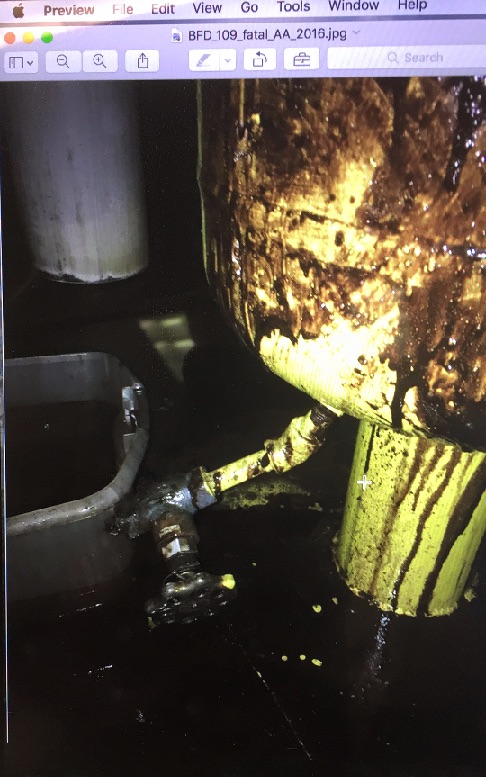
See below for more from the March 24th meeting.
The EPA also requested that the BFD take control of the building which we did. (Because it was not a crime scene the other agencies did not want to take control)
March 25th – A request was made by [the company] to allow two Water Cooled Refrigerated Supply Trucks to stage at the loading dock and supply the Freezers with cold air to preserve the product. This request was granted. The State Health Department was placed in charge of all food products and it was agreed that food decisions would come from them. (they were trying to rely on us to determine what freezers the ammonia may have leaked into) (This information was impossible to determine)
The Boston Fire Department Ordered [the company] to:
- Remove all Hazardous Materials from the Engine Room. (Flammable Solvents, Gases, Refuse, Ect.) (This was done by a [HAZMAT contractor])
- Flush all remaining Anhydrous Ammonia out of system. (This was done by an [Anhydrous Ammonia Supplier] on 4/1/16) NOTE: There was 3231 lbs of Anhydrous Ammonia in the system that was pumped out.
- De-Energize, Lock Out, Tag Out the electrical system. (Their were many electrical violations) (This was done by an [Electrica contractor])
March 30th – An abatement was issued for the above violations. The abatement was hand delivered and signed by the [company] CEO XXXXXXXX.
April 6th – Meeting was held with EPA, OSHA, OSHA Subcontractors, and the BFD to conduct an in depth investigation of the entire facility. All of the above abatement violations have been corrected and the abatement was dismissed. Tower Ladder 3 was used to gain access to the roof.
The Evidence (Receiver Liquid Drain Pipe) was handed over to OSHA for analysis. (An FIU Evidence Custodial Form was completed and signed by OSHA)
Request was made by [the company] to use the Loading Dock and Warehouse. This Request was granted.
At the conclusion of the meeting, Building Control was given back to [the company] with the understanding that the Engine Room is to remain out of service until all EPA and OSHA requirements and recommendations are met. It was also made known that consideration for an Annual Permit (not issued) or an FP 300 (Process Safety Management Permit) (not issued) would not happen until all Federal and State requirements are met.
Respectfully Submitted,
Captain XXXXXX XXXXXX, Fire Prevention
March 24, 2016, Close Out Briefing:
The following items are observations, areas of concern or requests for further information.
The area in the vicinity of the Principal Access (Double) Doors leading into the Storage/Maintenance area on first floor and Ammonia Machinery Room on second floor. Ammonia standards talked about at the out briefing are from the ANSI/IIAR 2 standards.
Principal Access Door
- Principal Access Door Need proper warning sign under the Audio/Visual alarm above the principal exterior doors.
- Need proper signs above the Emergency Ventilation and Emergency Machinery Shutdown switchs/buttons.
- Need proper Signs on the Principal access Doors, including the following signage:
- The facility lacked any Refrigeration Machinery Room sign,
- The facility had inadequate Caution Ammonia sign,
- The facility lacked any Caution Eye and Ear Protection Required sign in this area,
- The facility had inadequate NFPA 704 Ammonia Fire Diamond 3-3-0, Warning for indoor ammonia refrigeration equipment sign.
- Need tight fitting doors.
- Need to update how to access the emergency switches for shutting down the ammonia equipment and to activate the emergency ventilation system.
- Check to make sure the Red light above the outside door is both an Audio and Visual alarm.
Storage/Maintenance area on the first floor
- Propylene Glycol system not marked.
- Should not have chemicals or materials under the wood stairs.
- Flammable Storage cabinet needs to be grounded.
- Cutting Torch cart needs to be secured.
- Charging station under wooden stairs has frayed wires coming out of the unit.
- None of the chemicals or products stored in this area had any secondary containment.
- Need to segregate materials for incompatibility.
- Need to separate into Waste, Hazardous Waste and Universal Waste.
- Need a plumbed Eye Wash fountain/Shower Station; Facility had an inadequate eye wash only station, which was empty.
Ammonia Machinery Room on Second Floor
- Need to do Non-Destructive/Integrity testing on the ammonia system.
- Insulation on pipes, Control Pressure receiver and dump tank all show signs of being breached, including cracked insulation, rust, ice, and biological growth on equipment. Insulation should be removed for inspection and then replaced.
- All ammonia piping needs to be painted and properly labeled.
- Need two ammonia detectors for 25 ppm and 150 ppm detection level.
- Need tight fitting exterior doors.
- The two access doors need a gate to prevent a person from falling out the opening.
- Need doors labeled properly.
- Identify Emergency shut off valves such as the King Valves.
- Need to be able to access the Emergency Shut Off valves (King Valves).
- Need permanent sign securely attached and easily accessible on the ammonia refrigeration system displaying:
- name and address of the installer;
- refrigerant number and amount of refrigerant in the system;
- lubricant identity and amount; and
- field test pressure(s) applied2
- Piping and Instrumentation Diagram – P&ID diagram should be moved from the back of the Door and placed either on the wall as you enter or on the wall near the top of the steps.
- All ammonia system vessels need to be marked properly.
- Need to protect pipes from bumps
- Need to have a permanent structure to access the ammonia equipment on the roof, rather than an unsecured ladder.
- Need to add at least two more wind socks, which should be located 3 meters above the roof line.
- High Stage Compressor 1 had electric wire leads that were not properly secured.
- Need an Eye Wash fountain/Shower Station
- Need to check why louvers are closed when they should be open with the emergency ventilation on.
- The company supplied a diagram showing the location of floor drains in the building, and we were told that the floor drains connected to the storm drains that discharge to the harbor. We told the company office they should notify the National Response Center (”NRC”) at 800-424- 8802 because of the oil that was released during the ammonia incident.
- Who is the designated operator of the Ammonia system?
- Need a copy of the original ammonia system calculations done by the [company] contractor, XXXXXXXXXXXX and new ammonia system calculations for equipment currently at the facility. Reason for new ammonia system calculation is that a new larger condenser was installed on the roof within the last two years.
- Need Pressure Relief Valves installation and replacement records
- Need ventilation calculations for all phase of operations.
- Need copy of contract with XXXXXXX Refrigeration Company, Inc.
- Need copy of the Emergency Plan(s) for all regulations3
Emergency Planning and Community Right-to-Know – EPCRA
- Supply copy of Tier 2 for 2015, along with proof of submission to the Local Fire department, LEPC – Local Emergency Planning Committee and SERC – State Emergency Response Commission
- Need inventory of all chemicals, materials, and products that have SDS – Safety Data Sheet.
- Two materials of special note are the amount of Lead Acid Batteries in the electric forklifts and trucks and the amount of Propylene Glycol solution.
OSHA
- This a continuing process in which there will be follow up requests for information and interviews.
Massachusetts Department Public Safety – Boilers
- Continuing to monitor the situation.
Boston Fire Department
- http://www.cityofboston.gov/fire/forms/
- Need to file an Annual Permit Application
- Need to file Hazardous Material Process or Processing-Form FP 300 (SAFTENG members can click here to learn more about this permit)
- Need copy of Sprinkler and Fire alarm report
Boston Police Department
- Told the group that this ammonia release event was ruled an Industrial Accident.