It is not hard to find people who complain about government regulations, but the regulations often exist because people do not take optimal precautions on a voluntary basis. This case illustrates that problem.
Honorable Diane P. Wood, Chief Judge
This case arose after toxic fumes in a large container (i.e. tanker truck) knocked out a man who was working inside it. Fortunately, he was rescued by the local fire department, but his employer wound up fighting citations from OSHA. After an administrative law judge (ALJ) and the Occupational Safety and Health Review Commission upheld OSHA’s actions, The company turned to this Court. Because the company has not provided a compelling reason to over‐turn the Commission’s determinations, we deny its petition for review.
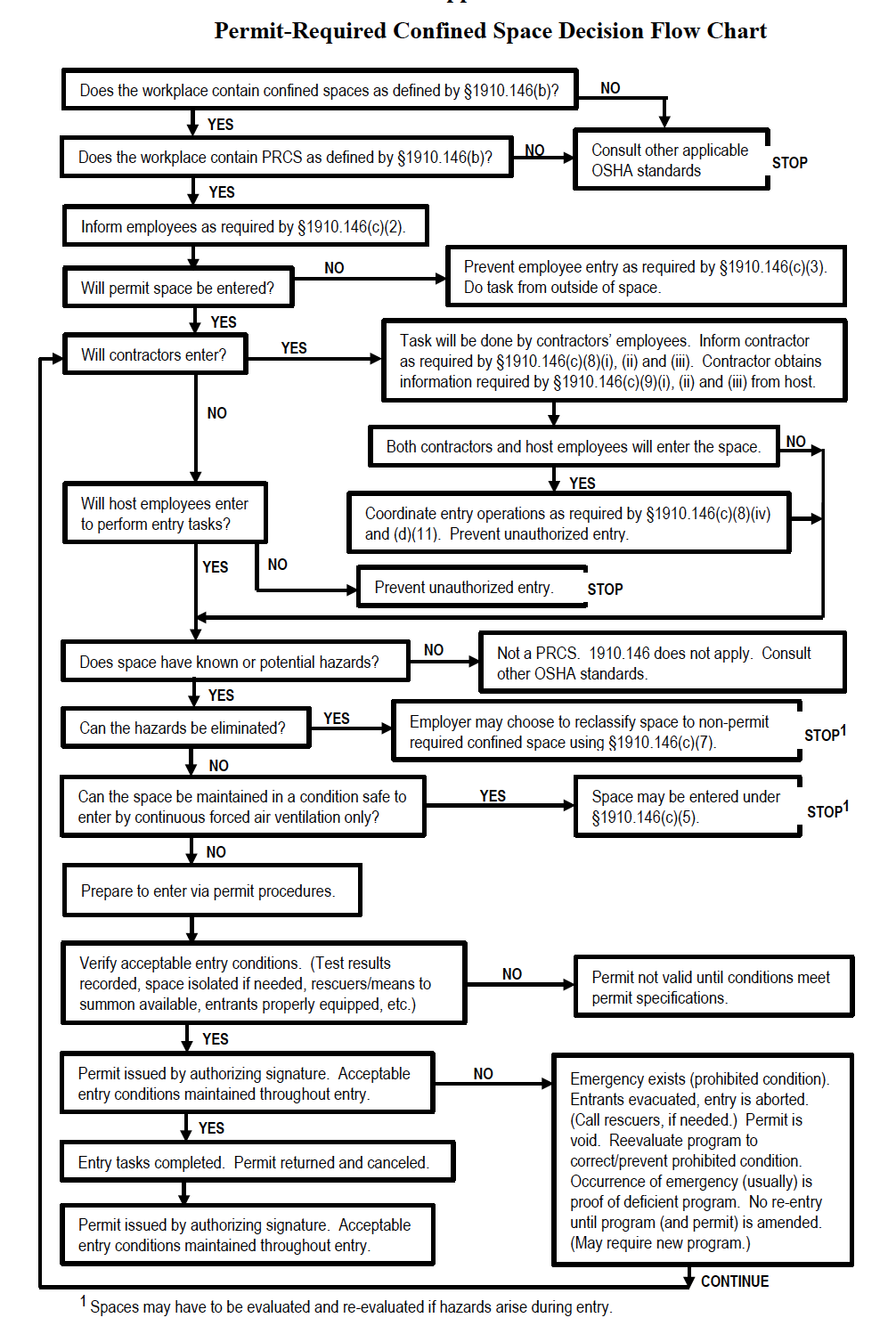
The company operates a truck‐tank washing facility. The tanks cleaned at the company’s facility are long metallic cylinders used to transport products such as ink and latex. After the tanks are emptied at their destination, truckers bring them to the company’s facility for a cleaning so that they can haul different products without adulteration. Before washing a tank, employees drain any residual product from it. They then insert a mechanical spinner that rotates scrubbers from one end of the tank to the other, simultaneously dousing it with soap or solvents (or both). They then give the tank a final rinse of water and blow it dry. Most of the time, this process suffices to clean the tank thoroughly. When it does not, however, employees enter the tank and manually clean out the remaining sludge or residue. Because the tank space is confined and may contain chemicals that are hazardous to health, OSHA has promulgated regulations that require companies to enforce certain safety precautions when their employees enter these “permit‐required confined spaces (PRCSs).” 29 C.F.R. § 1910.146.
At the company’s facility, employees enter tanks to clean them approximately ten times per month. Before doing so, the employee must obtain an entry permit from a supervisor; the permit contains a checklist of required safety precautions. The employee then climbs onto a catwalk above the tank and hooks a full‐body harness he is wearing to a mechanical retrieval device that can pull him out of the tank if he becomes incapacitated for any reason. He must also test the tank air for atmospheric hazards before going in. When he enters the tank, he is required to wear a respirator and to conduct continuous atmospheric testing. While an employee is in the tank, automatic blowers force fresh air into it. A fellow employee is required to be on standby outside the tank in order to assist in case of an emergency. OSHA regulations and the company’s safety rules prohibit employees from entering a “dirty” tank before it has been mechanically cleaned.
In the cold early morning hours of January 28, 2009, one of the company’s supervisors, XXXXXXX, was on the third shift along with former employee AAAAAAAA. XXXXXX was working on a trailer and encountered a problem with a clogged valve just as he was about to begin the mechanical cleaning process. Disregarding the safety rules, he entered the tank prior to cleaning it, without attaching himself to the retrieval device or following the entry permit procedures. After a short while, AAAAAAA looked inside, saw XXXXXXX unconscious in a pool of chemical sludge, and called the Summit Fire Department. The fire fighters hoisted him out, rinsed off the chemical residue, and transported him to the hospital. XXXXXXX was diagnosed with “Syncope and Collapse, Toxic Effect of Unspecified Gas, Fume, or Vapor” (i.e., fainting).
A local TV news crew broadcast the rescue that morning, and an OSHA inspector happened to see it before heading to work (i.e. this is what OSHA calls a “media referral”). She volunteered to inspect the company’s facility and did so, arriving at the station within three hours of the accident.
After her inspection, OSHA issued two citations to the company for serious and willful violations of the Occupational Safety and Health Act. Most of the items listed in the citations were for violations of the PRCS standards found at 29 C.F.R. § 1910.146. The company contested the citations, and the Secretary of Labor and the company settled some of the items. The rest were the subject of a hearing before an ALJ.
The ALJ vacated a number of the citation items, for the most part because she found that The company qualified for the less stringent “alternate en‐
try procedures” described in § 1910.146(c)(5). She also upheld the findings of several of the specific violations. Both parties appealed the ALJ’s decision to the Commission. This did not go well for The company; the Commission decided, contrary to the ALJ, that The company was not eligible for the alternate entry procedures, and so it reinstated those items in the citation. It affirmed the rest of the ALJ’s findings.
The company has filed a petition for review in this court.
The company attacks the Commission’s decision in several ways. First, it asserts that it lacked the requisite knowledge to support the order and that it should be exonerated because the incident resulted from “unpreventable employee misconduct.” It next argues that the Secretary did not prove the “willful” element of some of the items. Last, it contends that the Commission should have found that it satisfied the standard for alternate entry procedures.
We review the Commission’s conclusions in enforcement actions under the Administrative Procedure Act, 5 U.S.C. § 701 et seq. We defer to the Commission’s interpretations of law unless they are “arbitrary or capricious” or contrary to law. 5 U.S.C. § 706; Chao v. Gunite Corp., 442 F.3d 550, 556 (7th Cir. 2006). We uphold an agency’s determination “as long as [the agency] considered relevant data under the correct legal standards and offered a satisfactory explanation for its action.” Wisconsin v. E.P.A., 266 F.3d 741, 746 (7th Cir. 2001). An explanation is satisfactory if there is a rational connection between the facts the agency found and the decision it made.
Where, as here, the Commission reverses an ALJ, we confine our review to the Commission’s order. We must uphold the Commission’s factual findings if they are supported by substantial evidence on the record as a whole. Substantial evidence is “such relevant evidence as a reasonable mind might accept as adequate to support the conclusion’ reached by the agency.”
The Occupational Safety and Health Act is not a strict liability statute. This means that the Secretary was required to prove that The company knew about the problem in order to establish a “serious” violation. Under Commission precedent the Secretary can satisfy his burden without demonstrating any inadequacy or defect in the employer’s safety program, if a supervisory employee has actual or constructive knowledge of the violation. In that case, the supervisor’s knowledge can be imputed to the employer. Because XXXXXXX was a supervisor and had actual knowledge of his own misconduct, the Commission imputed his knowledge to The company.
This path for imputing knowledge is common in employment law. When an employee is acting within the scope of her employment, her knowledge is typically imputed to the employer. Conduct is “within the scope of employment when [it is] ‘actuated, at least in part, by a purpose to serve the [employer],’ even if it is forbidden by the employer.”
Here, XXXXXX knew that he was violating the rules when he entered the dirty tank in order to kick loose a stuck valve so that he could then drain the tank. His act was in furtherance of the company’s tank cleaning business. We thus see no problem with the Commission’s decision to impute XXXXXXX’s knowledge to the company.
The company urges that the Third Circuit requires more than this, and that it has the better view. It requires the Secretary to prove that a supervisor’s participation in misconduct was foreseeable by showing that the employer’s safety program was inadequate. In order to have an adequate safety program, that court says, the employer must have work rules designed to prevent the violation, adequately communicate those rules to its employees, take steps to discover violations, and effectively enforce the rules when it discovers violations.
This argument would have more force if the Commission had ignored the Third Circuit’s position. But it did not. At the time of its decision, it knew that the Third Circuit might hear this petition for review, because the company’s principal office is located in New Jersey. It therefore tested its conclusion under the standard of Pennsylvania Power & Light and found that the company’s safety program was indeed inadequate. That assessment finds sufficient support in the record.
There was evidence showing that nearly all of the tank entry permits at The company’s Summit facility contained errors or omissions. Some indicated that the entries had exceeded the maximum duration of 20 minutes by over an hour. Others had other flaws: for example, they lacked the requisite air monitoring results; they failed to show the duration for which the permit was valid; they indicated that employees had not reviewed material safety data sheets (or had no information about review); and they failed to name either the entrant or the entry attendant.
Whether these errors and omissions occurred because the employees were violating entry procedures or if they reflected only recording problems, there is no evidence that the Facility Manager followed up on the deficiencies. The Commission was therefore justified in concluding that there was a failure to enforce The company’s safety program.
The company argues that the particular problems the Commission mentioned would not have allowed it to predict Fox’s entry into a dirty tank. But this is asking for a higher degree of foreseeability than any court requires. The Commission was entitled to find that the uncorrected permit violations exhibited a pattern of disregard for the rules at The company. Even in the face of a robust written program, lax disregard of the rules can send a message to employees that a company does not make safety a priority. In such an environment, conduct such as Fox’s is reasonably foreseeable.
The company’s effort to persuade us that the Commission erred by rejecting the “unpreventable employee misconduct” defense also falls short. To use the defense an employer must show that it took steps to discover violations of its safety rules and that it effectively enforced the rules when violations were discovered. Here, the Commission agreed with the ALJ’s conclusion that The company failed to take these steps. It relied on the evidence of permit deficiencies and lack of disciplinary or follow‐up action. We have no reason to set aside this conclusion.
While serious violations of 29 C.F.R. § 1910.146 each carry a maximum penalty of $7,000, willful violations are subject to stiffer monetary penalties—up to $70,000 for each one. Though neither party disputes that XXXXXXXX’s behavior was willful, the company argues that it established a good faith defense that should have precluded the Commission from imputing Fox’s state of mind to the company. The company cites a Commission case holding that an employer can demonstrate that the willful conduct of its supervisory personnel should not be imputed to the employer if the employer can demonstrate a good faith effort to comply with the standard. See, e.g., Anderson Excavating & Wrecking Co., 17 BNA OSHC 1890 (No. 92‐3684, 1997), aff’d, 131 F.3d 1254 (8th Cir. 1997).
The company contends that it demonstrated this good faith effort in numerous ways:
(1) it had rules prohibiting exactly what XXXXXXXX did;
(2) The company employees did not usually violate the rules;
(3) the record contained instances of discipline and a lack of recidivism;
(4) The company’s wash process eliminated toxic atmospherics;
(5) The company had continuous testing and forced air ventilation in clean trailer tanks;
(6) The company’s written program had previously been examined by OSHA and found acceptable;
and
(7) The company had a good bilingual training program and no recordable injuries from tank injuries for years before the incident.
The Commission, however, was unpersuaded. It found that although, on the one hand, The company had work rules that were communicated to its employees and had submitted evidence of three instances of disciplinary action, on the other hand the facility manager had never disciplined an employee for improperly completing permits or for the violations apparent on the face of the permits. The Commission concluded that The company had therefore failed to take action when violations of safety rules were plain, as would have been required in a good faith effort.
In Stark Excavating, Inc. v. Perez, 811 F.3d 922, 928–29 (7th Cir. 2016), we considered a similar problem. Stark had argued that its efforts to comply with safety rules negated willfulness, where the company was cited for a foreman’s failure to construct a proper slope at an excavation site. The Commission nevertheless found that Stark failed to enforce rules and policies effectively when violations were discovered and thus could not establish a good faith defense on those grounds, and we upheld that result. The company attempts to distinguish Stark on the facts, urging that The company demonstrated good faith efforts to comply with the standard for confined spaces contained in 29 C.F.R. § 1910.146. But that loses sight of the fact that in Stark we focused on the employer’s failure to enforce its own safety rules and policies when it discovered violations, and that it was this broader lack of enforcement that demonstrated a lack of good faith. 811 F.3d at 929. Here, too, the Commission found evidence of a failure to follow up on documented violations of The company’s safety‐permit protocol, and it reasonably concluded that this defeated a finding of a good faith effort.
The company last argues that the Commission should have affirmed the ALJ’s finding that the Summit facility met the requirements for alternate entry.
According to 29 C.F.R. § 1910.146(c)(5), employees would have been eligible to use alternate entry procedures if The company had demonstrated that it met certain requirements. Chiefly, The company needed to demonstrate that potentially hazardous substances were not expected to approach the level at which they would create a hazardous atmosphere, and that continuous forced air ventilation alone was sufficient to keep the washed tanks safe for entry.
§ 1910.146(c)(5)(i)(A)–(B). The company also needed to develop monitoring and inspection data to support such a finding before any employee could use the alternate procedures. See § 1910.146(c)(5)(i)(C);
The Commission held that The company did not meet its burden because it could not identify relevant testing that established that the process removed all potential hazards or that analyzed the effectiveness of the forced air ventilation system.
The company’s 2009 expert report was of little value, it thought, because the report was finalized nearly six months after the incident. Worse, it did not contain testing data, nor did it specify what testing results supported the conclusion that the wash process rendered the tanks free of a potentially hazardous atmosphere. The company had also offered two reports from tests of other washing facilities in Alabama and Ohio in 1996 and 1999, but the Commission spotted relevant differences between the wash process in the 1996 report and the process used at the Summit facility. The results of the 1999 report did not show that the wash process removed the potential for a hazardous atmosphere; to the contrary, in some cases the data showed levels of hazardous vapors above the limits and levels of oxygen below the acceptable range. The Commission also found that the company’s pre‐entry testing did not compensate for the limitations of the wash process because the testing meter it used was incapable of testing for all potential atmospheric hazards.
The company offers no reason why we should upset the Commission’s determinations. The Commission considered and weighed the data in the reports and expert testimony and provided a reasonable explanation in support of its finding that the company had not met the alternate entry procedure standards in § 1910.146(c)(5).
Though the company vigorously attacks the credibility of the Secretary’s expert witness, we defer to an agency’s credibility determinations in all but extraordinary circumstances. This case does not meet that standard, and so we DENY The company’s petition for review.
CLICK HERE for the official decision document