
The day before Thanksgiving a driver was killed (may he RIP) when he entered the cargo hold of his box truck to”investigate a leak”. As can be seen in the video below, the delivery truck was an enclosed box truck, rather than the style of truck typically used to transport gas cylinders as shown below.
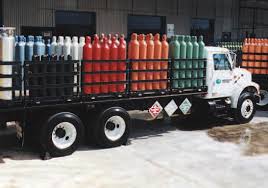
I am NOT sure of the arrangement in the back of this specific delivery truck, but it sounds as if it was dual purpose: 1) can offload liquid CO2 into a fixed liquid CO2 storage system and 2) deliver Dewars and/or Cylinders of CO2.
But witnesses stated this incident was most not likely caused by a leaking cylinder/container inside the truck but may have been a “drive-off” incident as witnesses reported seeing a hose whipping around the outside of the truck as the truck was pulling away. The driver stopped, opened the back of his truck and witnesses reported seeing the “smoke roll out” (e.g. the “smoke” was condensed water vapor which most calls a “cloud”). We are not sure why, but the door to the cargo area closed behind the driver as he entered. As the video shows us, the leak was significant and inside an unventilated cargo hold area of a box truck, the atmosphere could become dangerous quickly, especially with a HAMZAT such as CO2. One customer attempted to help the driver but was unable to enter the back of the truck. Some facts about CO2…
Just a short exposure to a 10% concentration of CO2 can be fatal. A 2% CO2 concentration in air can increase the breathing rate by 50 percent and a 3% concentration can increase it by 100 percent. As the breathing rate increases, so does the amount of CO2 being drawn into the person’s system with the eventual results being headache, nausea, dizziness, disorientation, unconsciousness, and death.
Bulk delivery of LIQUID CO2 has grown exponentially over the years, such that the International Fire Code (IFC) has a section on the use of CO2 for Beverages (SECTION 5307 CARBON DIOXIDE (CO2) SYSTEMS USED IN BEVERAGE DISPENSING APPLICATIONS)
This move to restaurants using bulk HAZMAT systems (e.g. Carbon Dioxide Liquid Systems vs gas cylinders) was a BAD IDEA and thankfully the code officials realized this after a number of fatalities and multiple injury incidents since 2010:
- June 2011, fast food restaurant in Phoenix, Arizona, was evacuated because of a leaking soda machine in the basement. A pregnant employee reportedly collapsed while exiting the basement and two firefighters were injured during the incident. The building was equipped with on-site CO2 monitors, but they failed to alarm (no maintenance program for the sensors/alarms) – See the Pheonix AZ FD Video
- June 2011, a fast-food restaurant in Yorkshire, England, developed a CO2 leak that necessitated the evacuation of the building. Firefighters wearing SCBA disconnected the cylinder and ventilated the occupancy. No injuries were reported.
- September 2010, a CO2 leak in a McDonald’s restaurant reportedly resulted in the death of a woman in a restroom. 10 additional victims were injured, including three firefighters.
- At a McDonald’s restaurant in Sanford, Florida, an 18-year-old employee reportedly died of asphyxiation while refilling CO2 tanks. The delivery driver also died trying to rescue the first victims.