
Many facilities have been struggling with their in-house labeling to meet OSHA’s Global Harmonized Standard (GHS) labeling. I have written on this topic too many times to mention since 2015, but one thing that I am finding and I can not explain is how compressed gas manufacturers have not revised their “shipped container” labels to comply with the new GHS requirements. For example, what do we see missing on this label… (look VERY close)
NOTE: I have marked out the manufacturer’s name and address as this is NOT about them but the entire industry sector.
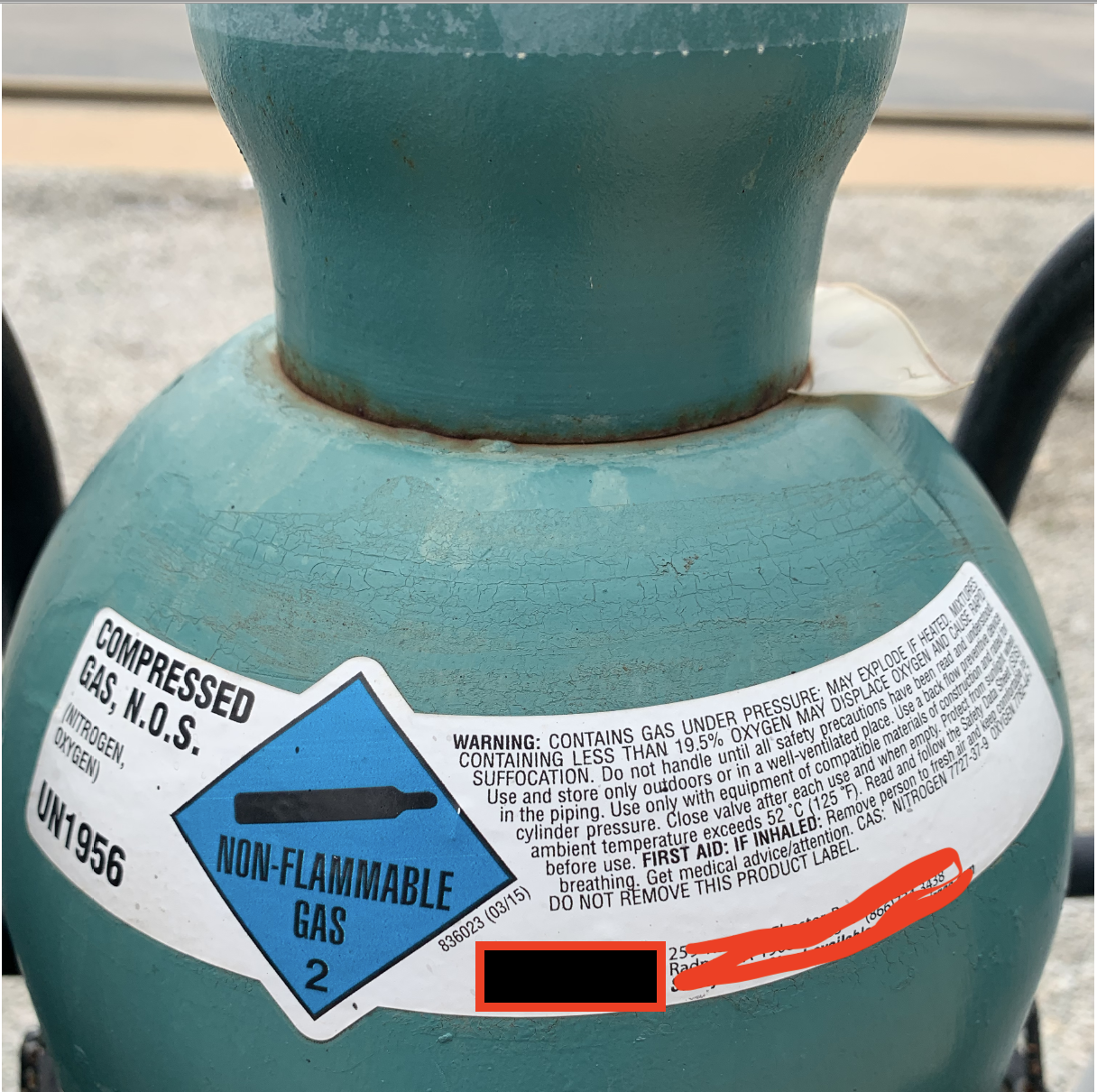
NOTE: this label is a tad faded, but that did NOT impact the deficiency I will point out.
Keep in mind this is a “shipped container” and OSHA requires “shipped containers” to meet some very specific labeling…
1910.1200(f)(1) Labels on shipped containers.
The chemical manufacturer, importer, or distributor shall ensure that each container of hazardous chemicals leaving the workplace is labeled, tagged, or marked. Hazards not otherwise classified do not have to be addressed on the container. Where the chemical manufacturer or importer is required to label, tag or mark the following information shall be provided:
1910.1200(f)(1)(i) Product identifier;
1910.1200(f)(1)(ii) Signal word;
1910.1200(f)(1)(iii) Hazard statement(s);
1910.1200(f)(1)(iv) Pictogram(s);
1910.1200(f)(1)(v) Precautionary statement(s); and,
1910.1200(f)(1)(vi) Name, address, and telephone number of the chemical manufacturer, importer, or other responsible party.
Still wondering why the label is not compliant with (f)(1)? For the answer, we turn to 1910.1200 Appendix C (MANDATORY)
APPENDIX C TO §1910.1200—ALLOCATION OF LABEL ELEMENTS (MANDATORY)
…
C.2.3 Pictograms
C.2.3.1 Pictograms shall be in the shape of a square set at a point and shall include a black hazard symbol on a white background with a red frame sufficiently wide to be clearly visible. A square red frame set at a point without a hazard symbol is not a pictogram and is not permitted on the label.
Now I told you-you had to look really close to find the failure… still wondering why the label pictured above.
A square RED frame set at a point without a hazard symbol is not a pictogram and is not permitted on the label.
In fact, OSHA cannot even allow modification of this requirement as the GHS is NOT OSHA’s standard; it is a GLOBALLY HARMONIZED STANDARD written by the United Nations. See the 2015 LOI from OSHA.
Question 1: Would OSHA allow the use of the pictogram to be printed on containers to match the single color currently screened?
Response: Unfortunately, we are unable to allow the accommodation you have requested. Appendix C.2.3.1 to 29 CFR 1910.1200, Allocation of Label Elements (Mandatory), specifically states that “pictograms shall be in the shape of a square set at a point and shall include a black hazard symbol on a white background with a RED frame sufficiently wide to be clearly visible.” This requirement applies equally to companies of all sizes to assure uniformity of label elements used on hazardous chemicals. Single-color pictograms are only allowed on safety data sheets and workplace (in-house) labelling. OSHA encourages you to look at all of your potential options when assessing your options in updating your labels such as tags, pull-out labels, or fold-back labels. Please note when tags are used, they must be affixed to the immediate container of the hazardous chemical in such a way that they do not become separated from the container.
The preamble of the 2012 Hazard Communication Federal Register (Volume 77, No. 58, March 26, 2012, pg. 17590) discusses the reasons for the red frame of the pictogram. The use of a red border pictogram on labels is effective in communicating hazards to employees in a non-verbal means. Studies showed that the color RED will make warnings more noticeable, because RED borders are generally perceived to reflect the greatest degree of hazard. A warning label with a notable color will more likely grab the attention of the user faster and produce quicker reaction time. Allowing ONLY A RED BORDER creates a degree of consistency in warnings to all labels that will ensure workers are protected.
During the development of the HCS 2012, OSHA was required to determine if this standard was economically feasible. This is explained in Section VI of the preamble of the 2012 Hazard Communication Federal Register (Volume 77, No. 58, March 26, 2012, pgs. 17605-17683). The Regulatory Flexibility Act, as amended by the Small Business Regulatory Fairness Act (SBREFA), required OSHA to determine if the regulation had a significant impact on a substantial number of small entities. The preamble explains how it determined the significant impact on small entities as a whole and the benefits of a uniform labeling system.
Another source of info, although it is not part of the standard… CLICK HERE
Pictograms are graphic symbols used to communicate specific information about the hazards of a chemical. On hazardous chemicals being shipped or transported from a manufacturer, importer or distributor, the required pictograms consist of a RED SQUARE FRAME set at a point with a black hazard symbol on a white background, sufficiently wide to be clearly visible. A SQUARE RED FRAME set at a point without a hazard symbol is not a pictogram and is not permitted on the label. The pictograms OSHA has adopted improve worker safety and health, conform with the GHS, and are used worldwide.