
This past week we got a “Factual Update” from the CSB on the Storage Tank Fire at Intercontinental Terminals Company (ITC) Terminal. After reading this update I was puzzled as to why the facts as we know them to date did not drive OSHA to open a NEP PSM inspection of the facility. Granted their tanks are atmospheric storage tanks and thus exempted under 1910.119(a)(1)(ii)(B); however, the Factual Update stated…
Tank 80-8 was an 80,000-barrel aboveground atmospheric storage tank… Tank 80-8 was leased to another company for naphtha storage and for naphtha-butane blending operations. ITC injects butane into the naphtha product using external piping and equipment (piping manifold) (Figure 3) to increase the octane level of the fuel product.
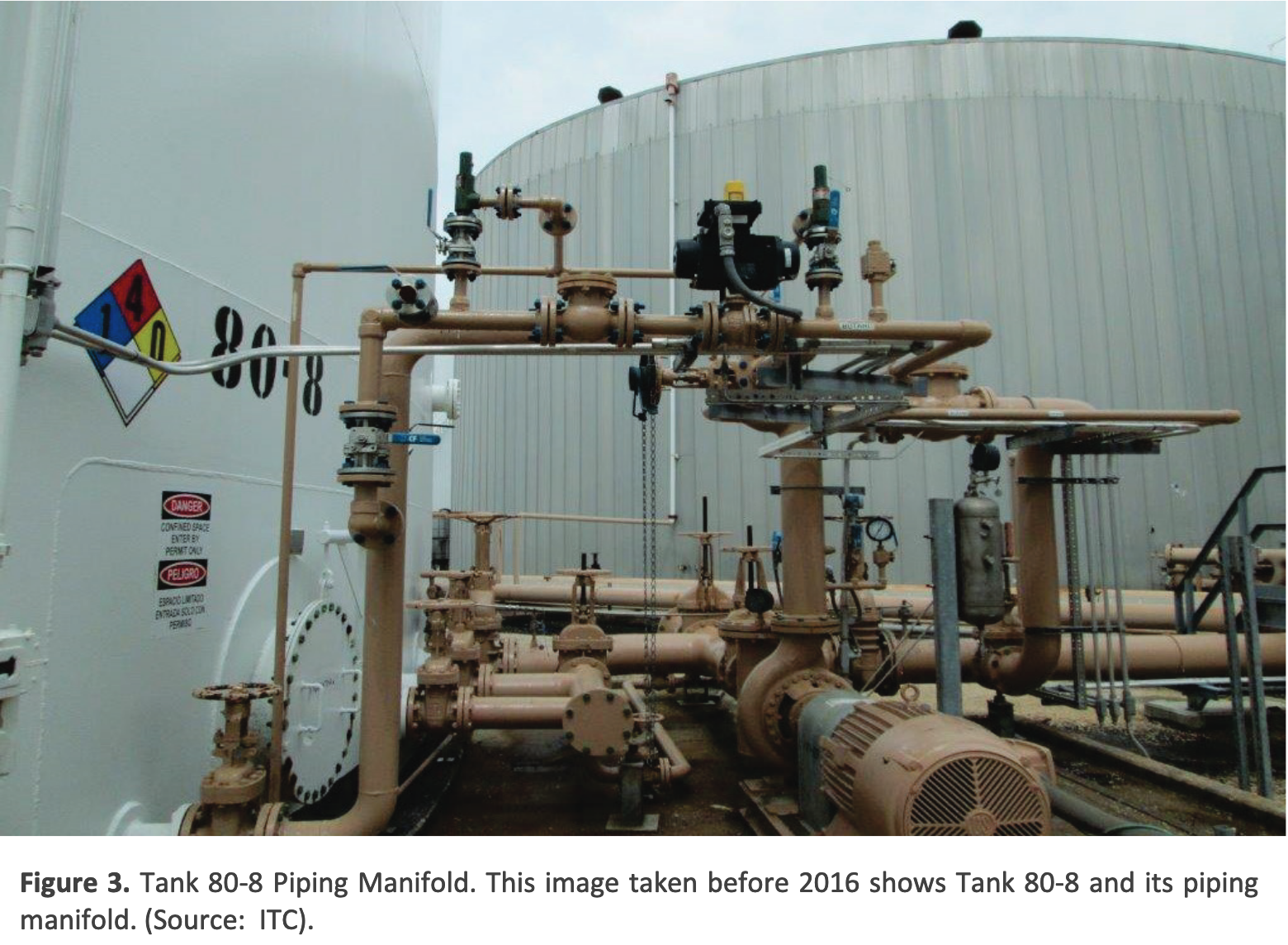
Butane is incorporated into Tank 80-8 via truck deliveries by way of a fixed butane injection system. The butane injection system originates at the truck loading rack, located south-west of the tank farm, and terminates at an injection point in the circulation line (piping manifold) at Tank 80-8. The control system is designed so that the butane injection operation cannot be started unless the Tank 80-8 pump is turned on to ensure that product is circulating. When this condition is met, an ITC operator can open an actuator valve by pressing the ON button at the truck loading rack to allow the butane unloading to begin. The butane is unloaded from the cargo tank truck, travels through 4-inch piping, which reduces to 2-inch piping, to the product circulation line where it combines with the existing naphtha product. The pump stays on throughout the unloading activity and for several hours afterward in order facilitate the mixing of naphtha and butane.
When I read this I immediately thought back to OSHA’s LOIs where they discuss the 1910.119(a)(1)(ii)(B) and how it applies to STORAGE ONLY in atmospheric tanks. To me, the process described at ITC is an actual process that involves injecting/mixing a CAT 1 Flammable Gas (Butane) into a CAT 2 Flammable Liquid (Naptha) and thus this “process” would indeed be a PSM covered process. After a few phone calls and e-mails I was directed to a 1995 OSHA LOI that addressed this specific type of set-up/process. OSHA determined that this set-up/process was NOT a PSM covered process…
NOTE: I do not agree with this interpretation and it should be held up as an example of “OSHA Minimums” and this incident should be a lesson in how trying to disect OSHA standards (the bare minimums) is not a good business practice!
Scenario: Terminal operators store gasoline in atmospheric tanks. Subsequently, this gasoline is sold over the rack to companies which sell at service stations to the general public. During the year, gasoline is shipped to the terminals by pipeline, barge, truck or rail tank car at a lower reid vapor pressure than the maximum allowed by the state or the Environmental Protection Agency (EPA), for the geographical location of the terminal. The terminal personnel test the Reid vapor pressure of the gasoline by using an instrument approved by the EPA. If the Reid vapor pressure of the gasoline is lower then the maximum allowed at the time, the terminal operator will order normal, that is, liquefied, butane delivered by CTMV(s) [Cargo Tank Motor Vehicle] to raise the Reid vapor pressure of the gasoline stored in the atmospheric tanks. The normal butane is delivered to the terminal in a Department of Transportation (DOT) approved CTMV. Typically, the gasoline is pumped from an atmospheric storage tank through a pipeline where the liquefied butane is mixed with the gasoline and returned to the atmospheric storage tank. When unloaded and disconnected, the CTMV leaves the terminal operator’s property. The gasoline is then retested to assure that the Reid vapor pressure is not higher than EPA regulations allow. Effective January 1, 1995, terminal operators who wish to continue normal butane blending at their terminals are required by EPA, pursuant to the Clean Air Act, to register as a refinery.
Reply: Unless additional, unaddressed circumstances require coverage, mixing of CTMV delivered butane with gasoline stored in atmospheric tanks as described in the scenario above is considered a process excepted by paragraph 1910.119(a)(1)(ii)(B) from coverage by the PSM Standard. This interpretation is based on the following factors.
1. Butane liquefied gas is delivered in compliance with DOT regulations; namely, 49 CFR Subchapter C – Hazardous Material Regulations and Particularly, Part 177 – Carriage by Public Highway.
2. In addition to the DOT regulated flammable liquefied gas, delivery activity, the process only involves atmospheric tanks storage and associated transfer.
CLICK HERE for the LOI