Too many safety professionals still to this day think that to reclassify a Permit-Required Confined Space (PRCS) is simply to lock out all the energy sources that made the space a PRCS. In August of last year, I posted a story where I asked the 30,000 members of the SAFTENG network if an enclosed palletizer was a PRCS. (see pic below for example) Overwhelmingly the members agreed that the space was a Confined Space, but the numbers dropped sharply in those who thought the space was a PRCS. But what was more concerning was the numbers of members who thought that locking out the palletizer “reclassified” the space from a PRCS to a Non-PRCS. Last week I got the call that made my point… there is a LOT MORE to reclassification than simple LOTO…

Three workers were inside a piece of equipment that was fully enclosed with plexiglass sides that extended from a few inches below the working surface to about 4′ high. The equipment sat down inside a special cutout which meant it sat about 8″ below the normal floor around the machine. The three contract workers, who were employees of the machine/equipment maker, had locked out the machine/equipment and entered through an opening about 3′ X 3′. The opening is made specifically for entry into this area of the machine for maintenance and servicing. As part of this job, the workers had been asked to remove interior paint and repaint the interior. The equipment had suffered from internal damage from a smoldering fire and extreme heat which made the interior paint peel and fall onto the finished product causing a couple of customer complaints.
To remove the damaged/peeling paint the workers used industrial paint stripper for approximately 4 hours and exited the space at least 6 times over this period for smoke and restroom breaks. But at some point, two workers went back into space while the supervisor ran an errand off-site. He was gone for 1 hour and 22 minutes; add another 15 minutes for him to arrive at the space where he found his two workers unconscious. 911 was called and the FD was not trained or equipped for PRCS rescue; however, one of the officers on the scene was a very practical thinker and he had all the sides removed either with tools or a sledgehammer. They then used their ventilation equipment to force fresh air into the depressed area of the space where the workers were lying.
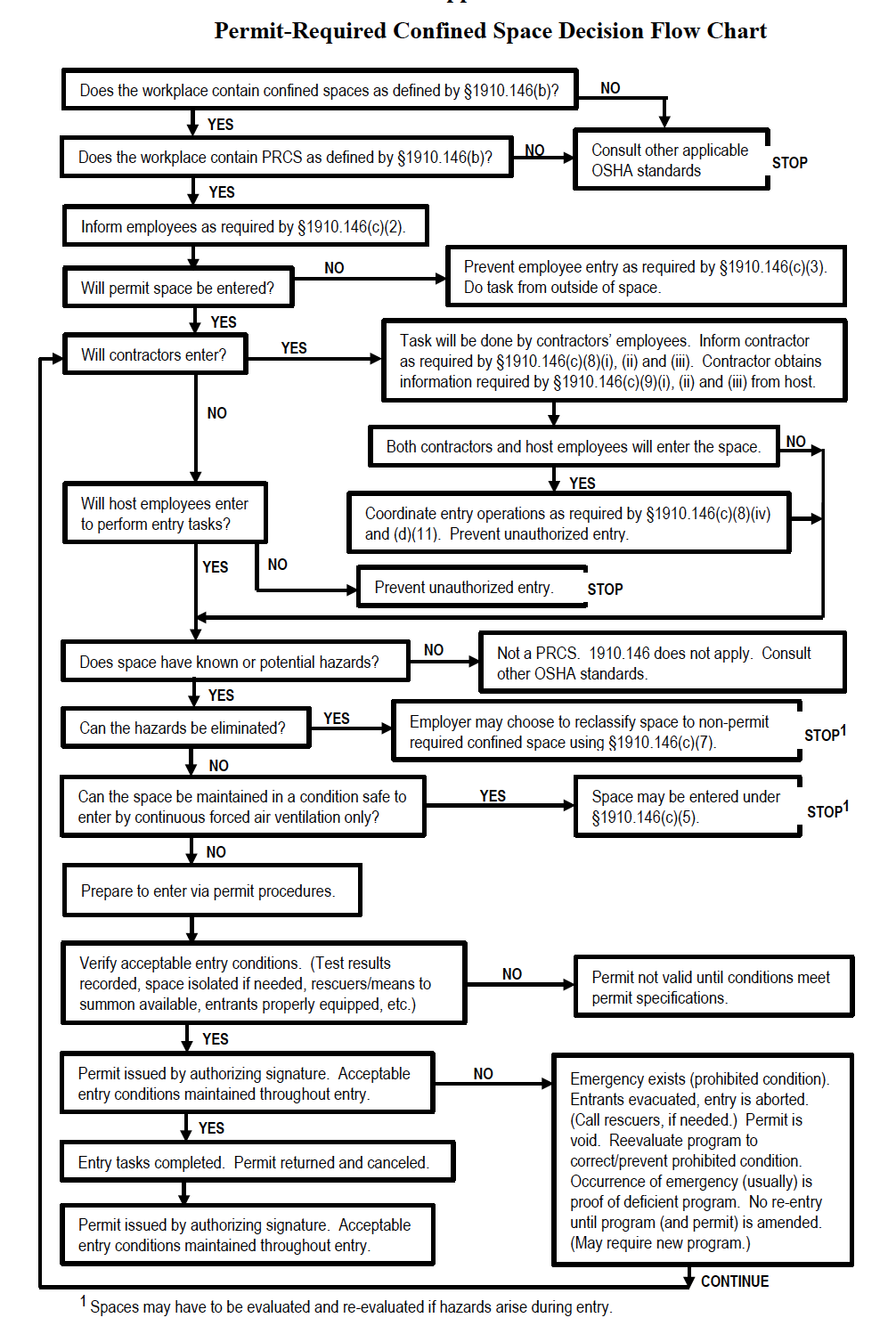
This piece of equipment had been evaluated and correctly determined to be a PRCS. This space had been entered for years with no incidents and each reclassification was done with only LOTO in place. But this is a perfect example of how reclassification is more than simple LOTO. Both OSHA standards allow for a PRCS to be reclassified to a Non-PRCS status but there is one (1) BIG catch to doing this… a HAZARDOUS ATMOSPHERE!
(emphasis by me)
1910.146(c)(7)(i) If the permit space poses no actual or potential atmospheric hazards and if all hazards within the space are eliminated without entry into the space, the permit space may be reclassified as a non-permit confined space for as long as the non-atmospheric hazards remain eliminated.
In many PRCS’s the hazardous atmosphere is inherent to the space because of what the space is used for, but there are a lot of spaces that may not even be a PRCS (e.g. just a confined space) and it is the work that takes place inside the space that creates the hazardous atmosphere. And this is why 1910.146(c)(7) and 1926.1203(g) both use the phrase “poses no actual or potential atmospheric hazards”. LOTO does NOT control or prevent the atmospheric hazards brought into the space by the workers.
We MUST control the work taking place inside the space, so when the worker(s) ask to use a chemical that poses even a “potential” to create a HAZ ATM we have to know and evaluate this request.