I have written over a dozen articles on the big change in automobile manufacturing and their new refrigerant HFO-1234yf which is going into almost all vehicles made today. Today HFO-1234yf is a Category 1 Flammable gas, hence it is a Highly Hazardous Chemical (HHC) and when the process exceeds 10,000 pounds of this refrigerant the process is a PSM Covered Process. That is today and in December 2019 the United Nations met to discuss the latest and greatest revision to the…
GLOBALLY HARMONIZED SYSTEM OF CLASSIFICATION AND LABELLING OF CHEMICALS (GHS).
In this Seventh Edition, we see some significant changes to how Flammable Gases are categorized. In the 2003 Edition, the edition OSHA adopted in 2012, we had only two (2) Categories of Flammable Gases:
| Category | Criteria |
|
1 |
Gases, which at 68°F and a standard pressure of 14.7 psia: (a) are ignitable when in a mixture of 13% or less by volume in the air; OR (b) have a flammable range with the air of at least 12 percentage points regardless of the lower flammable limit. |
| 2 | Gases, other than those of Category 1, which, at 68°F and a standard pressure of 14.7 psia, have a flammable range while mixed in air. |
As I have pointed out, HFO-1234yf is (as of today) a Category 1 Flammable Gas. And as I have stated in some articles, Anhydrous Ammonia (as of today) is a Category 2 Flammable gas. But we also know that OSHA is scheduled to propose a rule this month (January 2020) to update Hazardous Communications Standard with the latest edition of the GHS.
Those who have followed my HFO articles know that there has been a push to get HFO into a different category so as to lower the “regulatory burdens”, with the specific desire to get it out of the PSM arena. There are a lot of folks who have a lot of money riding on this and there are a lot of folks in the environmental movement who want to see refrigerants like HFO more widely used because of its very low Global Warming number. As we saw how ASHRAE revised their Refrigerant Classification by adding the “2L” class of refrigerant which made HFO-1234yf a “mildly flammable” refrigerant.
| A: Lower Toxicity | B: Higher Toxicity* | |
| 1: Non-Flammable | A1 (R-134a, carbon tetrafluoride) | B1 (R-123) |
| 2L: Mildly Flammable | A2L (HFO-1234yf) | B2L (Ammonia) |
| 2: Lower Flammability | A2 (methylene fluoride) | B2 (methylene chloride) |
| 3: Higher Flammability | A3 (Propane, Butane) | B3 (none) |
| A2L and B2L lower flammable refrigerants with a maximum burning velocity of LESS THAN 10 cm/sec | ||
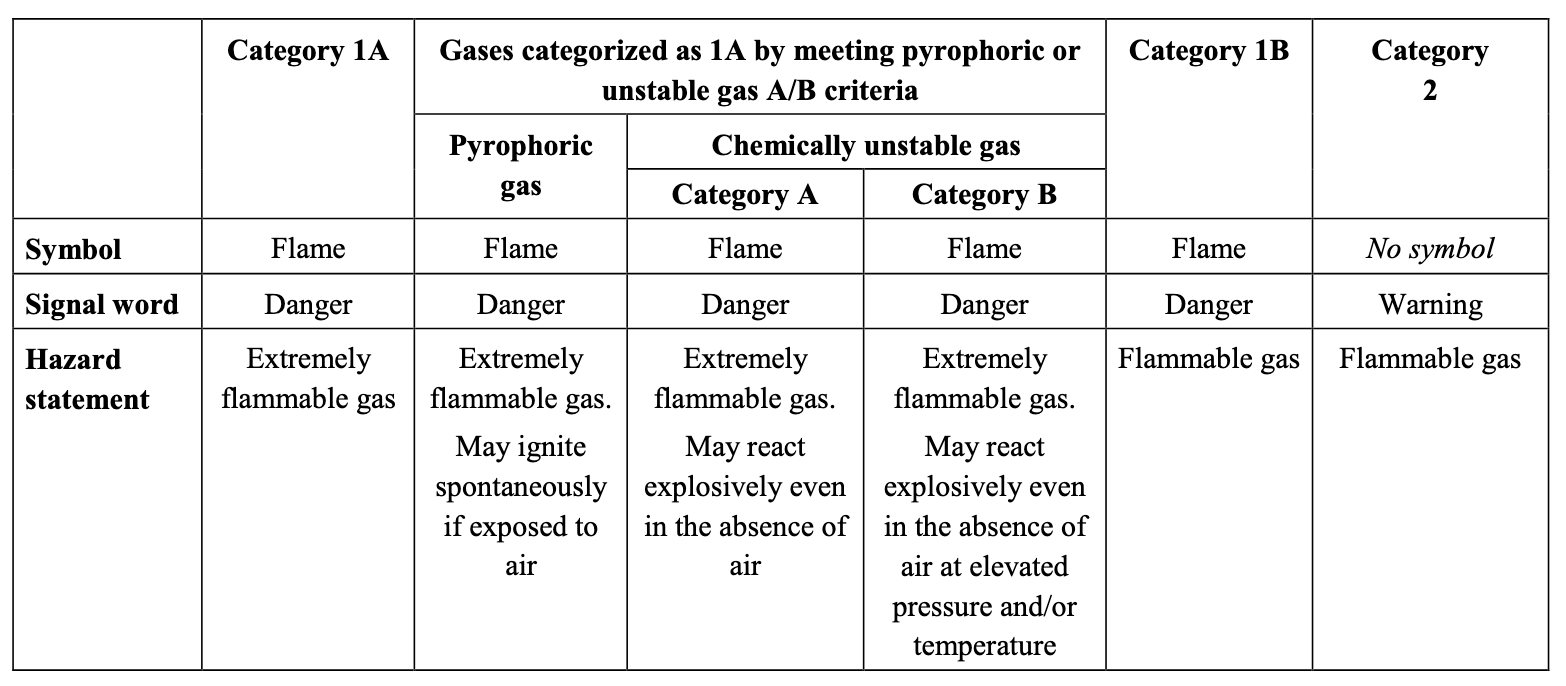
In the Seventh Edition of the GHS (2017) we are seeing the UN doing the same thing with Flammable Gases. The standard still has only two (2) categories of flammable gas; however, we see that Category 1 now has two (2) subcategories: 1A and 1B
Category 1A is the same as today’s Category 1; 1B is where we see the language from ASHRAE 34 being used. Category 2 is the same as it is today. So what characteristics does a Category 1B Flammable Gas have?
This new category is basically adding the ASHRAE 34 “mildly flammable” category and uses Lower Explosive Limits (LEL) and a burn rate of of less than 10 cm/s to categorize the flammable gas. The new Flammable Gas Categories look like this:
|
Category |
Criteria |
||
|
1A |
Flammable Gas |
Gases, which at 68 °F and a standard pressure of 14.7 psi: (a) are ignitable when in a mixture of 13% or less by volume in air; OR (b) have a flammable range with air of at least 12 percentage points regardless of the lower flammability limit unless data show they meet the criteria for Category 1B |
|
|
Pyrophoric Gas |
Flammable gases that ignite spontaneously in air at a temperature of 129 ºF or below |
||
|
Chemical Unstable Gas |
A |
Flammable gases which are chemically unstable at 68°F and a standard pressure of 14.7 psi |
|
|
B |
Flammable gases which are chemically unstable at a temperature greater than 68°F and/or a pressure greater than 14.7 psi |
||
|
1B |
Flammable Gas |
Gases which meet the flammability criteria for Category 1A, but which are not pyrophoric, nor chemically unstable, and which have at least either: (a) a lower flammability limit of more than 6% by volume in air; OR (b) a fundamental burning velocity of less than 10 cm/s; |
|
|
2 |
Flammable Gas |
Gases, other than those of Category 1A or 1B, which, at 68°F and a standard pressure of 14.7 psi, have a flammable range while mixed in air |
|
|
NOTE 1: Ammonia and methyl bromide may be regarded as special cases for some regulatory purposes. NOTE 2: Aerosols should not be classified as flammable gases. See Chapter 2.3. NOTE 3: In the absence of data allowing classification into Category 1B, a flammable gas that meets the criteria for Category 1A is classified per default in Category 1A. NOTE 4: Spontaneous ignition for pyrophoric gases is not always immediate, and there may be a delay. NOTE 5: In the absence of data on its pyrophoricity, a flammable gas mixture should be classified as a pyrophoric gas if it contains more than 1% (by volume) of pyrophoric component(s) |
|||
As we have discussed, HFO-1234yf is an A2L Refrigerant which means:
- it has a burn rate LESS THAN 10 cm/sec,
AND
- it has an LEL of 6.2% (10/2019 SDS)
making it a Category 1B Flammable Gas in the REVISED GHS categories. Now I am not much of a conspiracy theorist, but this revision to the GHS standard seems based on “needs” rather than safety science. Never have we taken into consideration the burn rate of a gas – how many of you can run fast enough to stay ahead of a frame front traveling 2 cm/sec? Or 9 cm/sec? By the way, 10 cm/sec is 0.328084 ft/sec – anyone want to race an A2L flash fire?
We do not yet know what OSHA will end up doing with 1910.1200 App B – Physical Criteria (Mandatory), but I have a very good idea as to what is likely to happen based on the “regulatory environment” we are in right now. We have a presidential election in November and sadly that will be about the time OSHA will be done with their proposed revisions. My prediction: Trump wins in 2020, as painful as it is to him to allow OSHA to update the HAZCOM standard, he will allow it to be revised due to pressure from the business community and environmental groups to adopt the new Categories for these flammable refrigerants.
But we still do not know if OSHA will adopt this new Flammable Gas categories, but if they do AND they revise the PSM standard to state only Category 1A flammable gases are an HHC and NOT Category 1B then with the stroke of a pen HFO-1234yf would no longer be a PSM covered chemical. So much for science or risk – Business is #1, Trees are #2, and the worker comes in around #3.
And the most disappointing matter… the safety profession will have officially adopted the phrase “mildly flammable” as it would be a codified term!