
On March 25, 2008, the State of New Jersey adopted rules requiring facilities regulated under the Toxic Catastrophe Prevention Act (TCPA) Program, which is PSM/RMP to those of us outside of the state of New Jersey, to perform Inherently Safer Technology (IST) reviews. Both OSHA and Federal EPA have tried to incorporate the IST model into their PSM and RMP standards with no luck. In the process safety arena, we can find those who believe IST is the heart and soul of process safety and we can find those that believe it is a waste of time and is government overreach. I will let you come to your own conclusions after I explain what an IST Review is.
As a note of reference, be sure to read “Inherently Safer Chemical Processes: A Life Cycle Approach,” 2ndEdition, 2008, Center for Chemical Process Safety(CCPS) if this post intrigues you.
The best, and quite possibly the only USA regulation on IST reviews is New Jersey’s Toxic Catastrophe Prevention Act (TCPA) Program. In this New Jersey rule, facilities must perform an IST Review when they do their Process Hazard(s) Analysis. Conducting theIST Review concurrently with the PHA/RA is more time-efficient, results in a more thorough review, and the same team can perform both studies. However, it may be necessary to supplement the PHA/RAteam with members meeting the IST experience requirements. Each inherently safer technology review must be conducted by a team of qualified personnel whose members must have expertise in environmental health and safety, chemistry, design and engineering, process controls and instrumentation, maintenance, production and operations, and chemical process safety. It is highly recommended that operations and maintenance personnel be included in the IST review process.
Each inherently safer technology review MUST identify ALL commercially available inherently safer technology alternatives or combinations of alternatives that minimize or eliminate the potential for a Loss of Primary Containment (LOPC) event. Using any available inherently safer technology analysis method, this review must include, at a minimum, an analysis of the following principles and techniques:
- Reducing the amount of EHS material that potentially may be released;
- Substituting with less hazardous materials;
- Using Extremely Hazardous Substance(s) in the least hazardous process conditions or form; and
- Designing equipment and processes to minimize the potential for equipment
There are two methods which are commonly used:
- Incorporating an analysis of the four principles listed above into the PHA. This is a much more detailed analysis and is preferred to the checklist method. It is strongly recommended that an integrated PHA/IST study approach be used. When the team identifies a hazard in the PHA, it applies principles to evaluate and address the hazard. The following examples of this method are available:
- See slides 65 -68 in IST Concepts and Methodologies posted on the TCPA website at http://www.nj.gov/dep/enforcement/tcpa/tcpadown.htm
- See Method 3 on pages 12-15 in IST Sample Worksheets also on the TCPA website.
- Chapter11of “InherentlySafer Chemical Processes: A Life-Cycle Approach,” 2nd Edition, 2008, has worked examples and case studies of IST principles and concepts.
- A checklist method. The Center for Chemical Process Safety (CCPS) has prepared a checklist in Appendix A in “Inherently Safer Chemical Processes: A Life Cycle Approach.” Some facilities have used similar variations of this checklist. For a new facility, the checklist approach could be used for a more global evaluation of the process. During the design phase of a new facility or process, it is easier to implement substitution.
In the state of NJ, after the first year of being required to conduct IST reviews, the state said:
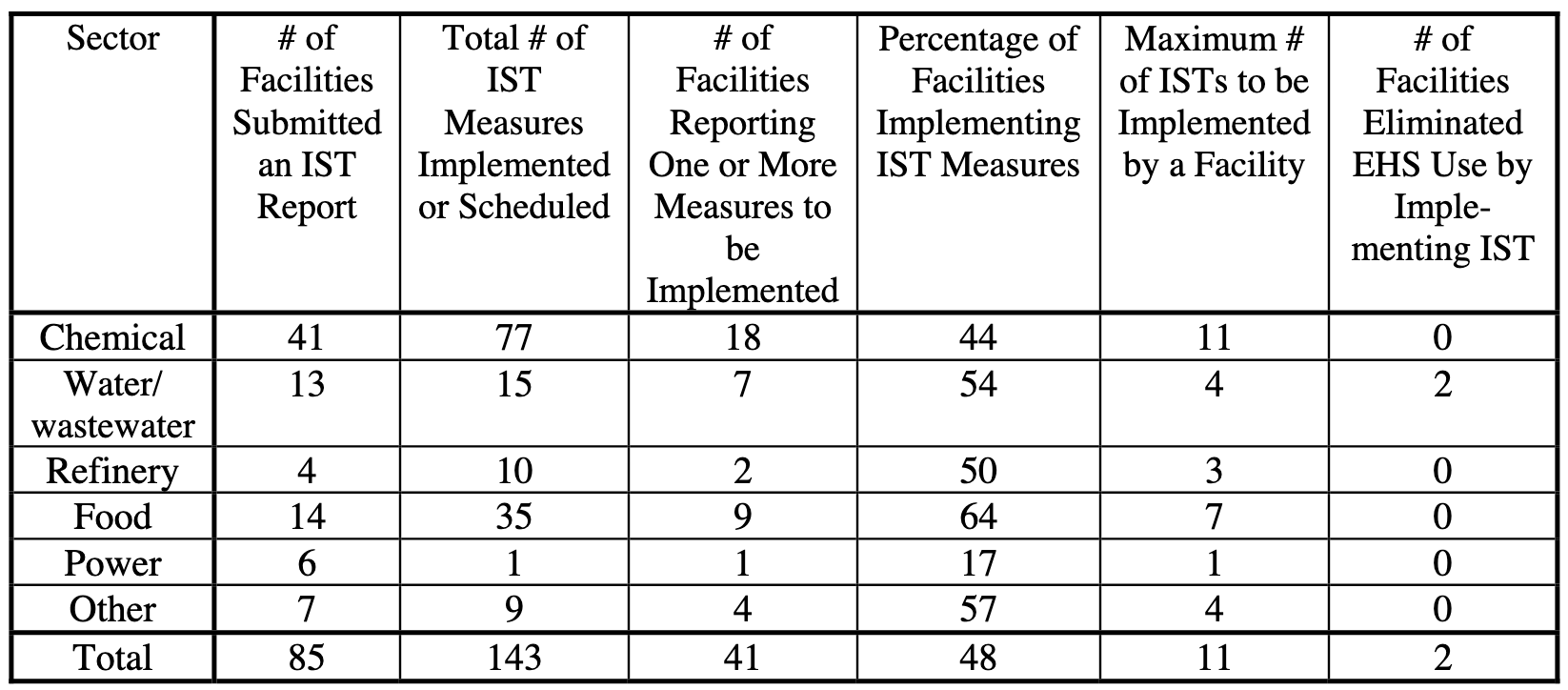
- From the 85 facility reports, a total of 143 additional IST measures were reported to have been implemented or scheduled to be implemented.
- Forty-one facilities implemented or scheduled to implement from one to eleven additional IST measures.
Table 1 below provides a summary of IST implementation for the following sectors: chemical, food (ammonia refrigeration), power generation, petroleum refinery, water/wastewater, and other.
Chemical Sector Facilities
Forty-one of the 85 reports reviewed by the Department were from chemical facilities subject to the Best Practices Standards. Eighteen facilities implemented or scheduled to implement from one to eleven additional IST measures. A total of 77 additional IST measures were reported to be implemented or scheduled to be implemented. Facilities reported some significant IST measures resulting from the IST review. One facility has replaced bulk storage of acetylene with onsite generation. Another facility is planning to greatly reduce its chlorine inventory with an onsite generation process. Other significant examples of IST measures reported to be implemented include the redesign of a relief system, changes in equipment and vessel configuration, safer EHS storage location, the addition of remotely activated valves and automatic shutdown systems with interlocks, protection of storage vessels from weather conditions, changes to truck traffic patterns, improved types and materials of construction of piping, installation of power backup systems for controls and equipment, improved computer control systems, the addition of EHS leak detectors, and a closed-circuit television system.
Several of the chemical sector facilities that had no additional IST recommendations had already implemented IST measures in the past that were identified in process hazard analysis and risk assessment studies. Also, many of these chemical manufacturing facilities run processes in which there is no feasible alternative for the EHS and inventories have already been minimized.
Water/Wastewater Treatment Facilities
Thirteen water/wastewater facilities submitted IST reports. Seven facilities implemented or scheduled from one to four additional IST measures. A total of 15 additional IST measures were reported to be implemented or scheduled to be implemented. Two facilities replaced chlorine with sodium hypochlorite. One facility plans to replace anhydrous ammonia with aqueous ammonia as one of its treatment chemicals. Other IST measures reported include the elimination of 150-pound cylinder usage, a scrubber for the chlorine storage room, upgrading the control system, equipment redesign, and reconfiguration, and adding remote shutoff through the computer control system.
Some of the water/wastewater facilities utilize ozone for treatment, which is considered an IST since ozone is generated onsite and continuously consumed. The facilities that are registered for chlorine have implemented past IST measures such as indoor storage, leak detectors, remote and automatic shutdown, scrubbers, and mitigation systems such as water fogs/sprays; these facilities have identified alternatives to replace chlorine but have not reported plans to implement a replacement.
Petroleum Refineries
Four petroleum refineries submitted IST reports. Two of the refinery facilities implemented or scheduled to implement additional IST measures as a result of the IST review. A total of six additional IST measures were reported to have been implemented or scheduled to be implemented. Examples of the IST measures reported to be implemented include the labeling of valves and equipment and revising procedures. The four refineries reported that many IST measures were identified in past process hazard analysis and risk assessment studies and had already been implemented. One New Jersey refinery that uses hydrogen fluoride (HF) in the alkylation unit reported that it would investigate the use of a solid catalyst and identified substituting HF with sulfuric acid or modified HF as possible alternatives, but stated that implementing these substitutes was too costly to implement. Refineries in California and other states have chosen to utilize a modified HF alkylation process, which incorporates a suppressant in the HF that reduces the HF volatility and amount of an airborne release. This significantly reduces the number of people that would be impacted by an accidental release. Using a sulfuric acid process or a solid catalyst would completely eliminate the risk of an HF release.
Ammonia Refrigeration at Food Manufacturing and Handling Facilities
Fourteen food ammonia refrigeration facilities submitted IST reports. Nine facilities implemented or scheduled to implement from two to seven additional IST measures. A total of 35 additional IST measures were reported to be implemented or scheduled to be implemented. Examples of significant IST measures reported for implementation include adding leak detectors to shut down equipment, updating computer controls, replacing mechanical controls with microprocessors, installing interlocks, converting single safety valves to dual valve systems, removing unnecessary piping and equipment, installing seal-less pumps, upgrading the material of construction of equipment, adding safety instrumentation, installing fail-safe instrumentation, indoor containment of storage vessels, and redundant critical equipment.
Several facilities reported they would not replace ammonia with another refrigerant such as hydrochlorofluorocarbons and hydrofluorocarbons due to environmental concerns such as contribution to the greenhouse effect and ozone depletion potential of these chemicals.
Several facilities identified carbon dioxide systems or carbon dioxide/ammonia cascade systems as potential replacements for the existing system but stated that they would not implement due to the substantial cost to completely replace the entire refrigeration system.
Power Generation Facilities
Six power generation facilities, five of which use aqueous ammonia and one which uses anhydrous ammonia to reduce nitrogen oxides emissions in a selective catalytic reduction process, submitted IST reports. Only one of these facilities reported one additional IST measure scheduled to be implemented, which is to install an emergency stop and interlocked shutdown of the unloading pump. The facilities stated that additional IST measures were not necessary because of the measures already in place which resulted in no or minimal offsite impact of a release. Some IST measures reported already in use include storage tank spill containment, leak detection, deluge systems, and automatic shutdown systems.