The word “potential” is defined by Merriam-Webster as:
existing in possibility : capable of development into actuality
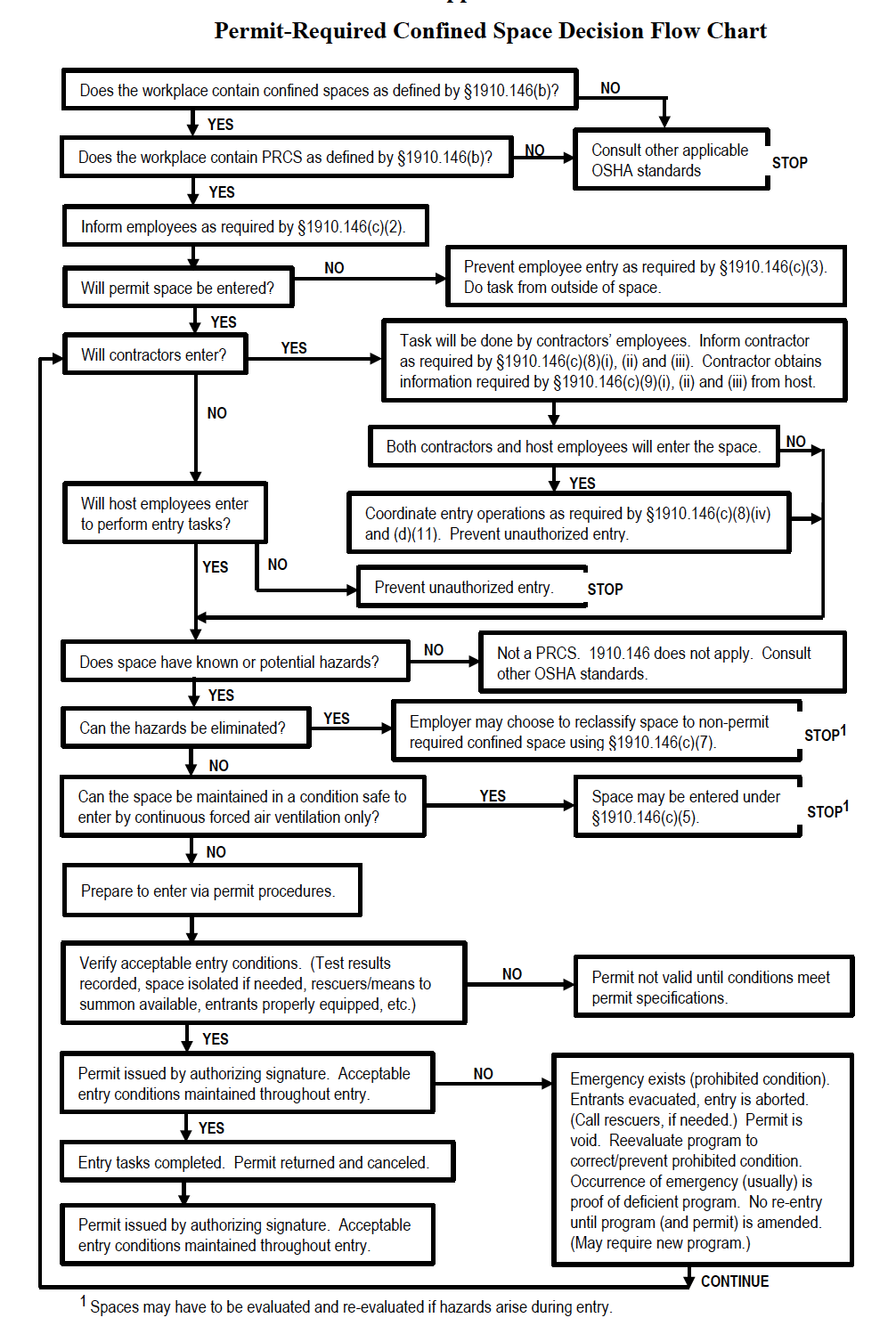
In OSHA’s PRCS standards (both 1910 and 1926 versions) it uses the word “potential” when talking about atmospheric hazards; especially when we are talking about RECLASSIFYING a PRCS to a NON-PRCS using 1910.146(c)(7) or 1926.1203(g)
1926.1203(g)(1) If the permit space poses no actual or potential atmospheric hazards and if all hazards within the space are eliminated or isolated without entry into the space (unless the employer can demonstrate that doing so without entry is infeasible), the permit space may be reclassified as a non-permit confined space for as long as the non-atmospheric hazards remain eliminated or isolated;
or
1910.146(c)(7)(i) If the permit space poses no actual or potential atmospheric hazards and if all hazards within the space are eliminated without entry into the space, the permit space may be reclassified as a non-permit confined space for as long as the non-atmospheric hazards remain eliminated.
So the question is… when do we say there is NO LONGER a “potential” for a hazardous atmosphere inside the space?
In my practices, it was VERY CLEAR when we had eliminated the “potential” but in today’s safety, there are some who want to redefine “potential” in the scope of when a PRCS can be reclassified. Take for example one of the battles I fight with my ammonia refrigeration clients and their evaporative condensers. These are without a doubt a PRCS, albeit one that can be reclassified using (c)(7) or .1203(g); however, in order to reclassify these PRCSs there can NO LONGER be a “potential” for a HAZ ATM within the reclassified space.
- What if I have ammonia still in my coils/tubes – is there a “potential” for a HAZ ATM?
- What if I evacuate the ammonia from my coils and tubes, then isolate my coils/tubes using one of the three (3) prescribed isolation methods in the OSHA standards – is there a “potential” for a HAZ ATM?
When we go through the “what-if scenarios” for the ammonia in the coils we can find scenarios where we end up with a HAZ ATM; however, when we go through the “what-if scenarios” for the ammonia evacuated from the coils we can find NO scenarios where we end up with a HAZ ATM.