
If you have attended any of my Process Safety, HAZMAT/ER, or PRCS courses over the years, you will certainly recognize this hazard evaluation methodology. I learned this method even before I learned the Process Hazards Analysis (PHA) methods. The method I will discuss in this post is one that we should all use when a business wishes to bring on-site a new/different hazardous material. With the recent Nitrogen deaths in GA, I thought it may be prudent to rehash this method, as many facilities may never rise to the level of needing a true PHA as they do not recognize this method since they are not a PSM/RMP facility. I now refer to this method as my “Non-PSM Evaluation of Hazardous Material hazards”.
By using our Fire/HAZMAT code(s), we have a very methodical means of keeping hazards in a corral of sorts. As long as we play within the Maximum Allowable Quantities (MAQ) box, then our layers of protection are minimized based solely on the limited amount of the HAZMAT available to create a serious hazard. Granted, the MAQs are based on the inherent hazard(s) of the HAZMAT so some HAZMATs come with a very small quantity such that a business just can not stay within those confines of the code. But even when we introduce a HAZMAT to a workplace in quantities that are within the MAQ, we do so with increased risks and therefore, before we allow these increased risks we MUST FIRST understand what these risks are and how they will impact our employees, facilities, and business (in that order mind you!).
But here is a flaw in the codes… Within the context of the code, inert gases do not exhibit either physical or health hazard properties as defined (other than acting as a simple asphyxiant) or hazard properties other than those of a compressed gas. So inert gases and cryogenic liquids, such as Nitrogen, do not have MAQs! See TABLE 5003.1.1(1) MAXIMUM ALLOWABLE QUANTITY PER CONTROL AREA OF HAZARDOUS MATERIALS POSING A PHYSICAL HAZARD and TABLE 5003.1.1(2) MAXIMUM ALLOWABLE QUANTITY PER CONTROL AREA OF HAZARDOUS MATERIAL POSING A HEALTH HAZARD
These gases (see TABLE 105.6.8 PERMIT AMOUNTS FOR COMPRESSED GASES) and cryogenic liquids (see TABLE 105.6.10 PERMIT AMOUNTS FOR CRYOGENIC FLUIDS) do have “operating permit” requirements, but many states do not adopt/enforce these permit requirements.
So if we do not have to get an inspection from the AHJ for our operating permit AND there are no MAQs established, what structure do we have left to evaluate the hazards of the HAZMATs?
Because of these SERIOUS hazards, the provisions in Chapter 53 for compressed gases and Chapter 55 for cryogenic fluids are applicable regardless of whether the stored gas or cryogenic fluid is inert and these requirements are NOT based on any quantities.
Even though the quantity of inert gases and cryogenics is not limited inside of a building, they are still subject to regulation. For example, Section 5307 has requirements for a mechanical ventilation system designed and operated in accordance with Section 5004.3 for storage and Section 5005.1.9 for use where a room or building contains INERT compressed gases. Rooms containing inert cryogenic compressed gases are required to comply with the construction and mechanical ventilation
Section 5504.2, which references the IMC for ventilation requirements.
The unit of measure for liquefied gases has historically been incorporated into the MAQ tables in terms of gallons (L) because that has been the conventional thinking. From a practical standpoint, the use of gallons (L) as a unit of measure for liquefied gases introduces an inconsistency into the concept due to the fact that, unlike most liquids, the density of liquefied gases varies widely.
SECTION 5307, COMPRESSED GASES NOT OTHERWISE REGULATED
Statistics show that there are more deaths every year from the use of inert and asphyxiant gases than from toxic gases. The indoor storage or use of compressed
gases falling into categories such as inerts, asphyxiants, irritants and radioactive can be hazardous regardless of the type of gas involved simply due to the hazards related to asphyxiation. Sections 5301 through 5305 have been designed as generic provisions that apply to all compressed gases. Sections 5306 and 5307 are unique in that they establish additional requirements for specific uses. This section is intended to fill a void in the regulations of compressed gases by addressing compressed gases posing material hazards not otherwise regulated while not creating additional, unnecessary material-specific chapters in the code. Note that this section requires that the storage and handling of cylinders containing the gases must comply with the remaining requirements of Chapter 53 because their contents are under positive pressure.
Chapter 55: Cryogenic Fluids
The code regulates hazards associated with materials that are considered to be cryogenic fluids. These requirements are in addition to other code requirements
that address hazards such as flammability and toxicity. Cryogenics are hazardous because they are held at extremely low temperatures and high pressures. Many
cryogenic fluids, however, are actually inert gases and would not be regulated elsewhere in the code.
For example, and I will use Nitrogen since it is the topic of the week after last week’s tragedy…
The management team wants to bring in a cylinder of calibration gas (the gas being N2) and this container which measures 10 3/4″ x 2 3/4″ and contains only 20 scf of N2 gas. I have certainly introduced a hazard with the Nitrogen, but at what “degree of hazard”?
This is the type of cylinder I am talking about:
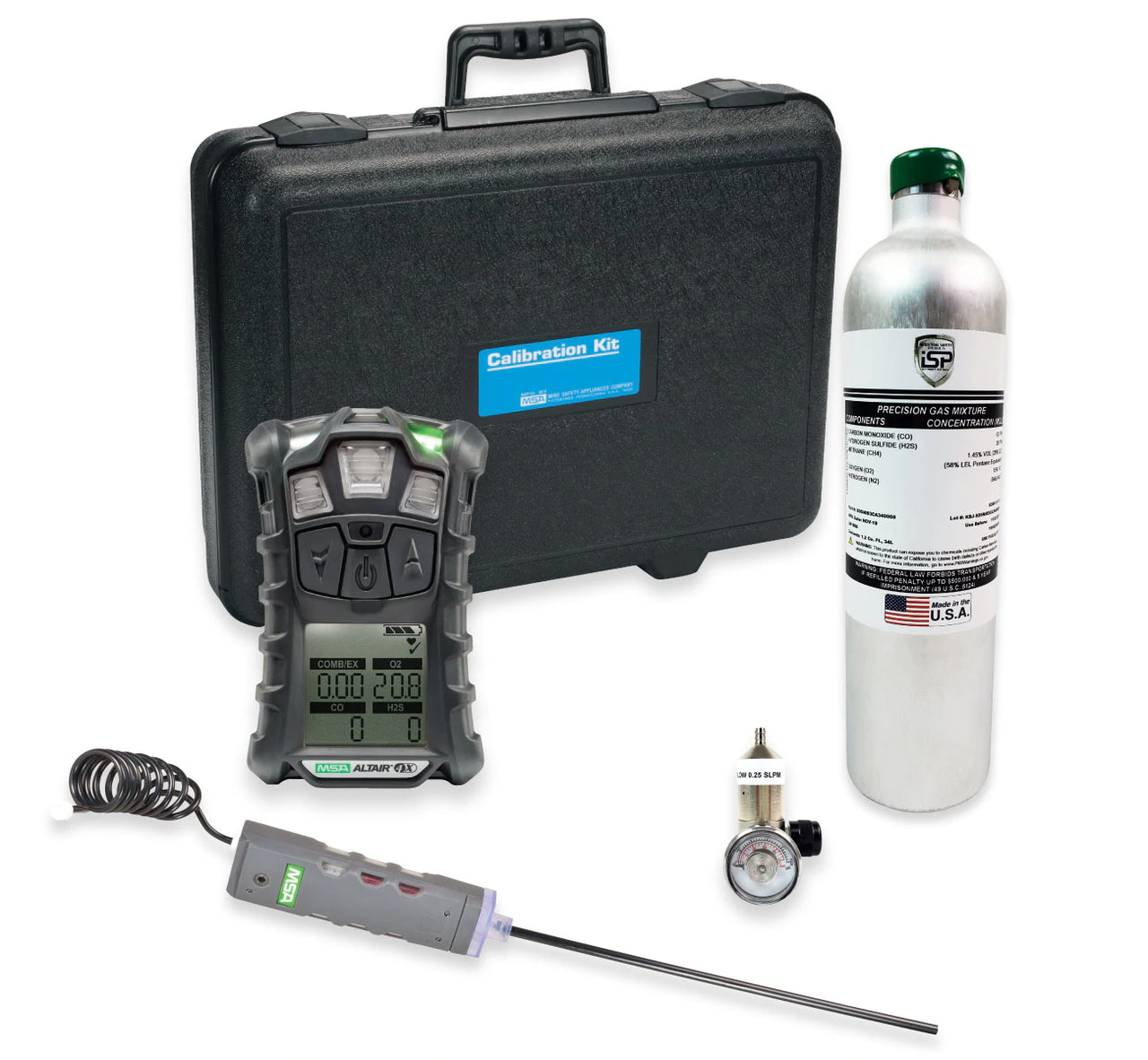
This is clearly a manageable hazard, but we MUST MANAGE it, because even this small amount of inert gas used improperly and in a poorly ventilated can be disastrous.
But what if management got a special deal on calibration gas and bought 100 of these cylinders (i.e. 2,000 scf) and stored them all inside a closet? Does this present the same degree of hazard as the single cylinder? ABSOLUTELY NOT – and this should not be allowed without some serious safeguards in place.
How about the scenario where management wants the container of N2 to be a 230L Dewar, cryogenic liquid storage, which when all the liquid boils off to gas from this 230L container we will have ~5,750 scf of N2 gas.
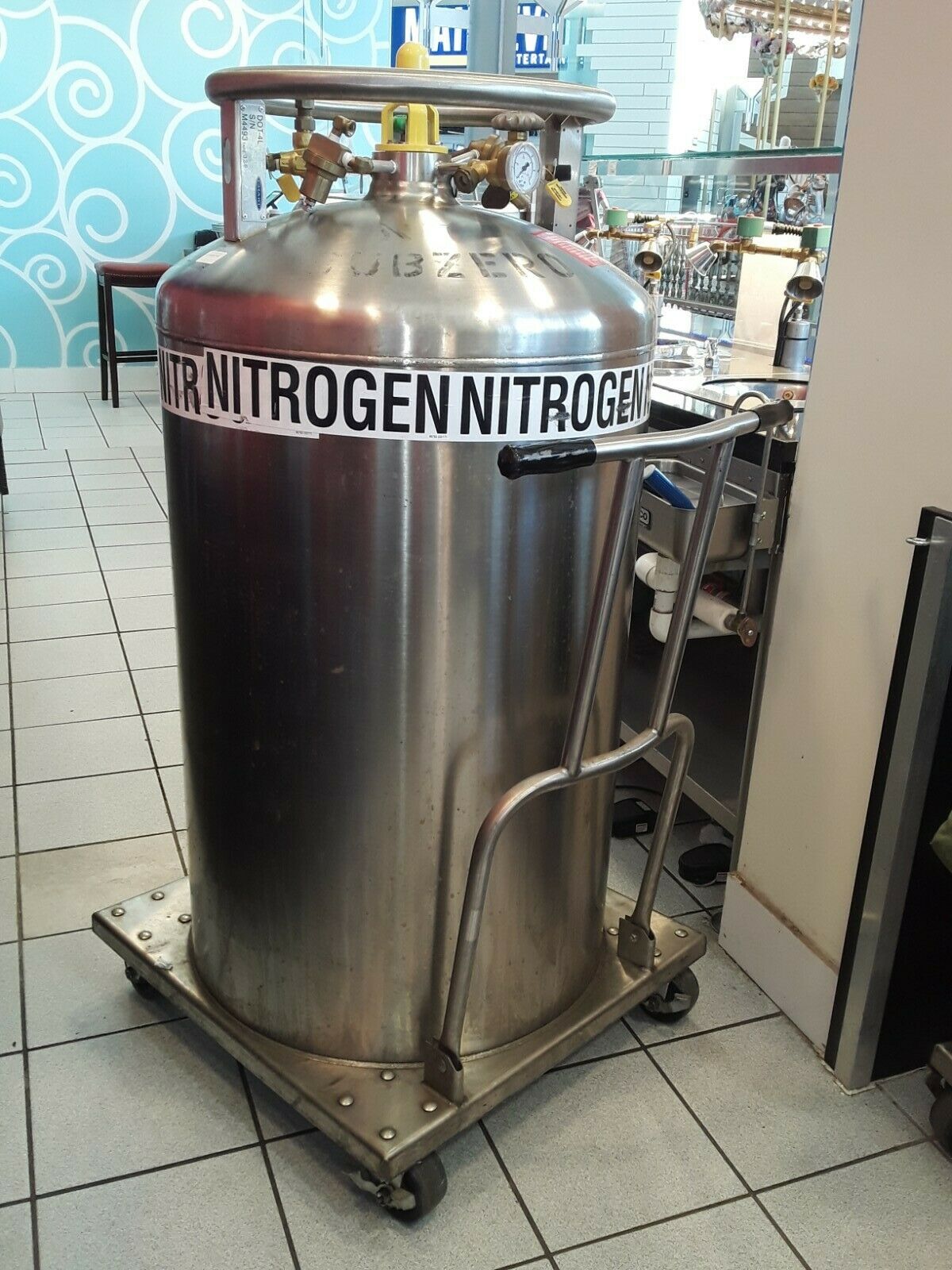
So we have just one (1) container of N2, but it is in LIQUID (cryo) state which is MUCH more hazardous (degree of hazard) and will eventually produce thousands of cubic feet of inserting gas!
These differences are reflected in the code’s “operating permit” section. States who have adopted the IFC as their state fire/hazmat code will require a business that wants to use an INERT GAS, such as N2, and this gas is stored/used as a COMPRESSED GAS may have to obtain an “operating permit” when the business would exceed 6,000 scf or more of this inert/simple asphyxiant compressed gas.
But if we want to store/use N2 in a cryogenic liquid state then the permit requirement is
- 60 gallons for “inside use/storage” and
- 500 gallons for “outside use/storage”
General note regarding N2… 1L of liquid will provide around 25 scf of gas (@ STP)
as written and provided by the International Fire Code:
Degree of hazard
The degree of hazard present depends on many variables that should be considered individually and in combination. Some of these variables we discuss below.
Chemical properties
Chemical properties of the material determine self reactions and reactions that could occur with other materials. Generally, materials within subdivisions of hazard categories will exhibit similar chemical properties. However, materials with similar chemical properties could pose very different hazards. Each individual material should be researched to determine its hazardous properties and then considered in relation to other materials that it might contact and the surrounding environment.
Physical properties
Physical properties, such as whether a material is a solid, liquid, or gas at standard temperature and pressure, considered along with chemical properties will determine requirements for containment of the material. Specific gravity (weight of a liquid compared to water) and vapor density (weight of a gas compared to air) are both physical properties that are important in evaluating the hazards of a material.
Amount and Concentration
The amount of material present and its concentration must be considered along with physical and chemical properties to determine the magnitude of the hazard. Hydrogen peroxide, for example, is used as an antiseptic and a hair bleach in low concentrations (approximately 8 percent in water solution). Over 8 percent, hydrogen peroxide is classed as an oxidizer and is toxic. Above 90 percent, it is a Class 4 oxidizer “that can undergo an explosive reaction when catalyzed or exposed to heat, shock or friction,” a definition that, incidentally, places hydrogen peroxide over 90-percent concentration in the unstable (reactive) category. Small amounts at high concentrations could present a greater hazard than large amounts at low concentrations.
Mixtures
Gases—toxic and highly toxic gases include those gases that have an LC50 of 2,000 parts per million (ppm) or less when rats are exposed for a period of 1 hour or less. To maintain consistency with the definitions for these materials, exposure data for periods other than 1 hour must be normalized to 1 hour. To classify mixtures of compressed gases that contain one or more toxic or highly toxic components, the LC50 of the mixture must be determined. Mixtures that contain only two (2) components are binary mixtures. Those that contain more than two components are multicomponent mixtures.
Where two (2) or more hazardous substances (components) having an LC50 below 2,000 ppm are present in a mixture, their combined effect, rather than that of the individual substance components, must be considered. The effects of the hazards present must be considered as additive, except where there is a good reason to believe that the principal effects of the different harmful substances (components) are not additive. For binary mixtures where the hazardous component is diluted with a non-toxic gas such as an inert gas, the LC50 of the mixture is estimated by use of the methodology contained in CGA P-20. The hazard zones specified in CGA P-20 are applicable for DOTn purposes and shall not be used for hazard classification.
Actual use, activity, or process
The definition of handling, storage, and use in closed systems refers to materials in packages or containers. Dispensing and use in open containers or systems describes situations, where the material is exposed to ambient conditions or vapors, is liberated to the atmosphere. Dispensing and use in open systems, then, are generally more hazardous situations than handling, storage, or use in closed systems. The actual use or process could include heating, electric or other sparks, catalytic or reactive materials, and many other factors that could affect the hazard and must therefore be thoroughly analyzed.
Surrounding conditions
Conditions such as other materials or processes in the area, type of construction of the structure, fire protection features (for example, firewalls , sprinkler systems, alarms), occupancy (use) of adjoining areas, normal temperatures, exposure to weather, etc., must be taken into account in evaluating the hazard.
Evaluation questions
The following are sample evaluation questions:
1. What is the material?
Correct identification is important; exact spelling is vital. Checking labels and SDS and asking responsible persons should be among the highest priorities.
2. What are the concentration and strength?
3. What is the physical form of the material?
Liquids, gases, and finely divided solids have differing requirements for spill and leak control and containment.
4. How much material is present?
Consider in relation to permit amounts, maximum allowable quantity per control area (from Group H occupancy requirements), amounts that require detached storage and overall magnitude of the hazard.
5. What other materials (including furniture, equipment and building components) are close enough to interact with the material?
6. What are the likely reactions?
7. What is the activity involving the material?
8. How does the activity impact the hazardous characteristics of the material? Consider vapors released or hazards otherwise exposed.
9. What must the material be protected from? (For example, other materials, temperature, shock, pressure.)
10. What effects of the material must people and the environment be protected from?
11. How can protection be accomplished? Consider:
11.1. Proper containers and equipment.
11.2. Separation by distance or construction.
11.3. Enclosure in cabinets or rooms.
11.4. Spill control, drainage and containment.
11.5. Control system ventilation, special electrical, detection and alarm, extinguishment, explosion venting, limit controls, exhaust scrubbers and excess flow control.
11.6. Administrative (operational) control signs, ignition source control, security, personnel training, established procedures, storage plans and emergency plans.
Evaluation of the hazard is a strongly subjective process; therefore, the person charged with this responsibility must gather as much relevant data as possible so that the decision will be objective and within the limits prescribed in laws, policies, and standards. It could be necessary to cause the responsible persons in charge to have tests made by qualified persons or testing laboratories to support contentions that particular material or process is or is not hazardous.