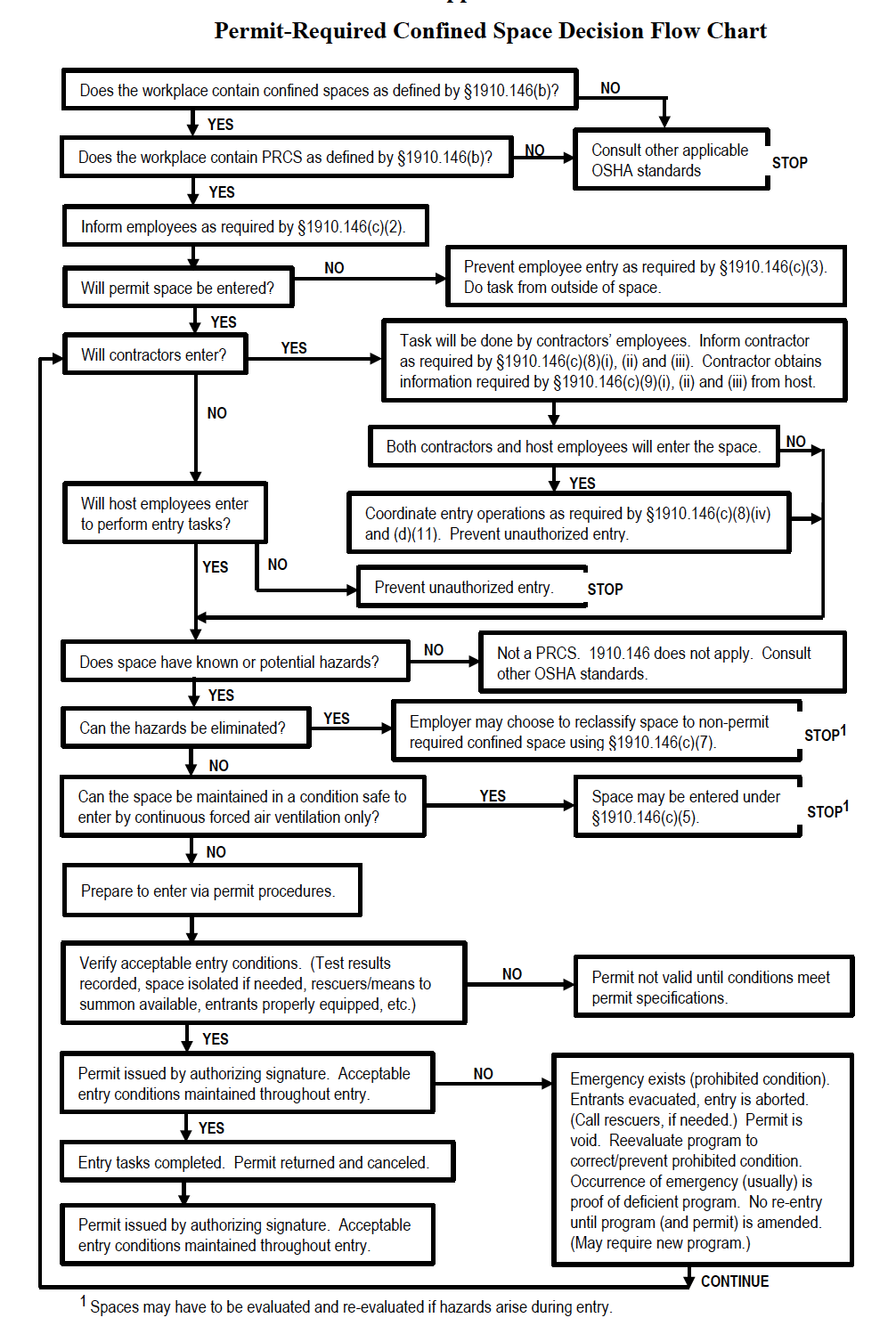
To continue with the articles I have written about Permit-Required Confined Spaces found in mechanical refrigeration processes, today I want to discuss the Compressor Oil Separator. SAFTENG Members can read my earlier post on Evaporative Condenser(s) and Sprial Freezers. Over the last several years I have shared several pics of workers halfway inside these separators and this week another one was shared in the SAFTENG FaceBook Group and it again stirred a great debate: Are these separators a PRCS?
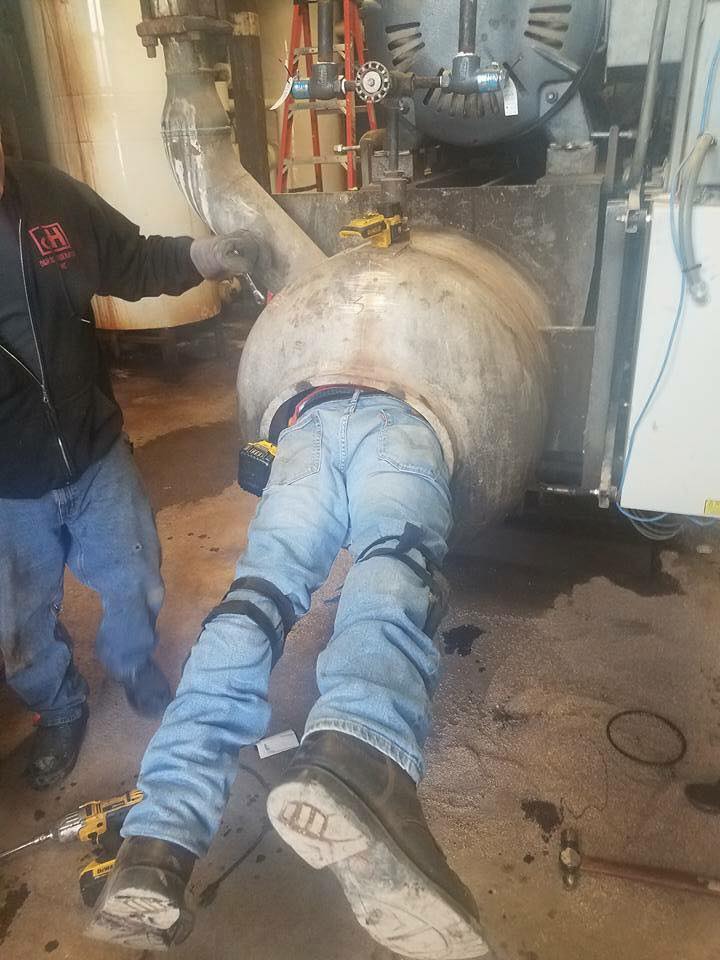
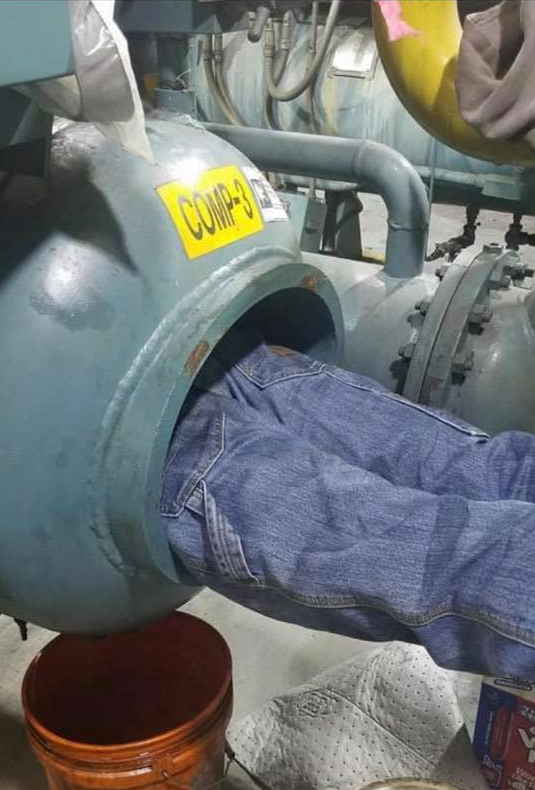
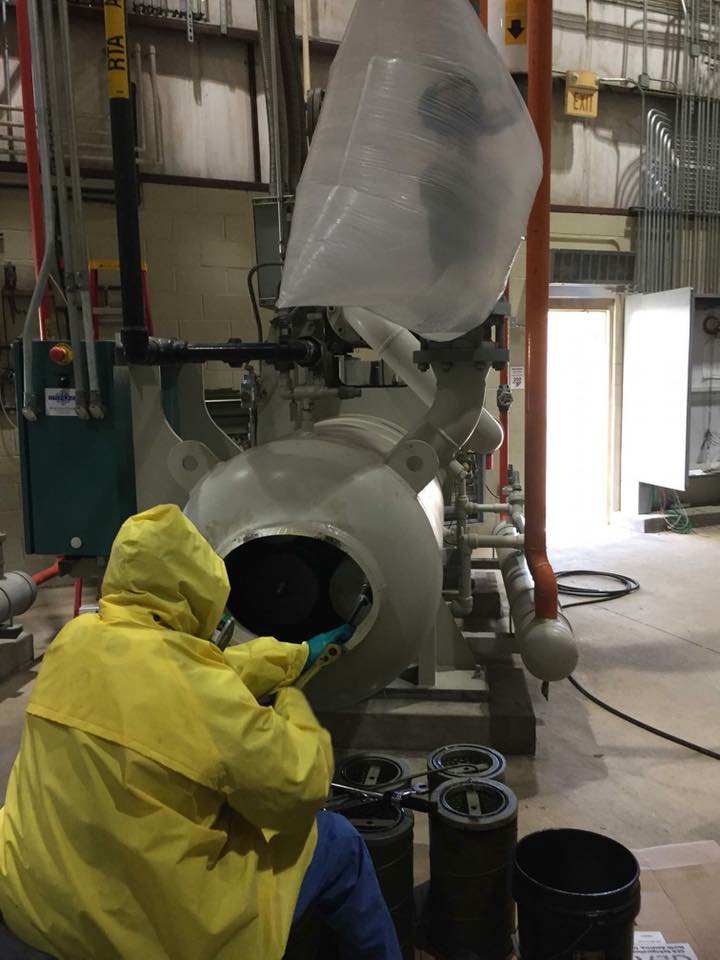
As we can see in the pics below, these vessels have a man-way on the end of the vessel and this opening is there so that the coalescer filter elements can be changed and worked on, which is usually done every 3,000 hours of operation (depending on the manufacturer).
But are these pictures a depiction of an “entry into a Permit-Required Confined Space”? Well, the OSHA COMPLIANCE answer may very well surprise you!
 |
 |
 |
First things first! What makes a space a “confined space”? Well, a “Confined space” means a space that:
(1) Is large enough and so configured that an employee can bodily enter and perform assigned work; and
(2) Has limited or restricted means for entry or exit (for example, tanks, vessels, silos, storage bins, hoppers, vaults, and pits are spaces that may have limited means of entry.); and
(3) Is not designed for continuous employee occupancy.
And for us to have a Permit-Required Confined Space, we MUST FIRST have a space that is at least a Confined Space and two of the spaces we see in the pics above are NOT a confined space because as we can see (partially see at least) is that the worker is not able to “BODILY ENTER” the space. The larger oil separator shown above IS LARGE ENOUGH to BODILY ENTER and thus it should be labeled as a PRCS and entry into the space MUST be managed as a PRCS Entry (1910.146).
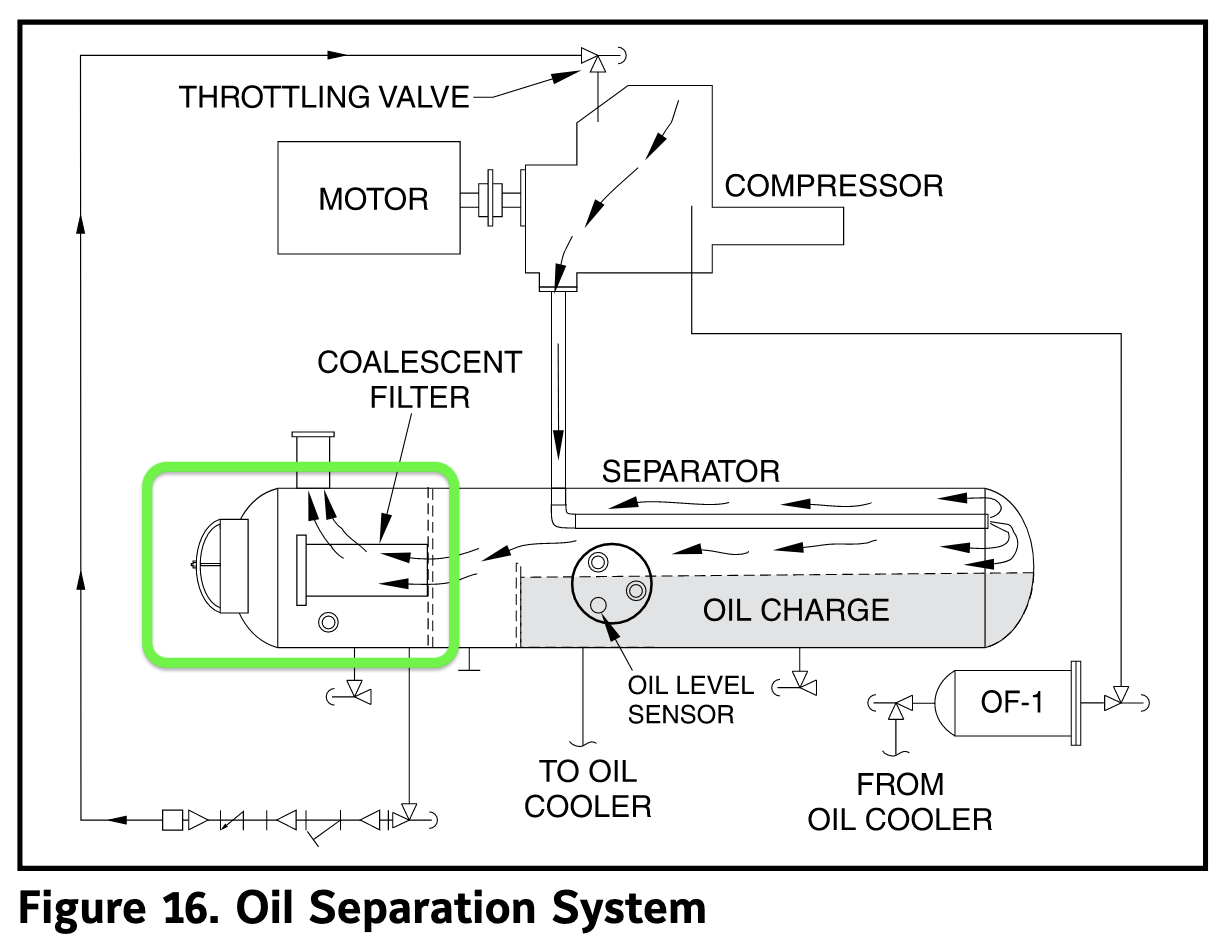
The pics with half a worker hanging out of the man-way is showing us what it looks like when we change our coalescer filter elements. Here is a drawing from an owner’s manual showing us “sort of” what the configuration looks like and the size of the space we are talking about. I have drawn a green box around the area we see in the pic above. Now the workers we see in the two pics above have the coalescer filter out and they are replacing the gasket. With the filter in place, you can see there is very limited space; even with the filter(s) removed we can see that a worker is UNABLE to “bodily enter” the space.
Here is a pic from a filter change job that gives us a little more perspective. If we look closely we can see the wall inside the separator that the filter mounts to and we can see the length of the filters sitting on the floor.
This is a neat 360° video that gives us a nice look at these oil separators. The video is showing a larger style, but not near as big as the pic below…
Refer back to the drawing above to see how the NH3 gas flows from the compressor and into the separator, through the oil reservoir, and into the coalescer filter elements, and out of the separator.
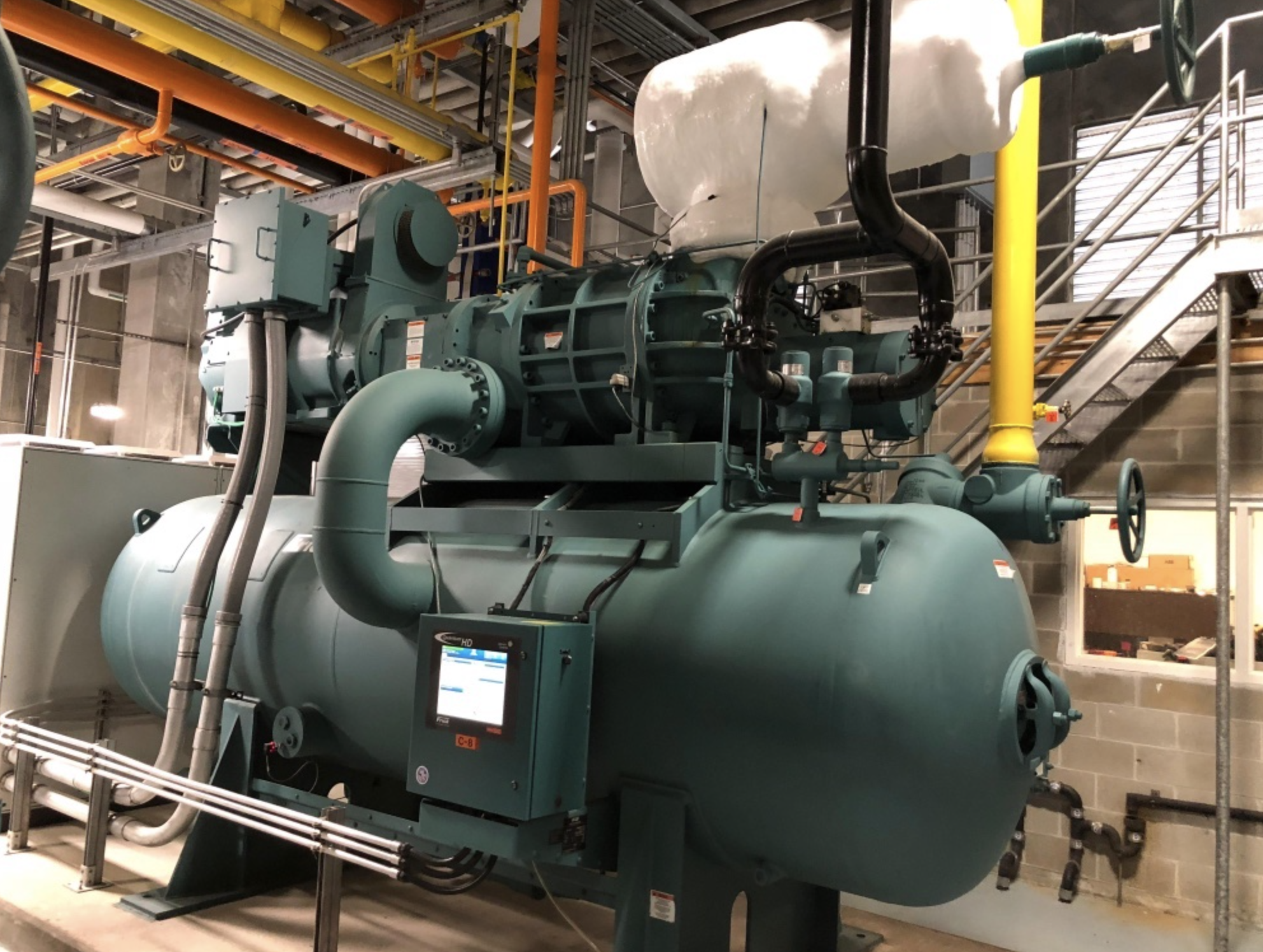
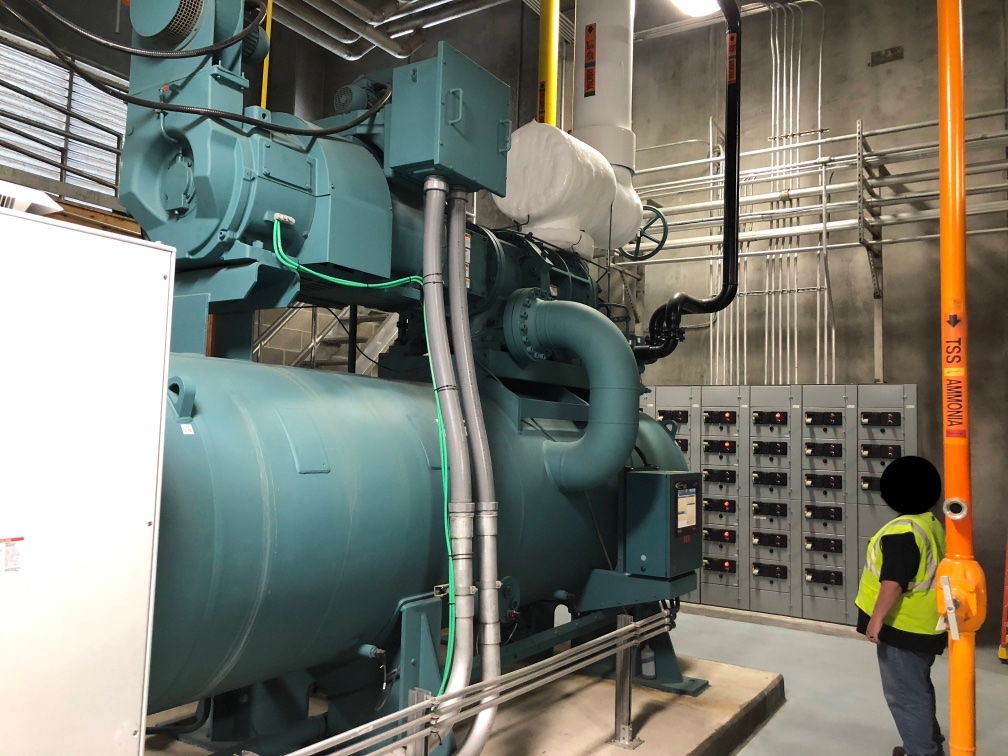
But it is this oil separator (below) that I came across a couple of years ago that was really interesting and it shows us that not all oil separators are alike!
This oil separator has the same size opening as the pics above which shows the workers with half their body’s inside the vessel. This oil separator is JUST THAT BIG making the manway look really small – but trust me, it is the same size or it may be slightly bigger and yes, a person who can fit through the manway will have room to “bodily enter” this space and thus this oil separator is indeed a PRCS. In other words, when your working on the filter assembly, half of your body need not be hanging out of this separator, as you can COMPLETELY climb inside and do the work.
This pic (same compressor as above, just at a different angle) may give us some perspective… the worker is 5’4 and 200+. So we can see just how large this oil separator is.
Please see my 2012 Article, Discussing the three (3) criteria that makes a space a Confined Space. But if all you want to know is about “bodily entry” here is what I said in 2012 and please know that this is NOT just me; this information was taken from OSHA’s Preamble to 1910.146…
(emphasis by me)
Large enough to bodily enter
OSHA is concerned that spaces that are too small for complete bodily entry may pose hazards for employees, however, the Agency did not intend to cover such spaces under the permit space standard. OSHA intended to cover ONLY spaces that were large enough for the entire body of an employee to enter.
The proposed definition of “permit-required confined space” did NOT cover the “small” spaces. Such spaces do NOT meet the definition of “confined space”, nor do they pose hazards comparable to those associated with confined spaces. Since an employee cannot totally enter such spaces, he or she should not have difficulty withdrawing from the space. In order for a space to be considered a permit-required confined space, it MUST FIRST be a confined space. A space that cannot be entered is NOT confined; therefore, it does not pose hazards related to the difficulty of exiting the space.
OSHA realizes that an employee may still be injured or killed as a result of some atmospheric hazard within such an enclosed area; however, the permit-required confined space standard (1910.146) is NOT intended to address all locations that pose atmospheric hazards. The Agency believes that the procedures necessary to protect workers from atmospheric hazards alone are NOT those required by this standard, but are required by other OSHA standards, such as Subpart Z of the General Industry Standards. The exposed employee MUST ALSO have difficulty exiting the space for the many requirements of section 1910.146 to apply. Spaces that cannot be entered are small enough to be readily ventilated, and in many cases, a reaccumulation of a hazardous atmosphere is highly unlikely.
- 1910.146 – Determining whether an aircraft fuel tank is considered a confined space. [03/05/2008]
- 1910.146 – When permits are required for entry into a permit required confined space. [10/18/1995]
I realize there will be some who will claim my position will get someone killed and that this is reckless! I would NEVER tell someone to NOT manage this work as a PRCS entry if they so choose to do so; however, when we claim we are doing it as a PRCS entry then we MUST DO IT CORRECTLY! Just saying we treat these as a PRCS is NOT enough! In the pics with the workers hanging half out of the separator, how many energy isolation devices do we see in place? In one pic you can see the end of some pink ribbon – that is how TOO MANY refrigeration plants still do their version of Lockout/Tagout!
Climbing inside a space that once processed anhydrous ammonia is a SERIOUS HAZARD; regardless if we see it as a PRCS Entry, Line Break/Equipment Opening, or just a LOTO task we MUST manage the hazards appropriately. We ALWAYS did this work at my plant with a supplied-air respirator, but not many refrigeration plants have this level of respiratory protection. In fact, it would a nice find if we came across a filter change where an APR was being used by the entrant; realizing that oftentimes the ammonia concentration for this job is quite high.
And this leads me to OSHA’s PRCS CPL and how they address these types of atmospheric hazards when the plane of the space can be broken by a worker’s head, but not bodily entered:
|
6. How will OSHA address a space that does not satisfy the criteria for a confined space but that potentially contains a hazardous atmosphere? Employers must comply with the permissible exposure limits and other requirements contained in standards addressing specific toxic substances and air contaminants, to the extent applicable, in all spaces in which employees may be present. In addition, the respiratory protection standard, 29 C.F.R. 1910.134, applies where an employee must enter a space in which a hazardous atmosphere may be present and no other specific standard applies. The respiratory protection standard contains special precautions for working in atmospheres that are oxygen-deficient or immediately dangerous to life or health. |
|
Federal Register / Vol. 58, No. 9 / Thursday, January 14, 1993 page 4477 Proposed paragraph (b)(23)(i) stated, as the first criterion, that a space had to be “large enough and so configured that an employee can bodily enter and perform assigned work” in order to be considered a permit-required confined space. many comments were submitted… The Agency has not adopted this suggestion. While OSHA is concerned that spaces that are too small for complete bodily entry may pose hazards for employees, the Agency did not intend to cover such spaces under the permit space standard. OSHA believes that the NPRM preamble discussion of permit space incidents and of proposed provisions clearly indicates that THE PROPOSED RULE WAS INTENDED-TO COVER ONLY SPACES THAT WERE LARGE ENOUGH FOR THE ENTIRE BODY OF AN EMPLOYEE TO ENTER. As commenters have correctly noted, the proposed definition of “permit required confined space” did not cover the “small” spaces. Such spaces do not meet the definition of “confined space”, nor do they pose hazards comparable to those associated with confined spaces. Since an employee cannot totally enter such spaces, he or she should not have difficulty withdrawing from the space.In order for a space to be considered a permit-required confined space, it must first be a confined space. A space that cannot be entered is not confined; therefore, it does not pose hazards related to the difficulty of exiting the space. OSHA realizes that an employee may still be injured or killed as a result of some atmospheric hazard within such an enclosed area; however, this standard is not intended to address all locations that pose atmospheric hazards. The Agency believes that the procedures necessary to protect workers from atmospheric hazards alone are not those required by this standard, but are required by other OSHA standards, such as Subpart Z of the General Industry Standards. The exposed employee must also have difficulty exiting the space for many the requirements of §1910.147 to apply. For example, the need for an attendant to be present is doubtful. Spaces that cannot be entered are small enough to be readily ventilated,8 and in many cases a reaccumulation of a hazardous atmosphere is highly unlikely. Because the requirements set forth in final §1910.146 are not appropriate for application to spaces into which an employee cannot completely enter, OSHA has retained the language proposed in paragraph (b)(23)(i), which appears under the definition of “confined space” in the final rule.OSHA notes that, as discussed previously in the preamble, “entry” as defined in the final rule begins when any part of the entrant’s body breaks the plane of the entry portal. This language indicates the Agency’s concern that exposure to a permit space hazard can occur before the entire body of the entrant is inside the space. The definition of “entry” is not intended to indicate that a space large enough to accommodate only part of an employee’s body constitutes a permit space. Therefore, OSHA has determined that the definitions of “entry” and “permit-required confined space” are consistent.
CLICK HERE for the full preamble |