
This week I shared a serious chlorine incident that sent seven (7) people to the hospital, including firefighters and neighbors. This incident could have been managed very easily and with much fewer impacts on responders and the community had the facility followed basic RAGAGEP requirements for their 1-ton chlorine containers. Basically, the leak was on a fusible plug in the liquid phase and because the cylinder was not stored properly and the trunnions had not been maintained properly, the cylinder was unable to be rolled! So instead of a gas leak, we had a liquid leak and for those who may not be familiar with chlorine – this translates into a leak that is 460X’s worse!
So what the heck are trunnions and why are they so critical for safely handling 1-ton cylinders?
From Wikipedia…
A trunnion (from Old French “trognon”, trunk) is a cylindrical protrusion used as a mounting or pivoting point. First associated with cannons, they are an important military development. Alternatively, a trunnion is a shaft that positions and supports a tilting plate. This is a misnomer, as in reality it is a cradle for the true trunnion. Trunnion positions saw table and provides a pivot point. In mechanical engineering, it is one part of a rotating joint where a shaft (the trunnion) is inserted into (and turns inside) a full or partial cylinder. The term is also used to describe the wheel that a rotating cylinder runs on.
Here is what trunnions look like:
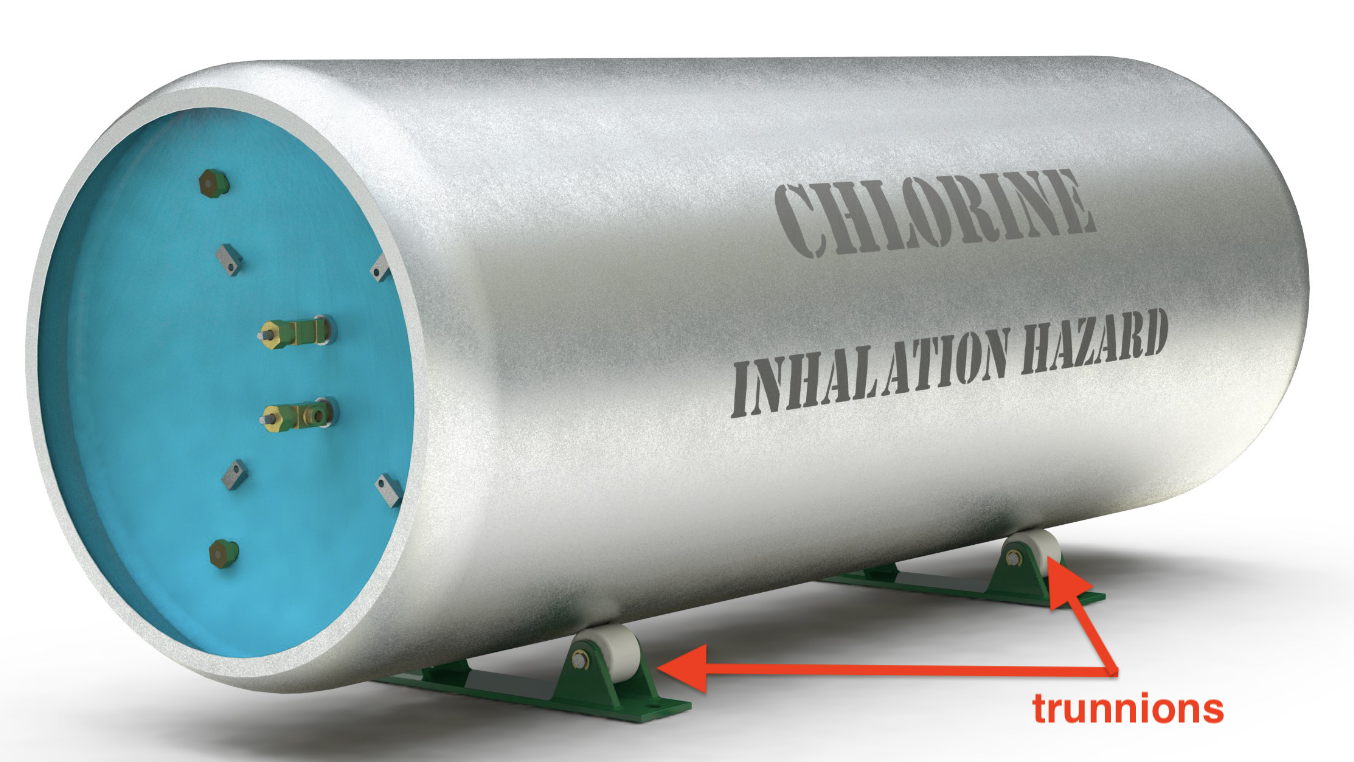
Source: https://www.forceflowscales.com/downloads/brochures/B208F.pdf
So why are these itty-bitty “rollers” (as I call them) so important?
The chlorine inside the container is in two phases: Liquid on the bottom and gas on the top. The liquid is such because of the VP of Chlorine being so high that the pressures generated from the chlorine inside the container keep the chlorine from boiling off. But a leak on the container, especially where the liquid is present is REALLY BAD. So the first thing we are trained/instructed to do is to ROLL THE CONTAINER on its trunnions so that the leak is in the vapor phase.
Liquid chlorine has an expansion ratio of 460:1, meaning that 1 cubic ft of liquid will make 460 cubic ft of gas, or another way of looking at it one (1) pound of liquid will make 5.4 cubic feet of chlorine gas. And it does this VERY quickly because chlorine’s BP is -29°F.
In the event I shared this week, the cylinder was not able to be rolled because the trunnions were rusted AND the cylinder storage was such that the cylinders did not have adequate spacing to allow the responders to get adequate leverage to roll the cylinder over the rusted trunnions. Hence the fusible plug that was leaking was always in the liquid phase causing way more exposure to liquid chlorine than necessary.
Some of the newer styles of trunnions seem to be “maintenance free” but they will NOT last as long as the old-fashioned steel trunnions. These UHMW Polyethylene Rollers do not have grease fittings so one would assume that the Polyethylene rollers will need to be replaced at a frequency such that the rollers will fail before the bearings need greasing??? The epoxy powder-coated ASTM A36 steel frames with zinc plated steel rollers come with grease fittings leading one to believe “greasing” at some frequency will be necessary; however, finding a manufacturer of trunnions who will specify a minimum greasing frequency is like finding a diamond in the rough!!!
As we can see here, the very first thing responders who have been trained in the application of the B-Kit onto a leaking 1-ton cylinder is to ROLL the cylinder so the leak is in the gas phase…
