A few years ago I wrote a piece about identifying ALL equipment, especially valves, with a unique identifier. The purpose of that posting was brought about by a lot of facilities challenging our PHA, II, Audit findings/recommendations that all equipment be identified with a unique identifier in the field, on P&ID’s, in SOPs, LOTO procedures, and the CMMS (e.g. work order system). For me, I am at a loss as to how a covered process is suitably managed without this fundamental tool. But today I want to talk about another CRITICAL IDENTIFIER that we will not find in an OSHA standard or any RAGAGEP that I am familiar with: Identification of our Electrically Classified Locations
I will also touch on managing these HAZLOC(s) as an “engineering control” vs. “administrative control” which seems to be gaining traction and is just asking for trouble (IMPO).
With specializing in flammable liquids and gases, we come across a lot of Hazardous Locations (HAZLOCs) in our work. But there is one (1) common theme that we find puzzling in the vast majority of these HAZLOCs: they are not identified in the plant!
I grew up in process safety working with flammable (and Toxic) processes and although we may have gone over the top with our signs and markings – you knew when you crossed a critical threshold that required some type of behavior, permit, PPE, etc. These signs and markings were a big part of “controlling access” to our covered process(s). And although I had a few engineers angrily tell me “it’s not an exact science Bryan!”, I was taught we have to draw the line somewhere. This was another example where some engineers claimed I read the engineering standards too literally – imagine that; reading an engineering standard literally and I was the crazy one!
So how would an employee, much less a contractor, know where the line is if we have not identified the line?
In almost every case where we find personnel using non-rated equipment in these HAZLOCs, almost all of them thought they were not inside the HAZLOC. We have even found equipment installed by engineers/contractors in HAZLOCs that was not rated for the area and when asked why; they “thought” it was outside the HAZLOC.
So yes, there is no requirement that these HAZLOC boundaries be identified, but if we do not identify the boundaries how will workers know? Showing a distance on a HAZLOC drawing to mimic the NFPA 497/499 figures is one thing, but translating and identifying those distances in the plant is ABSOLUTELY CRITICAL.
How far a facility goes in its efforts to demarcate these HAZLOCs is based on its risk tolerance in this matter. Some of my former plants painted lines on the floors/curbs entering the open process areas and posting signs on all doors one would enter into a HAZLOC.
Lastly, we came across a very interesting “practices” with regards to entering a HAZLOC which I still have issues with – but with no RAGAGEP or OSHA standard to base my concerns on it can only be listed as a Best Management Practice (BMP) concern. I treat my HAZLOCs as an Engineering Control within my PROTECTION LAYER (Prevent-Protect-Mitigate). But these signs and practices turn my engineering control into an Administrative Control…

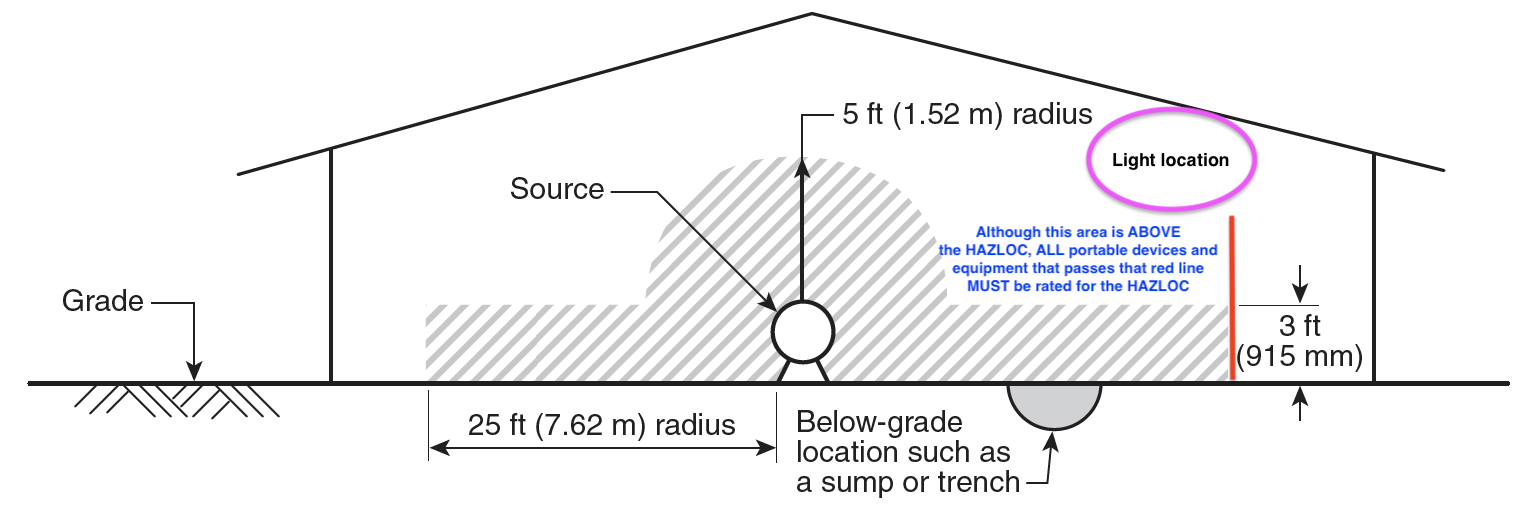
To be frank, there is no way in H_LL that I would have ever permitted this practice. Yes, the HAZLOC may only extend 18″ off the floor/ground in some areas; however, allowing non-rated equipment to be taken into the area as long as it is kept above the 18″ mark it is suitable. We had a discussion about the personnel radios and how they were not rated for a Class I, Div 2 area and they all said it was OK as they wear their radios on their belts and thus the radios are never lower than 18″. This drew some strange looks from Dennis and I, but we refrained from further discussion as it was obvious the operators and maintenance personnel were well versed on this matter. We exited the control room and walked maybe 50′ and there we found two (2) mechanics doing a PM on a pump. Both were on their knees and both radios were well within the 18″ range AND these two workers were actually doing a LINE BREAK on a pump that contained a flammable liquid.
We always use these heights when defining the area for FIXED EQUIPMENT, but NEVER for PORTABLE EQUIPMENT. For example, an engineer comes to me and wants to add lighting to a process area in response to a PHA recommendation. He prefers to use the newer LED lighting and wants to stay away from the HAZLOC. We pick a spot well above the 18″ or 36″ height for the Div 2 area. So the lighting will be WITHIN the horizontal distance of the HAZLOC but ABOVE the height of the HAZLOC. Similar to what is shown below: