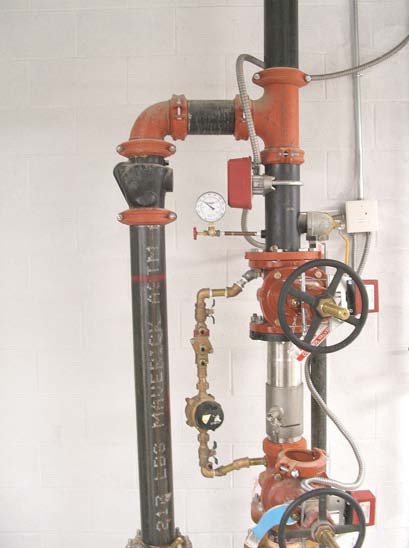
Closer examination reveals the presence of supervisory switches on the backflow preventer’s outside stem and yoke (OS&Y) valves, a water pressure gauge measuring about 150 pounds per square inch (psi) (10.3 bar), a main drain assembly, and a water metering assembly on the backflow preventer. The OS&Y valves are open—as evidenced by the visible stems—and the water pressure gauge appears to measure a positive static pressure. The electronic supervisory switches are attached to the fire alarm system through a zone module mounted on the wall and, if operable, will signal if anyone tries to close or tamper with one of the water supply control valves. So what’s the problem?
Look closely at the orientation of the swing check valve in the fire department connection line located left of the shotgun riser. It is installed backwards. Not only will this have the effect of preventing the fire department from supplementing the sprinkler system through the fire department connection but also it creates a safety hazard to firefighters who may attempt to remove the brass caps or plugs from the fire department connection when it is pressurized from the sprinkler system. Swing check valves are equipped with a round, flat plate or clapper that—when seated—prevents water from flowing back toward the source. The clapper is attached to or part of a metal rod that serves as a pivot point; when water begins to flow, the clapper is pushed out of the water stream to allow full flow conditions. In today’s illustration, that pivot point is located at the upper left side of the swing check valve assembly. In order to avoid installation errors like the one shown, the outside of a swing check valve assembly is embossed with an arrow or pointer that indicates the direction of water flow. The swing check valve, in today’s illustration, should be removed by a competent service technician and reinstalled with the arrow or pointer directed toward the ceiling.
For more information and cutaway illustrations, search the Internet for “fire protection swing check valves,” and review manufacturers’ technical product literature.
Source: This all came from one of my very favorite FREE publications! The United States Fire Academy “Coffee Break Training” series. If you want to learn more about fire safety from a highly reputable source, this FREE publications is a MUST HAVE! CLICK HERE to visit their “Coffee Break Training”.