
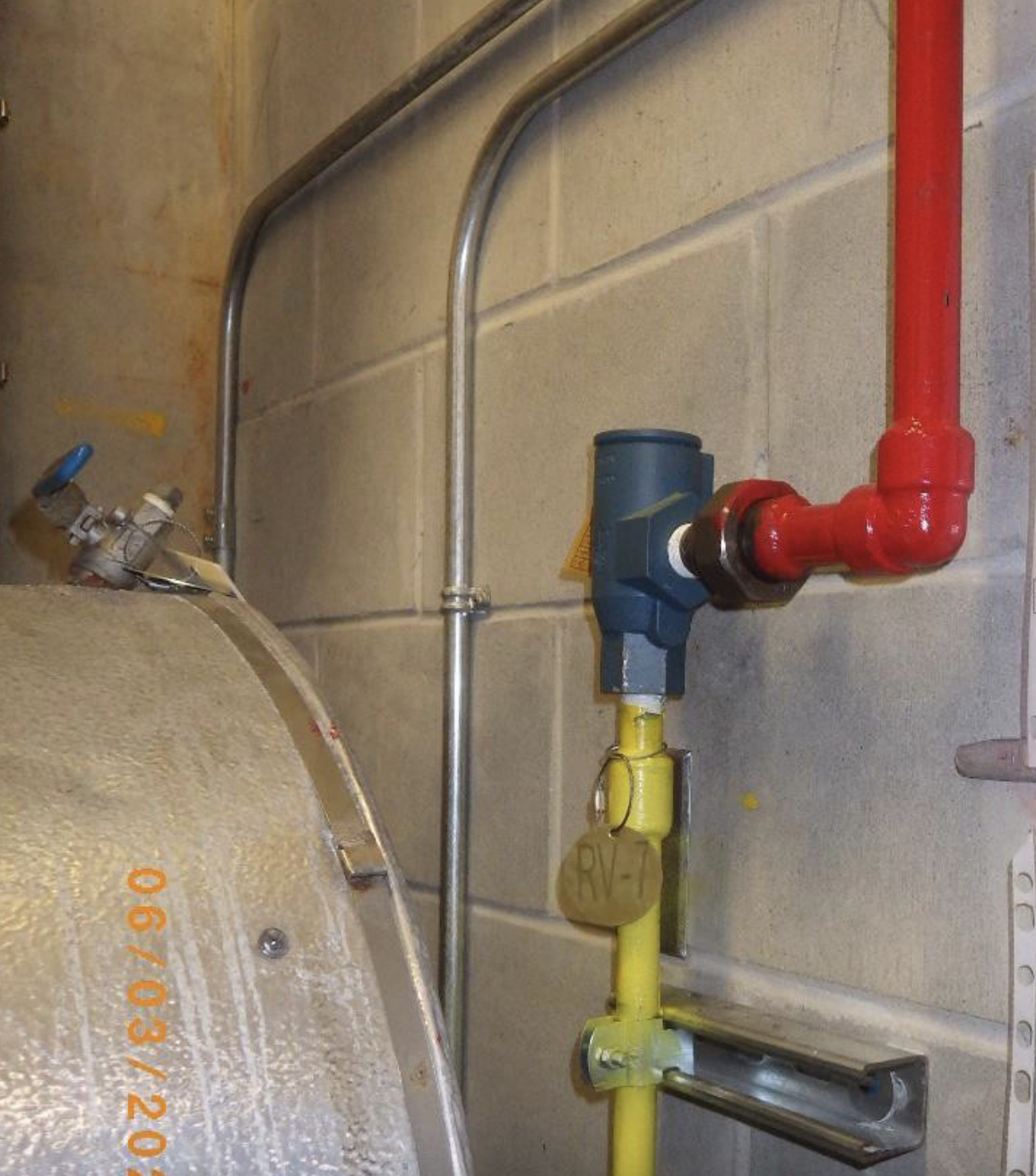
This ammonia refrigeration system for the ice rink had been shut down, and the full ammonia charge (800 pounds) was being stored in the chiller, attached surge vessel, and the oil pot. Three (3) days before the incident, a contractor was doing maintenance on the brine system to install a pH sensor in the brine pump discharge piping upstream of the pump’s discharge isolator (Image 4). When the job was finished, the contractor had only partially de-isolated the equipment, leaving the brine pump suction valve closed, tagged, and locked out (Images 2 and 3).
On the day of the incident, the facility staff started the brine pump as part of the Preventative Maintenance (PM) schedule and was unaware that the pump suction valve was still in the closed position. After 4 hours with the pump running, the brine fluid temperature increased to 111 Deg. F (44 Deg. C) – this raised the liquid ammonia temperature that was stored in the chiller.
The increase in temperature caused an increase in the ammonia systems pressure to the point the safety valve on the oil pot (Image 5) opened at 250 pounds per square inch (psi), discharging ammonia into the vent stack and to the outside air (Image 7). The oil pot safety valve was the first and only safety valve to open. The system pressure forced ammonia liquid out of the chiller, through the oil pot connected to it, and into the vent stack.
NOTE: When the cooler ammonia gas mixed with the surrounding air, the ammonia cloud dropped to the ground level instead of rising upward as expected on a warm day. The ground-level ammonia cloud then entered the machinery room through open louvers of the machinery room ventilation intake.
This reduced pressure in the vent stack when the ammonia liquid vaporized as it absorbed heat and changed to a vapor as it moved upward and exited the vent stack.
When the cooler ammonia gas mixed with the surrounding air, the ammonia cloud dropped to the ground level instead of rising upward as expected on a warm day. The ground-level ammonia cloud then entered the machinery room through open louvers of the machinery room ventilation intake.
The ammonia leak detectors in the machinery room were activated, which started the machinery room exhaust fan that increased the amount of ammonia entering the room through the ventilation intake louvers.
Interview Statements:
- The ammonia system was shut down for the dry floor season, and the ammonia charge was stored in the chiller and surge vessel.
- A contractor was doing maintenance on the brine system three (3) days before the incident to install a pH sensor in the pump discharge piping before the pump
discharge valve. - The contractor was responsible for isolating the equipment they were working on but only partially de-isolated the equipment, leaving the pump suction valve closed, tagged, and locked out.
- On June 2, the ice facility operator started the brine system as part of the non-running pump preventative maintenance program. The closed pump suction valve was not noticed when the pumps were started.
- The brine pumps ran for approximately 4 hours with no brine flowing in the system.
- With the suction valve in the closed position, the pump ran with no flow, and the brine fluid temperature rose to 111 Deg. F (44 Deg C).
- After the 4 hours, the warm brine raised the ammonia liquid stored in the chiller vessel, which also raised the ammonia pressure to the relief valve set pressure of 250 psi (1723.7 kPa).
- The oil pot safety valve lifted first; the oil pot also connected to the chiller sump, and the liquid ammonia was pushed out of the chiller through the open
relief valve to the vent stack located above the machinery room by the evaporative condenser. - The stack sensor alarmed and notified the monitoring company that notified the plant staff by phone at 14:06
- The machinery room vestibule monitor was checked, and the vent stack sensor reading was reading 10,000 ppm.
- The machinery room sensors were reading 0 ppm, so entry was made.
- The oil pot safety valve discharge piping was frosting up, indicating ammonia was flowing to the vent stack. It was noticed that the brine pump was
operating but making an unusual sound and was shut down. - An attempt was made to view the vent stack and the windsock but when the east outside door was opened a strong smell of ammonia was observed, and
the door immediately closed. - An order to evacuate the community center was given.
- The wind direction at the incident time was blowing from the northwest going to the southeast, verified by sight from the northeast side of the community
center. - A warning was communicated to people using the field southeast of the community center to leave the area.
- The ammonia liquid discharging from the safety valve was flashing into a vapor inside the vent discharge piping; during this change from liquid to
vapor the temperature drops, and the liquid /gas mixture that leaves the top of the vent stack can be denser than the surrounding air and proceeded to
drop to the ground instead of rising as would have been expected on a warm day. - The ammonia vapor entered the machinery room through the air intake louvers located at ground level below the discharge vent stack.
- This activated the ammonia leak sensors that initiated the room ventilation exhaust fan; this increased the amount of ammonia entering the machinery room by pulling it in through the machinery room air intake louvers.
- The machinery room was vacated while the ammonia sensors were reading high ppm in the room.
- Plant staff called The Fire Department & Hazmat crew, who responded with mobile EMS personnel.
- The staff proceeded to evacuate the community center
- The Killarney High School, located adjacent to the community center, was also evacuated.
- Once the ammonia charge volume was reduced enough, the safety relief valve closed the machinery room was cleared of vapor by the room exhaust system.
- The EMS personnel looked at thirteen (13) people outside of the community center and released them.
The starting of the brine system with the pump suction valve in the closed position caused the incident by allowing the liquid ammonia contained in the chiller to
increase in temperature and pressure, causing the safety valve to open and relieve the pressure by releasing the ammonia into the atmosphere.
Contributing factors to this incident include:
- The contractor responsible for isolating / de-isolating the equipment did not leave a service report or communicate with the facility operator when they left
the facility. - The facility staff assumed the equipment was ready for service.
- The operations personnel started the brine pump without making a complete operational assessment prior to running the pump.
CLICK HERE for the full report with pictures
