
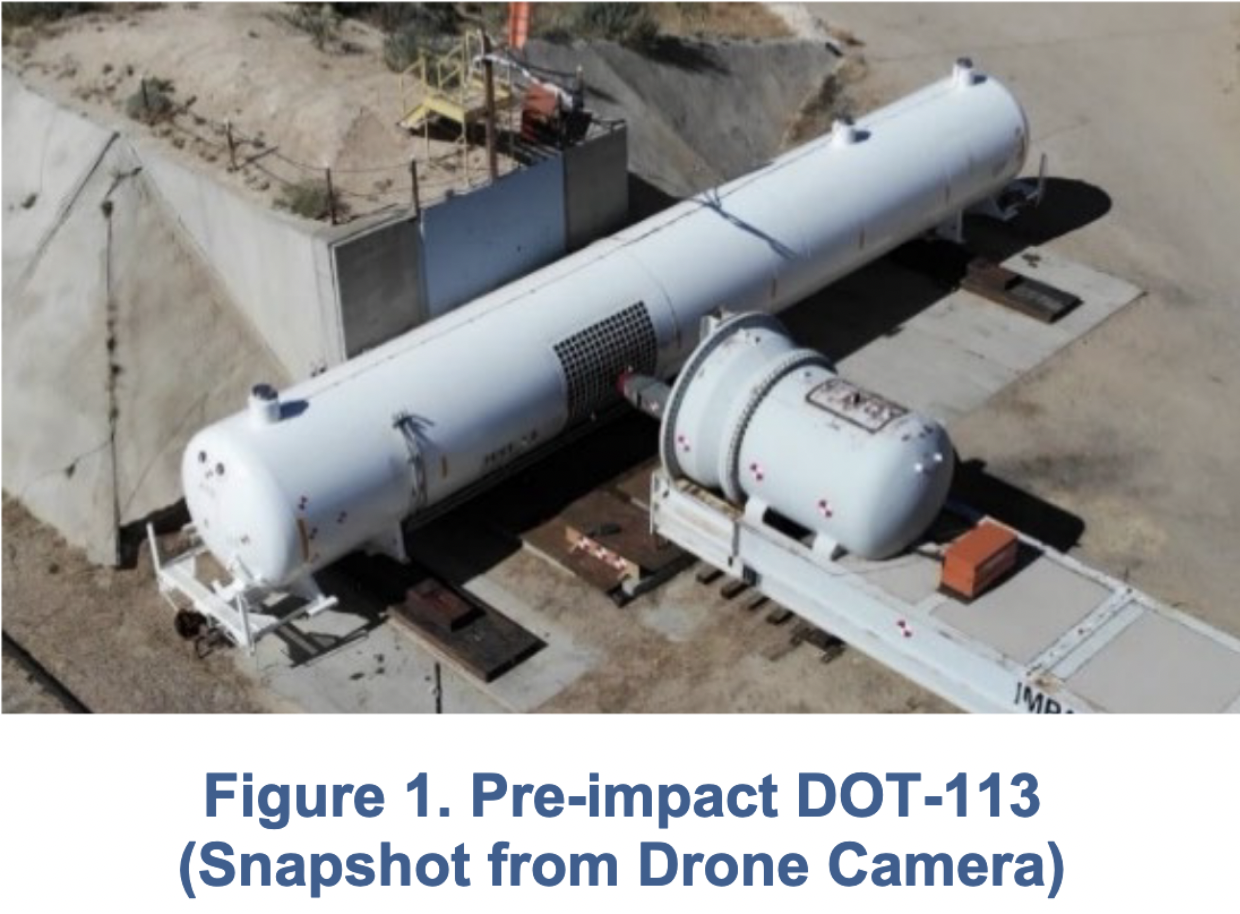
 On May 14, 2022, the Federal Railroad Administration (FRA) conducted a full-scale shell impact test (Test 13) of a DOT-113C120W9 (also identified as DOT-113) specification tank car at the Transportation Technology Center (TTC) in Pueblo, CO. This test was the final impact test in a planned series of four. A DOT-113 is a double-walled tank car (i.e., tank-within-a-tank) designed to transport authorized cryogenic liquids by rail. The tested tank car was purpose-built for this test to meet the specifications for a DOT-113C120W9 tank car. The tank car had a volume of approximately 34,500 gallons. During the test, a ~297,000-pound ram car equipped with a 12-inch by 12-inch impactor struck the outer shell of the tank car at its mid-height and longitudinally offset 10.8 feet towards the A-end. The researchers intended the offset impact location to be consistent with the impact location in the previous side impact test of a legacy DOT-113 tank car (Test 10). Figure 1 shows the tank car in its pre-test position against the impact wall at the TTC.
This test used cryogenic liquid nitrogen (LN2) as a stand-in for the cryogenic materials typically transported in a DOT-113. The researchers filled the tank car to approximately 97 percent by volume with LN2. The remaining 3 percent volume contained pressurized gaseous nitrogen (GN2). The temperatures and pressures in both the LN2 and GN2 fluctuated prior to the test. The outage pressure was 21 psig immediately prior to the test. The researchers targeted a test speed of 22.0 ± 0.5 mph, intending to puncture both the outer and inner tanks. The measured impact speed was 22.1 mph. This speed and ram mass corresponds to 4.8 million foot-pounds of impact kinetic energy.
At the time of puncture, the impact developed a maximum force of approximately 1.7 million pounds, and the impactor indented the tank car to a depth of approximately 60 inches. The tank car absorbed 4.3 million foot-pounds of energy prior to puncture. After puncturing the inner tank, the impactor continued moving at a speed of 7 mph before coming to rest with the head of the impactor lodged inside the inner tank. Figure 2 shows the state of the DOT-113 tank car following the shell impact test.
CLICK HERE for the full report