
Since the 1980s, Active and Latent failures have been a major part of Human Factors Engineering, we have all done it at some point in our careers… an accident happens, and we go straight to the obvious ACTIVE FAILURES and point to those as the sole cause of the incident; until one day a more senior safety engineer schools you on the LATENT FAILURES involved in the accident. There is a ton of studies on this matter, but the founder of ACTIVE and LATENT FAILURES was Dr. James Reason. He explained these principles in accident causation like this:
The accident sequence begins with the negative consequences of organizational processes (i.e., decisions concerned with planning, forecasting, designing, managing, communicating, budgeting, monitoring, auditing and the like). Another very influential factor is the system’s safety culture.
Some of the LATENT CONDITIONS thus created are transmitted along departmental and organizational pathways to the various workplaces where they show themselves as conditions that promote errors and violations (e.g., high workload, time pressures, inadequate skills and experience and poor equipment)
At the level of the individual at the “sharp end,” these local latent conditions combine with psychological ERROR and VIOLATION tendencies to create unsafe acts. Many unsafe acts will be committed, but only very few of them will penetrate the many defenses and safeguards to produce bad outcomes.
The fact that engineered safety features, standards, administrative controls, procedures, and the like can be deficient due to latent conditions, as well as ACTIVE FAILURES, is shown by the arrow connecting the organizational processes to the defenses.
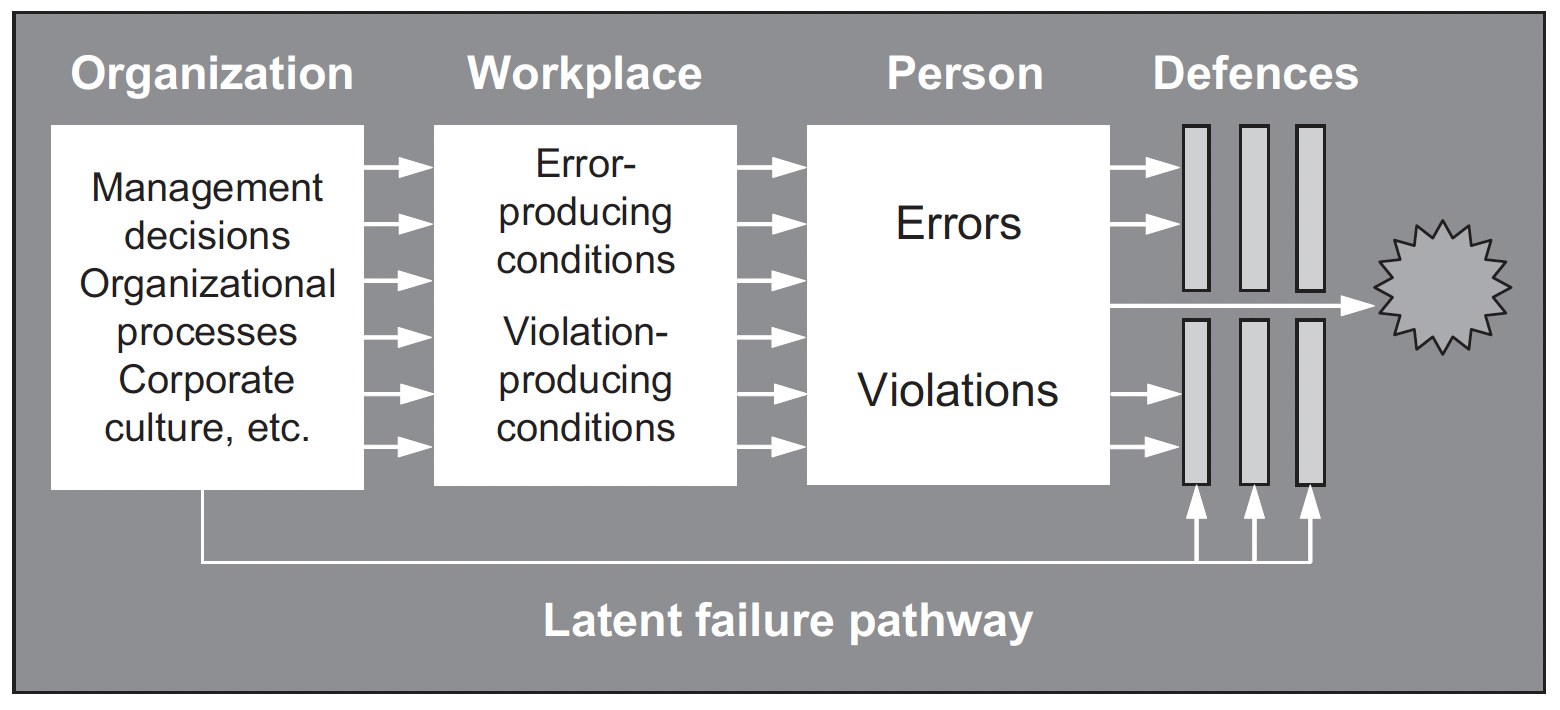
Source: Organizational Accidents Revisited, James Reason, 2016