
A traditional view of events and accidents is that they are caused by human competence, attention, or attitude shortcomings. It may be under the label of “loss of situation awareness,” “procedural violation,” or “poor management”. A new and different view is that human error is NOT the cause of failure but a SYMPTOM OF FAILURE – trouble deeper inside the system. Human error is not the chief threat to safety; latent organizational conditions set the stage for error and determine the severity of the consequences.
Human error is not just random. It is tied to features of people’s tools, their tasks, and the operating environment in which they work. In this perspective, human error is not the conclusion but the starting point of investigations.
The point of these investigations should be to prevent a recurrence, not simply to find people to punish. Investigations of accidents or events triggered by ACTIVE error are usually distorted by hindsight – the knowledge of facts after the event that was not known, or possibly even knowable, by the individual(s) involved in the event.
In traditional investigations, the investigators interview the people involved after understanding the requirements and becoming very familiar with the event’s details. Hindsight predisposes the investigator to search for information that confirms the individual’s apparent shortcomings. Further, explaining what people could have or should have done says nothing about why they did what they did. Analyzing events from the perspective of “why did the actions taken seem appropriate at the time?” goes a long way to preventing the same thing from happening in the future.
In HUMAN ERROR investigations, a key approach is to recreate the mindsets of those involved in the accident or incident scenario. Knowing the mindset does not mean getting into the mind of the individuals but rather determining the environment they found themselves in at the time that may have influenced their decision-making process. The challenge, therefore, is to determine why the actions of the individuals made sense to them at the time. With this new approach, investigators are encouraged to interview those involved with the incident BEFORE acquiring detailed knowledge of the event. This allows for gathering information without being biased by previous assumptions and information. This process of recreating the decision-making environment assesses the decisions and behaviors in their “context.” It is important to understand how facts—including decisions and behaviors—were influenced. Understanding context is the key to a successful human error investigation and learning lessons for the future.
This is important when:
- Preventing recurrence is more important than personnel punishment
- There is a desire to identify latent organizational conditions that create error-likely situations or weaken defenses – contributing to the severity of the incident or accident.
Recommended Practices When Using This Tool
Given a description of the event consequences (fatality, injury, facility shutdown, equipment damage, near miss, etc.), follow these steps.
1. Debrief the participants to help reconstruct the situation that surrounded them at the time and receive their point of view on the situation.
- Ask participants to tell the story from their point of view
- Tell the story back to them to check whether you understand the story as the participants understood it
- Identify with participants the critical junctures (moments in time when decisions and/or actions were required) in the sequence of events
- Progressively probe and rebuild how the world looked to people inside the situation at each juncture. At each juncture in the sequence of events, you want to get to know
- Which cues were observed (noticed or seen or did not notice what he/she had expected to notice?)
- What knowledge was used to deal with the situation? Did participants have any experience with similar situations that was useful in dealing with this one?
- What expectations did participants have about how things were going to develop, and what options did they think they had to influence the course of events?
- How did other operations or organizational influences help determine how they interpreted the situation and how they would act?
2. Use Questions to find out how the situation looked to people on the inside at critical junctions.
| Cues | a. What were you seeing? |
| b. What were you focusing on? | |
| c. What were you expecting to happen? | |
| Interpretation | What would you have said if you had to describe the situation to your crew member at that point? |
| Errors | What mistakes were likely at this point (for example, in interpretation)? |
| Previous experience and knowledge | a. Were you reminded of any previous experience? |
| b. Did this situation fit a standard scenario? | |
| c. Were you trained to deal with this situation? | |
| d. Were there any rules that applied clearly here? | |
| e. Did you rely on other sources of knowledge to tell you what to do? | |
| Goals | a. What goals governed your actions at the time? |
| b. Were there conflicts or trade-offs to make between goals? | |
| Taking action | a. Was there time pressure? |
| b. How did you judge you could influence the course of events? | |
| c. Did you discuss or mentally imagine a number of options or did you know right away what to do? | |
| Outcome | a. Did the outcome fit your expectation? |
| b. Did you have to update your assessment of the situation? |
3. Review the job-site conditions for each individual involved in the accident.
- Look for procedures, logs, computer printouts, recorders traces,
- Review the workplace and the equipment
4. Assemble all the data acquired to this point – These data should indicate a sequence of events and activities.
5. Lay out the sequence of events in context-specific language – The data as the investigator found them (or factual information) using time and space as organizing bases. Include people’s actions and observations, and changes in a process that happened.
6. Divide the sequence of events into episodes (chapters). An episode is a long stretch of time that (initially) makes sense from the point of view of the domain. For example, the time taken to taxi out to a runway is a meaningful chunk of time in which particular actions and assessments must be made to prepare for the next episode (taking off).
7. Find out what the world looked like during each episode. Find the data known to have been available to people during each episode (what their process was doing, what data was available). This is the first step toward coupling behavior and situation. Link up all the events that have been identified with the unfolding process.
- Find out how process parameters were changing over time, both due to human influences and the process moving along. Trace changing pressures, ratios, settings, quantities, modes, rates, etc.
- Find out how the values of these parameters were available to people – dials, displays, knobs that pointed certain ways, sounds, mode annunciations, alarms, and warnings. There will be mismatches between what was available and what people observed or used that do not explain anything by themselves.
- Decide which of all the parameters counted as a stimulus for behavior under investigation and which did not. Which of these indications or parameters were actually instrumental in influencing the behavior in the mishap sequence?
8. Identify knowledge, focus of attention, and goals. Reconstruct people’s unfolding mindset. Explain why their assessments or actions made sense to them at the time. This is done by re-establishing people’s knowledge, goals, and attention at the time.
- People have goals. They are in a situation to get a job done, to achieve a particular aim. People have knowledge. They use this to interpret what goes on around them. People’s goals and knowledge together determine their focus of attention..
- Use the principle that people do reasonable things given their knowledge, objectives, point of view, and limited resources. This is the step that takes the most work
Complete the following steps using the Anatomy of an Event model as a guide.
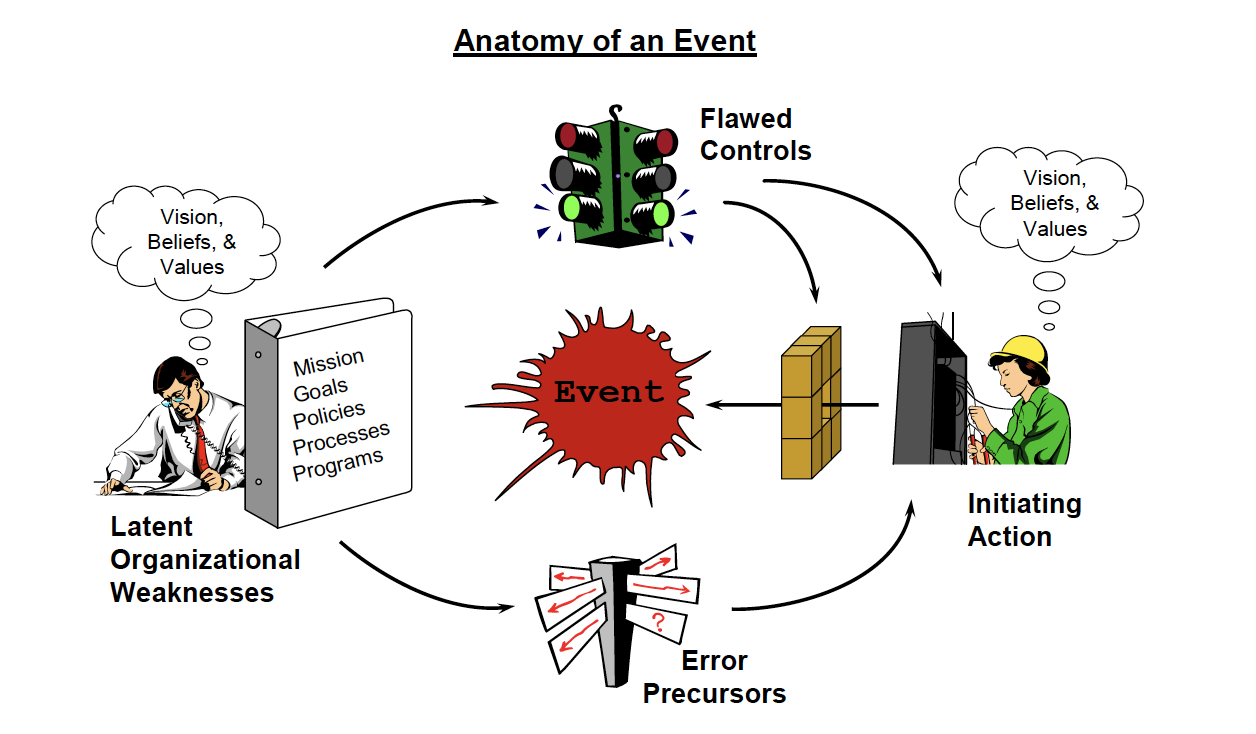
9. Identify the task(s) or activities associated with the initiating action.
10. Identify the defenses or barriers that failed to prevent, catch, or mitigate the consequences of the event (the behavior of the individual).
11. Identify the defenses or barriers that failed to prevent or mitigate the consequences of the event (the results to the facility).
12. Identify job-site conditions and error-precursors that provoked active errors or encouraging violations.
13. For the factors identified in 10, 11, and 12 above, trace the organizational process or cultural contributors.
Avoid These At-Risk Practices
- Learning too much about the event before debriefing the individuals involved
- Failing to debrief all the individuals involved in the event
- Failing to ask all the questions needed to establish the individual’s frame of mind (context of actions)
- Failing to adequately reconstruct the sequence of events as they occurred
- Assuming the system is sound; and free of latent weaknesses, conditions, or failures
- Ignoring the results of the front-end error investigation in the back-end analysis of flawed defenses, job-site conditions, and organizational contributors
- Concluding that the cause of the event was that the people involved in the event did not act reasonably and not identifying why
Source: Sidney Dekker and Department of Energy Human Factor manual