
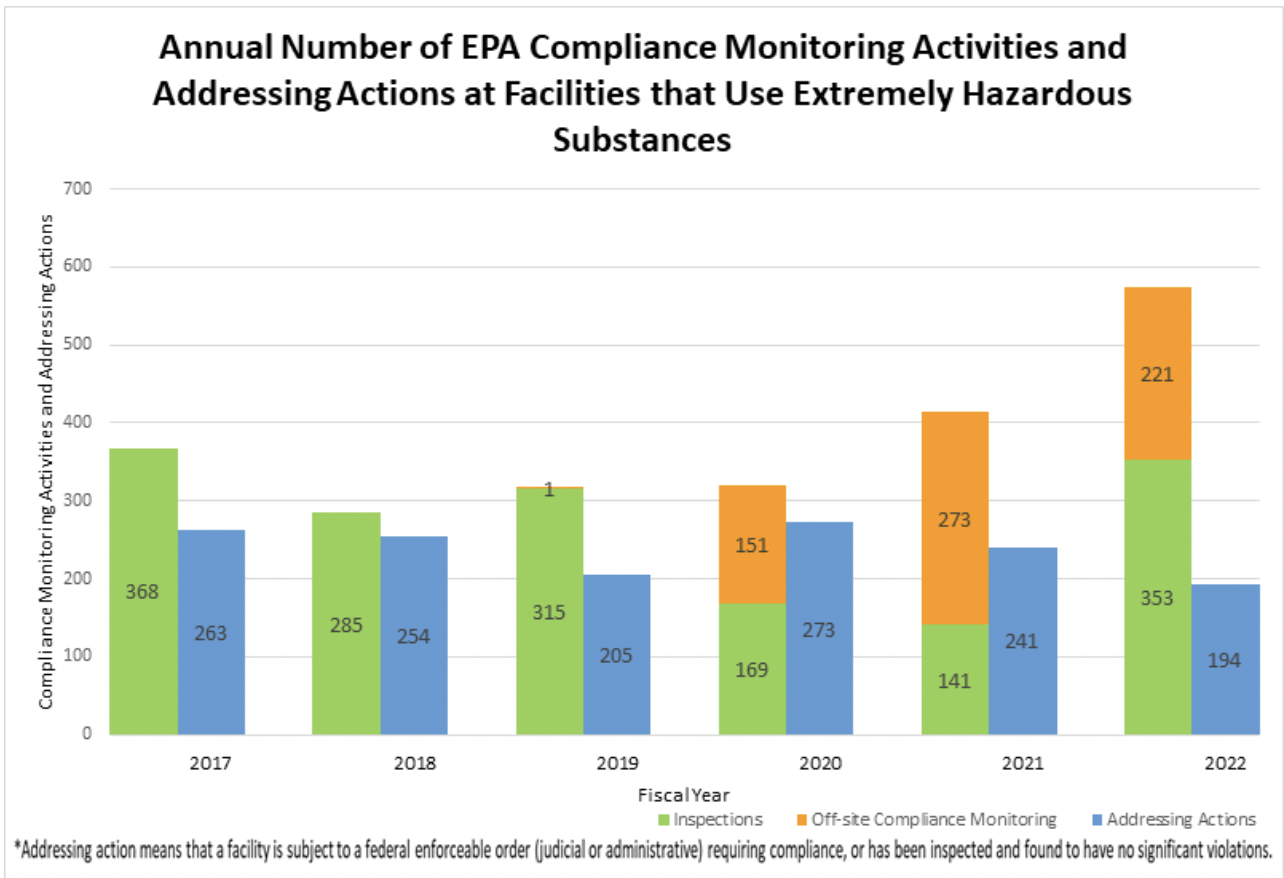
 In FY 2022, the agency continued its efforts to reduce risks of accidental releases at industrial and chemical facilities, such as:
-
Concluded three (3) judicial actions,
- 145 administrative penalty actions, and
- 18 administrative compliance orders
In FY 2022, EPA renewed its presence in the field and increased its on-site inspections by more than 150% compared to FY 2021.
EPA has addressed serious violations through enforcement actions. Examples of concluded enforcement actions in FY 2022 include two (2) judicial actions and 113 administrative penalty actions, close to 2021’s 117 actions.
- Formosa Plastics Corporation
- HollyFrontier El Dorado Refining LLC
- West Texas Gas
- Barnhardt Manufacturing Company
- Smith Frozen Foods
- Farmers Union Cooperative
- Fuller Industries
- TPC Group
- George Prepared Foods Corporation
- Packaging Corporation of America
EPA Delivered multiple trainings to states, local authorities, and/or OSHA staff:
- Inspector training to EPA, states, local authorities, and OSHA staff – These new inspectors will enhance EPA’s ability to monitor compliance and pursue necessary enforcement actions to address violations.
- The three-day Process Hazard Analysis (PHA) training – This specialized course for inspectors from EPA, OSHA, state, and local partners explains the PHA requirements under the Risk Management Program regulations, familiarizes participants with general hazard analysis theory, explains what is necessary to perform a complete PHA, and identify common deficiencies and issues associated with PHA execution. The hazard analysis requirements of the Risk Management Program regulations and the General Duty Clause are fundamental to identifying the potential causes of chemical accidents and designing processes so that they are safer and less likely to experience a chemical release.
- The three-day Natural Gas Processing Plants (NPG) training – The purpose of this course is to train inspectors on how the requirements of the Risk Management Program applies to natural gas processing plants, review the recognized and generally accepted good engineering practices (RAGAGEP) applicable to the NPG industry, and to identify common deficiencies in NGP RMP programs.
- Understanding Codes, Standards & Mechanical Integrity Training – This three-day course is designed for staff from EPA, OSHA, and state and local partners. The course explains the use of codes and standards developed and used by industry to ensure the safe operation of facilities. It also explains the process of developing a mechanical integrity system used to reduce the likelihood of accidents.