
 As more facts are coming to light regarding the runway incursion incident at JFK on January 13, 2023, it appears that a “safety system” used by ground controllers may have saved the day. In the NTSB’s preliminary report on the incident, it is stated:
The ASDE-X alerted the JFK ATC tower to the conflict, and the tower controller issued a takeoff cancellation to DAL 1943.
The Airport Surface Detection System — Model X (ASDE-X) is a surveillance system using radar, multilateration, and satellite technology that allows air traffic controllers to track the surface movement of aircraft and vehicles. It was developed to help reduce critical Category A and B runway incursions.
The preliminary report does NOT draw any conclusion, but it does make clear that this “safety system” is what alerts the traffic controllers of the “conflict.” I would love to know the means that the ASDE uses to alert the controllers of any conflict, as imagine the controller(s) not recognizing the alarm by not hearing a tone or not seeing the indicator.
A special NOTE regarding the ASDE system… it is in use at ONLY 35 airports in the USA.
Here is what we know so far…
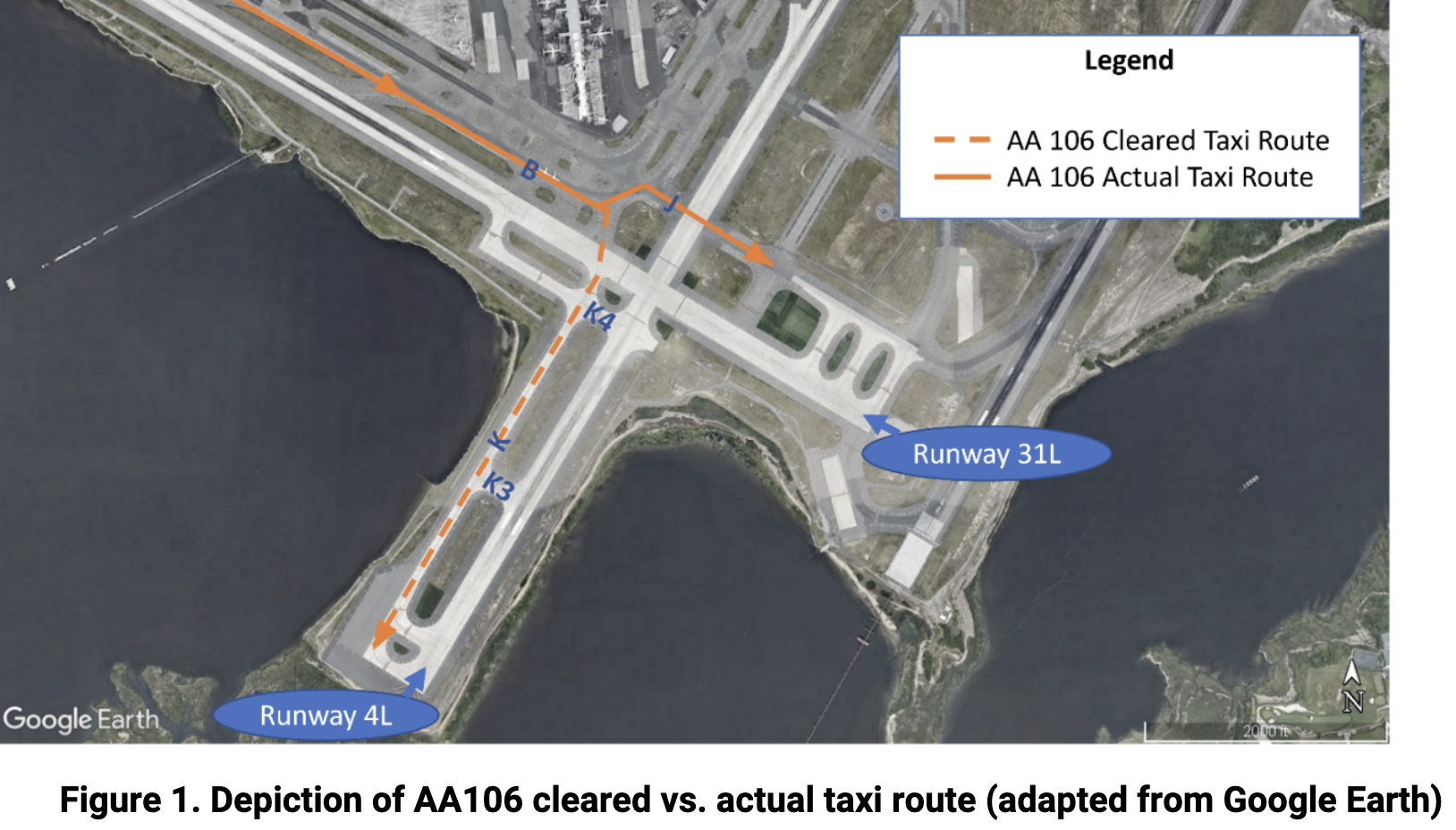
AA 106 was instructed to taxi from the ramp to Runway 4L via taxiway B and hold short of taxiway K. As the aircraft left the ramp, the ground controller cleared AA 106 to cross runway 31L at taxiway K. Upon reaching the Taxiway B/Taxiway K intersection, AA 106 continued straight to taxiway J, crossing runway 4L WITHOUT ATC CLEARANCE.
At the time AA106 entered on runway 4L at taxiway J, DAL 1943 had begun its takeoff roll, increasing speed through 80 knots, and was abeam taxiway K3, about 2700 feet from the taxiway J intersection.
The ASDE-X alerted the JFK ATC tower to the conflict and the tower controller issued a takeoff cancellation to DAL 1943.
The DAL 1943 crew aborted takeoff at about 100 knots and came to stop about 500 feet short of taxiway J.
The closest point between the two aircraft was about 1400 feet and occurred as DAL 1943 decelerated past taxiway K4 and AA106 exited the runway at taxiway J.
On February 1, 2023, NTSB conducted ATC interviews, which were audio recorded for transcription. Recorder data from both aircraft were obtained.
Cockpit voice recorder data were both overwritten.
Flight crew statements were received. In addition to the crew statements, NTSB attempted to interview the American Airlines flight crew three different times.
American Airlines cleared the flight crew’s schedule to ensure their availability; however, the flight crew refused to be interviewed on the basis that their statements would be audio recorded for transcription. On behalf of the crew, the APA party representative informed the NTSB that the crew would not consent to participate in audio recorded interviews in any manner.
NTSB has determined that this investigation requires that the flight crew interviews be audio recorded and transcribed by a court reporter to ensure the highest degree of accuracy, completeness, and efficiency.
As a result of the flight crew’s repeated unwillingness to proceed with a recorded interview, subpoenas for their testimony have been issued.
We should not jump to conclusions until all the facts are obtained and evaluated; however, when the pilots union is shielding the pilots simply because they oppose the interviews being recorded is quite concerning. With BOTH cockpit voice recorder data having been overwritten, these interviews are critical for understanding the actual human failures associated with this incident.
Source: CAROL, Case Analysis and Reporting Online; Search using Incient # DCA23LA125