
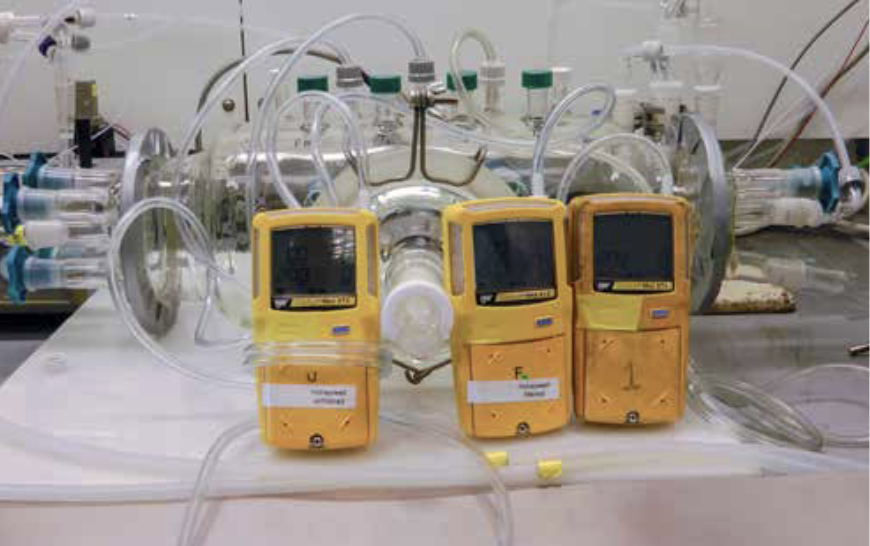
 A fatal explosion at a chemical facility in 2018 killed a welder who was carrying out maintenance work on a mixing vessel. The HSE investigation found that toluene vapors had leaked into the vessel from faulty valves, producing a flammable atmosphere. Workers had checked the atmosphere with a flammable gas monitor before their work began. However, the gas monitor had failed to detect the presence of flammable vapor. Hot work had proceeded in the belief that there was no flammable vapor present.
Specialists at HSE’s laboratory analyzed the gas monitor’s data logs and tested its response. This showed that the MONITOR HAD BEEN INCORRECTLY SET UP. As a result, the monitor took about 7 minutes to alarm on exposure to flammable toluene vapor. It should have taken less than 2 seconds.
The laboratory tests included testing the incident gas monitor and other differently configured monitors against a variety of test vapors using HSE’s Standard Atmosphere test facility. The analysis showed that a significant contributor to the failure of the monitor to detect the flammable toluene vapor was it being adsorbed on the inner surface of the sample tube. This meant that when the monitor was used during the incident, no flammable vapor had reached the detector before the monitor test was completed.
Other factors included the incorrect flammable gas sensor and that the monitor was configured for methane rather than toluene. The issues with the monitor resulted in a false conclusion that the work area was free of flammable vapor.
a maintenance contractor, 46, was carrying out repair work on a mixing vessel during a planned period of shutdown maintenance when he was killed in an explosion on 27 July 2018.
It’s believed that while using a grinder or welding torch on the vessel, the heat from the tool ignited some Toluene vapor inside the vessel. Toluene residue had been left inside the vessel, which should not have been the case when maintenance work was being undertaken. There were also some leaks found in a Toluene supply pipe outside of the vessel which could have contributed to the blast. Prior to the incident on 27 July 2018, operatives had transferred a large quantity of Toluene from one storage tank to another through the supply pipe. It was thought that this action allowed flammable liquid to leak into the vessel.
The owner of the site admitted they had failed to take all necessary measures to prevent the explosion and pleaded guilty to a breach of Regulation 5 of the COMAH Regulations 2015 and was fined £1m and ordered to pay costs of £10,967.20.
Here is the Safety Alert…
Introduction
- Gas detection may be used in support of a risk assessment associated with, for example, hot work or confined space entry. It is important that the gas detection system used is suitable for the intended purpose and gives a sufficiently accurate and reliable indication of the presence of the hazardous material. Pumped gas detectors can be used to sample locations at a distance from the detector via a sampling tube.
- In a recent incident, a gas detector failed to detect a flammable atmosphere. Hot work proceeded based on the false reading. The hot work resulted in the ignition of a flammable atmosphere and a fatal injury.
- While there were errors in the selection and set-up of the gas detector, the most significant contributor to the failure of the gas detector was the adsorption of the flammable vapor on the surface of the sample tube before it could reach the gas detector.
- This safety alert is to remind operators of the need to ensure the suitability of the gas detection system for its intended purpose.
Background
- The gas detector involved in the incident was performed in accordance with the manufacturer’s specifications.
- The manufacturer’s technical performance information reported that it was not suitable for the detection of the substance to be measured. The detector was being used for a substance other than its calibration gas but had not been configured to include a correction factor. Each of these issues would have resulted in an incorrect reading. On this occasion, if these had been the only faults the reading would still have been sufficient to result in a decision not to proceed with the hot work.
- The most significant contributor to the failure was the adsorption of the substance of interest on the inner surface of the sample tube. During laboratory testing of the gas detector and at a concentration of 50%LEL (lower explosion limit) of the substance involved, the sample tube extended the time to achieve a non-zero reading by more than 1 minute. This extension was considerably longer than the time taken to test at any particular location with a recommended sample tube fitted. At 50%LEL of the substance involved, the time to achieve 90% of the final reading was over 15 minutes.
- The same gas detector and sample tube had a response time of less than 5 seconds to the calibration gas (methane).
- The phenomenon of adsorption of some substances on sample tubes is known. It is mentioned in each of the references to this safety alert and has been studied in previous HSE research (eg Research Report RR635).
- A REVIEW OF MANUALS FOR GAS DETECTORS FROM A RANGE OF MANUFACTURERS HAS IDENTIFIED THAT MOST MANUALS INCLUDE LITTLE OR NO INFORMATION ON THE IMPORTANCE OF SELECTING A SAMPLE SYSTEM OF A SUITABLE MATERIAL.
- While the incident to which this safety alert refers involved a highly flammable substance and measurement of LEL, similar issues may apply to some other gases, particularly reactive gases such as H2S and NOx.
Action required
- Operating instructions for most gas detectors recommend a function check (often referred to as a “BUMP TEST”) before each day’s use. This is in addition to the requirement for periodic calibration. It is recommended in the case of gas detectors that will be used with a sample tube, at least the first function check (“bump test”) for a new intended use and/or a new sampling configuration be conducted using the combination of the gas detector and its sample tube and the substance of interest, where practicable. This is of particular importance if the substance of interest is not the substance used to calibrate.
- For example, the head space in a sample jar containing a liquid sample of the substance of interest at a temperature above its flashpoint would be expected to give an output representing greater than 100% LEL.
- Sample tubes should be as short as possible. The increase in response time should not exceed the response time of the gas detector without a sample tube plus the delay time specified in the gas detector manual or, where no time is specified in the manual, 3 seconds per meter (eg BS EN 60079-29-1:2016, section 5.4.15). The combination of the gas detector and sample tube should be considered unsuitable where this time is exceeded.
- Particularly for spot testing, users should be aware of the response time of the combination of the gas detector and its sample tube.
Relevant legal documents
- Provision and Use of Work Equipment Regulations 1998. Approved Code of Practice and guidance. L22 (4th edition) HSE November 2014
- Dangerous Substances and Explosive Atmospheres Regulations. 2002 Approved Code of Practice and guidance. L138 (2nd edition) 2013
- A guide to the Control of Major Accident Hazards Regulations (COMAH) 2015. L111 (3rd edition) HSE June 2015
References
- BS EN 45544-4:2016 Workplace atmospheres — Electrical apparatus used for the direct detection and direct concentration measurement of toxic gases and vapours Part 4: Guide for selection, installation, use and maintenance
- BS EN 60079-29-1:2016 Explosive atmospheres Part 29-1: Gas detectors —Performance requirements of detectors for flammable gases
- BS EN 60079-29-2:2015 Explosive atmospheres Part 29-2: Gas detectors — Selection, installation, use and maintenance of detectors for flammable gases and oxygen
- The selection and use of flammable gas detectors (PDF)
- Research Report RR635 Effect of tubing type on gas detector sampling systems
CLICK HERE for the 2023 Annual Report
CLICK HERE for the HSE Safety Alert