
Thanks to Ross W Skaggs, CSP (ret) , for another pic – follow him @ LinkedIn for more.
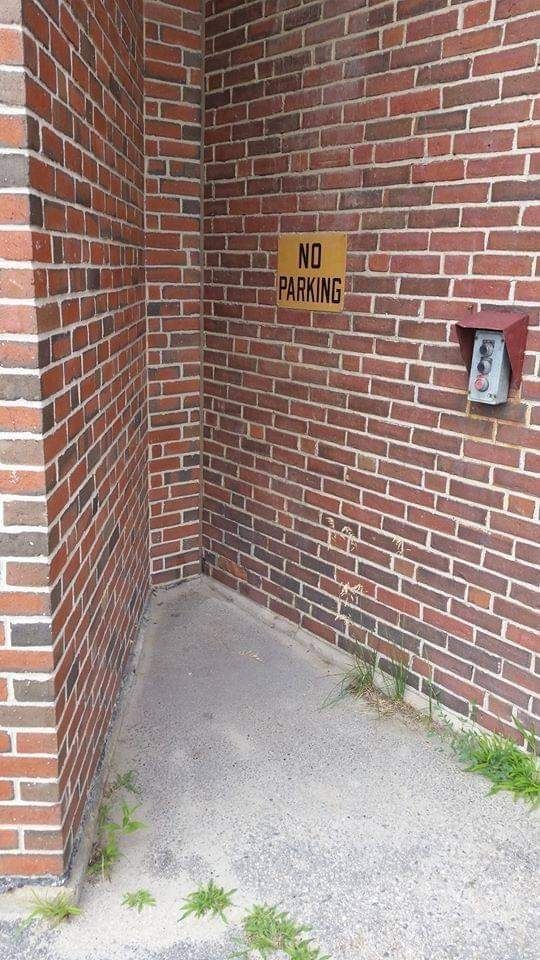
Today’s pic will make you scratch your head and maybe wonder how that could happen. “No Parking” signs may be one of society’s most widely used signs. They convey a simple directive, yet can you guess the #1 non-moving violation on our roadways? Yep, parking violations. Here we see the use of the sign that obviously was most likely needed at one time, and then change comes along, and the building grows, making the sign’s placement comical – yet no one took the time to remove the sign.
One of the main problems with using “safety” signs as a “safety control/safeguard” is putting them up and NOT managing them. This leads to workers not respecting the message and, thus, why these safety signs often fail to elicit the behavior(s) we need. Many of us may use the phrase “sticker safety” as many of us have walked into a facility and seen safety stickers and signs all over the place (floors, walls, hanging from ceiling, doors, etc.); yet the behaviors we are observing in the presence of the safety signs are far from what the signs are conveying!
For a real-life example, the next time you’re out and about in public businesses, government buildings, private companies, etc., look around, and you will see we have NOT cleaned up after the Pandemic. In my travels since the Pandemic, especially since our government officially declared it over, I still see signs posted requiring 6′ separation, elevators that have # of passenger limitations, empty hand sanitizer stations that are in just a gross state now, stickers on floors showing how to achieve 6′ separation, masking requirements, etc. And do you know that NO ONE IS FOLLOWING the instructions of these “safety signs”! Are we supposed to behave as the signs still instruct us?
This lax safety environment teaches/conditions humans to IGNORE special safety signs. We learn to have very little confidence in them, leading us to ignore the legitimate signs and safety instructions they attempt to convey. We have all seen this in our own workplaces… signs that are so old and faded they no longer are effective in their ability to provide proper warnings or instructions, or signs (like the one above) that are no longer needed but still reside – stating a nonessential safety requirement.
As we have heard before… WORDS MATTER. And in the use of safety signs, words do matter, but the size of the lettering also matters, the color of the letters matters, the color of the background matters, the orientation of the sign matters, the proper use of Caution, Warning, Danger wording matters. Some facilities are unaware that 1910.145 Specifications for accident prevention signs and tags even exist. When was the last time you read 1910.145 or audited your workplace signage for accuracy and compliance? We could probably write a book on some of the crazy things we have seen regarding “safety signs”. I have over a dozen postings on the mis-use of the NFPA labels, and some will just make you shake your head or how about all the confusion we saw in signs when OSHA adopted the GHS in 2012 and the OSHA Categories were the exact opposite of NFPA’s Classifications.
Bottom line… if we want our safety signs to elicit the behavior we need, then we need to MANAGE them as actual ADMINISTRATIVE CONTROLS. 1910.145 is a great starting place to establish expectations for safety signage.
TIP: the next time your facility performs its annual PRCS program review, ensure that review includes an inspection of the PRCS labeling on those spaces.