
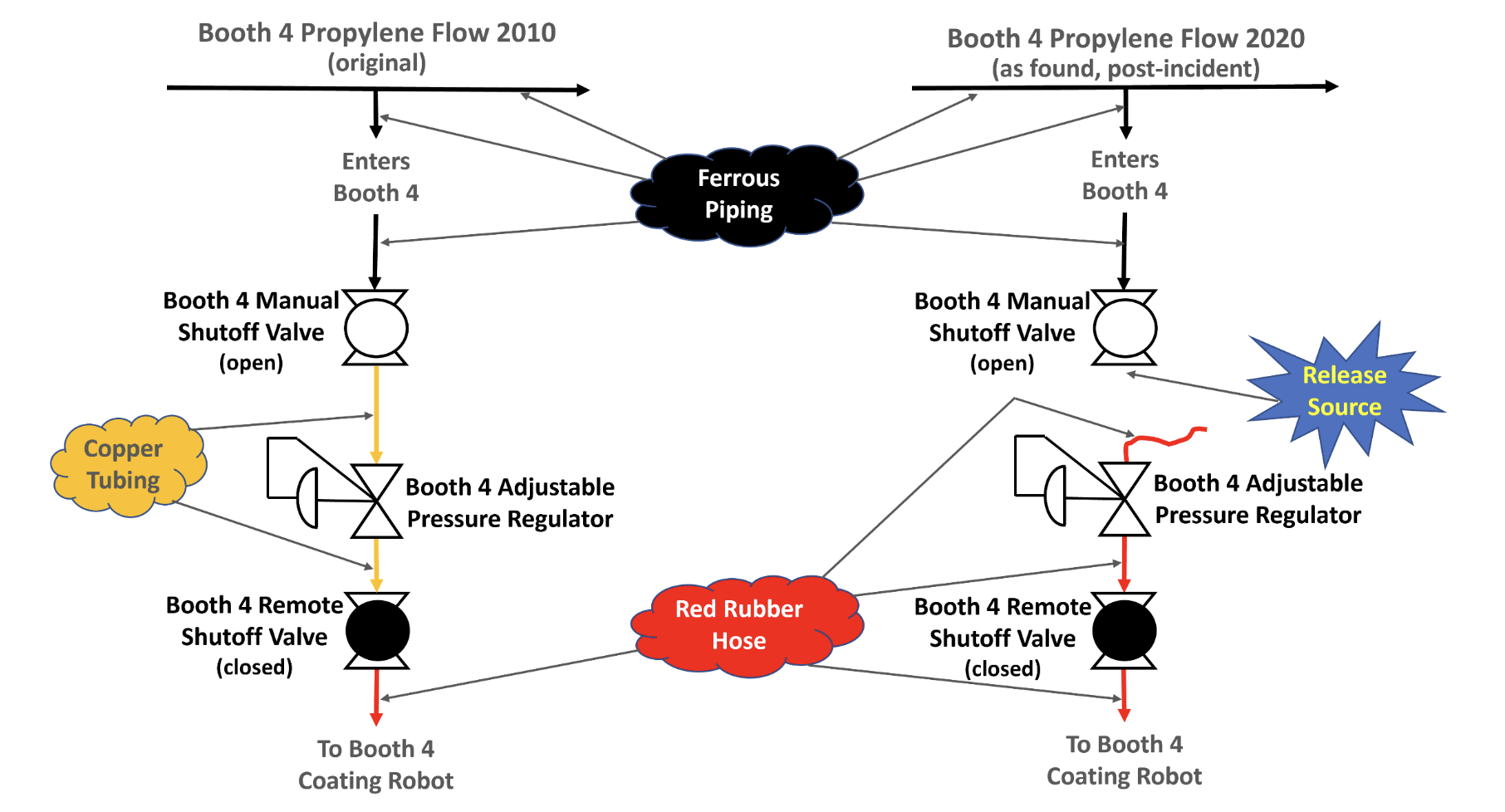
The incident occurred shortly after 4:30 am on January 23, 2020, when an accidental release of propylene accumulated and exploded inside the building. The CSB found that before the incident, a hose disconnected from its fitting inside a coating booth and released propylene, a flammable hydrocarbon vapor, which accumulated inside the coating building. When employees arrived at the facility early on the morning of January 23, an explosive concentration of propylene had formed inside the building. When one of the employees entered the building and turned on the lights, the flammable vapor ignited, triggering the explosion.
CSB released its final investigation report on the 2020 propylene release and explosion at a grinding facility in Houston, Texas, that fatally injured two workers and a nearby resident and damaged hundreds of neighboring homes. The CSB’s final report highlights several safety issues:
- Rather than using the rigid copper tubing, as in other booths, the failure appeared to have occurred in a booth where these items were substituted with a single section of Grade R flexible red rubber welding hose. The disconnected hose was found to be degraded. This is partly because it was not the appropriate material grade for a propylene service hose. In addition, several years before the incident, the facility went from using factory-crimped hose within each coating booth to crimping its own hoses for that application on-site. The facility did not have a procedure for crimping, nor were its employees formally trained on how to crimp fittings onto the rubber welding hose properly.
- Following the 2010 rebuild of the coating building, the practice was to isolate the propylene storage tank at the end of each workday. Over time, however, supervisors developed inconsistent practices concerning isolating the propylene storage tank at the end of the workday. The Coating Supervisor, who was normally responsible for shutting down the facility at the end of each workday, would sometimes close at least one of the two propylene manual shutoff valves at the storage tank at the end of the workday. He would typically do so, however, only on days when the workers did not plan to be at the facility for over the next 24 hours (or longer). The Coating Supervisor felt that closing the manual shutoff valve after the end of each workday and then having to open the valve the following workday prevented a quicker morning startup.
- Six of the eight coating booths had a wall-mounted gas detector. Each gas detector was originally configured to transmit a signal to the programmable logic controller (PLC), a type of computer control system when its gas sensor(s) detects the pre-set concentration level of flammable gas or oxygen. Upon the receipt of a signal from one (1) of the gas detectors, the PLC was originally configured to:
- Trigger, both audible and visual, alarms notifying employees that propylene had been detected inside a coating booth and to take appropriate action (evacuate);
- Automatically start up the booth’s exhaust fan to help remove flammable gas from inside the booth if the fan is not already running;
- Automatically close the remote shutoff valve inside the individual coating booth where gas is detected; and
- Automatically close the remote shutoff valve at the propylene storage tank, thus shutting off the flow of propylene (see Figure 7).a
At the time of the incident:
1) the automated gas detection alarm,
2) exhaust fan startup, and
3) gas shutoff system
were NOT FUNCTIONAL.
Had the system been functional, it would have
1) alarmed to alert employees,
2) started up the exhaust fan, which would have removed the leaking propylene from inside the booth, and
3) remotely shut off the propylene storage tank, stopping the flow of propylene vapor and likely preventing the dangerous accumulation of propylene from Booth 4.
- Several years before the incident, facility management disabled the safety function of its automated gas detection alarm, exhaust fan startup, and gas shutoff system, essentially disconnecting it from the computer control system (a PLC), that should have automatically triggered the closure of the remote shutoff valve at the propylene storage tank. Gas sensor calibration contractors visited the coating building in 2013, 2016, and 2019, and raised concerns in writing that the gas detection system was disconnected from the PLC. Management also discussed two weeks before the incident that the booths’ gas detectors were not
connected and needed to be fixed. Management did not address these issues prior to the incident. - In addition, the facility had no testing program in place to ensure the functional integrity of the automated gas detection alarm, exhaust fan startup, and gas shutoff system. As a result, once the propylene leak began inside Booth 4, the alarms did not activate, the exhaust fan did not start up, and the remote shutoff valve at the propylene storage tank did not close, allowing propylene to accumulate to explosive levels inside the coating building.
- The facility’s ineffective emergency response plan – the emergency response plan did not address responding to a propylene gas leak, and the facility did not train its employees to recognize or respond to a propylene gas release
KEY NOTES:
- The propylene used at the facility was NOT odorized
- The process did NOT exceed the PSM/RMP thresholds and the flammable gas was being used as a “fuel”
- The CSB estimated that approximately 2,600 pounds of propylene were released
- The company filed a petition for voluntary Chapter 11 reorganization bankruptcy leading to an initial layoff of 80 of the company’s 130 employees. The explosion destroyed the coating building and caused heavy damage to the administration building and valve shop. The company was later liquidated under bankruptcy proceedings and is no longer in business.
As a result of its findings, the CSB is issuing recommendations to encourage both companies and standard-setting bodies to share information from the CSB’s report, as well as existing industry guidelines that emphasize the need for an effective process safety management system.
https://www.csb.gov/assets/1/6/watson_final_report_2023-06-29.pdf