
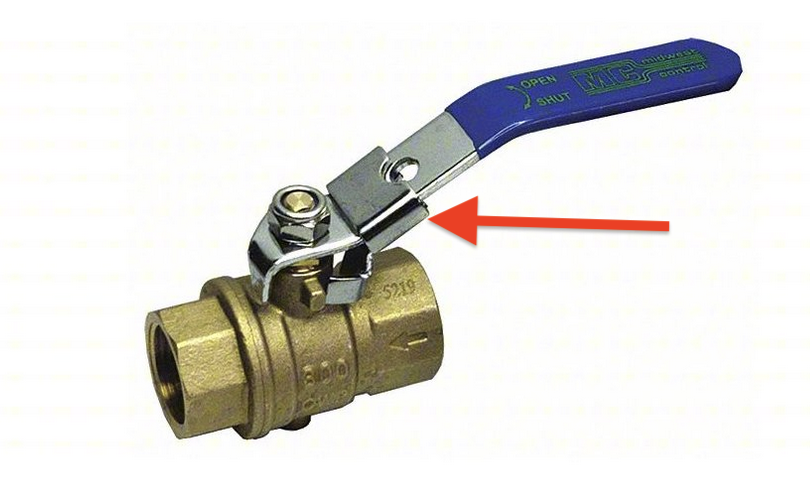
 One of the most common valves used in industrial settings is the 1/4-turn ball valve. From 1/4″ up to 6″, these valves are everywhere, regardless of the risks they may pose. Recently a client and I discussed these valves and their risk in highly hazardous chemical processing. I have had several incidents over my career where this type of valve led to LOPC events, some of which were severe. The discussion centered around process safety, but what got our attention was their use in energy control/LOTO and Car-Seal.
These valves, by design, require the operator to move the valve handle 1/4 of a turn to OPEN/CLOSE the ball valve FULLY. This means that once the handle is moved, even the slightest, we have flow through the valve. This small movement can be disastrous in many situations. So the question was asked, if we allow these 1/4 turn valves in the process, should we require they be equipped with the sliding/lockable tab (see red arrow in image)? This sliding tab physically prevents the handle from moving the slightest; however, the $60,000 question was: Can we lock out one of these valves WITHOUT the sliding tab so the valve will securely stay closed? The results are in, and it was a unanimous decision…
NO!
Our test was simple. We attached a water hose to most of the brands/models the facility used. We did this only on those valves smaller than 1″ in diameter. Basically, bleed/vent/drain valve sizes.
We then had operators “lockout” the valve in the CLOSED position using the tools/equipment/devices they usually use on this type of valve. They did not know they were part of the test in the first round of testing. We wanted to see how tight they would attempt to get the chain/cable around the valve and handle. We then just tried to move the handle to OPEN the valve. If water came out, it was a failed test. 100% of the valves failed their first round (i.e., we got water to flow through the partially open valve)
In the second round, the operators knew what we were doing, so they did their best to secure the valve in the CLOSED position. Even using tools to tighten the cable around the valve. 70% of the valves failed in that round. And we did not use tools or crazy forces to crack open the valve.
In the last round, we told the operators to use the sliding lockable tab in their LO of the valve. Many operators had never used this tab; a few never bothered to ask or understand what the tab was for. This tab was NOT part of their operator training in their “valves training,” nor was it part of their “LOTO training.” Once they were shown how it operates, they were blown away at how simple lockout was using the sliding tab. In this round, 100% of the valves passed.
These devices also make a handy spot to apply CAR-SEAL devices.
But the bottom line is a lot of 1/4 turn ball valves are not equipped with these lockout devices, yet they are being used regularly in energy control plans. Some valves were purchased with these tabs, but the tabs were never part of the MI/PM for these valves, and once broken/gone, they were never replaced/repaired. Sometimes the business will buy the cheaper valves that do not come with this feature. And when they are on the valves, as indicated above, oftentimes they are not part of the valve training for operations or in LOTO training.
But these little tabs make a world of difference!
Image Source: Grainger