
I can remember our first attempt at writing SOPs for our PSM covered process(s):
Deviation is “High Pressure” in V-1
Steps to Correct “High Pressure”:
1) Lower Pressure
Sound familiar? We chuckle now, but in the early 1990’s we thought this was the intent. We still find this kind of PSM/RMP SOP in 2023; however, most businesses have matured beyond this silliness.
But when it comes to LOTO, which is older than the PSM standard, we still find a lot of immaturity in Machine/Equipment-Specific Procedures when verifying each energy source is at a ZES. The most common phrase in the step(s) to verify ZES is…
“Verify zero energy state”
For a step in the process to be so critical, we would hope that the specifics are provided, but in our experience, it is not. So, how specific does our procedure have to be?
| 1910.147(c)(4)(ii)(D) Specific requirements for testing a machine or equipment to determine and verify the effectiveness of lockout devices, tagout devices, and other energy control measures. |
The simple answer is “specific enough to ensure the authorized worker(s) can verify the energy source is at a ZES.”
We typically find a general comment in the machine/equipment-specific procedures to use the “Start/Stop Button” on the control panel. Unfortunately, this may only apply to the electrical LO. Other energy sources, such as air, water, steam, nitrogen, etc., are most likely NOT verified to be at a ZES using the “Start/Stop Button.”
Here is an example from a nationally recognized business that provides services to write machine-specific procedures…
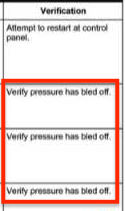
*This cut and paste from their marketing materials was captured on 9/6/23.
Notice anything lacking in its Specific requirements for testing a machine or equipment to determine and verify the effectiveness of lockout devices, tagout devices, and other energy control measures?
How does the authorized worker(s) “verify pressure has bled off” to a ZES?
What valve/device/method do they use to bleed the pressure?
What gauge/method do they use to verify the pressure is at a ZES?
This is what is meant by “specific requirements”
Here is an example of how SAFTENG writes our machine/equipment-specific procedures. You will notice this is an air source, and the only means to isolate it is a 1/4-turn ball valve (which I have written about numerous times). Simply closing and locking this valve CLOSED does NOT achieve a ZES. So, my procedures walk the authorized employee through the specific means to achieve a locked-out state at a ZES.
As you will see, I believe in color coding my procedures; RED SQAURES are for Isolation devices, GREEN SQAUARES is for achieving a ZES for a stored energy source, and BLUE CIRCLES is the means to verify ZES.
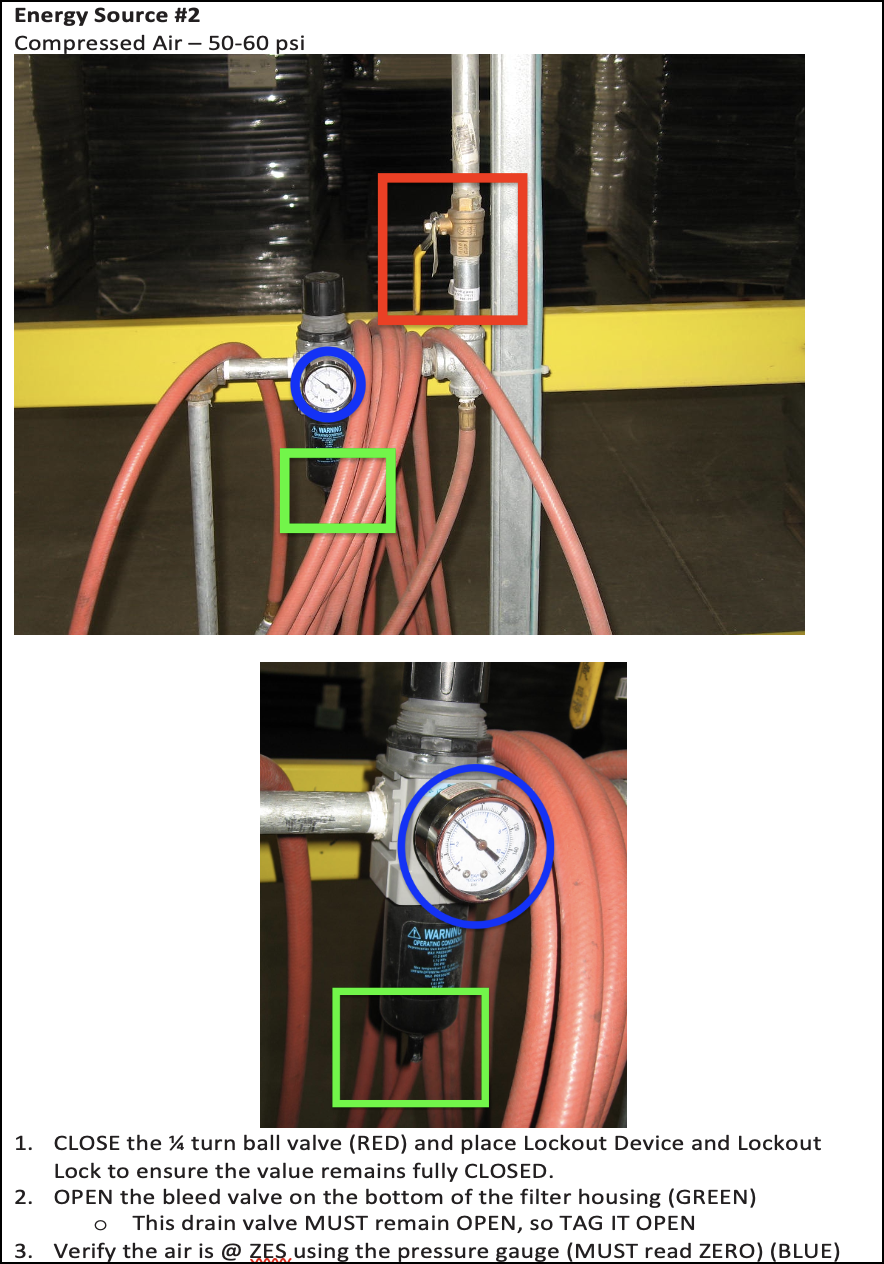
Did you notice step #2?
We always require the means/methods to achieve the ZES for a “stored energy source” to be LOCKED in that position to ensure that should the isolation valve leak/bleed by, the energy source can NOT re-accumulate to a hazardous level. This is a fundamental step for us, but it also ensures compliance with
|
1910.147(d)(5)(ii) If there is a possibility of reaccumulation of stored energy to a hazardous level, verification of isolation shall be continued until the servicing or maintenance is completed, or until the possibility of such accumulation no longer exists. |