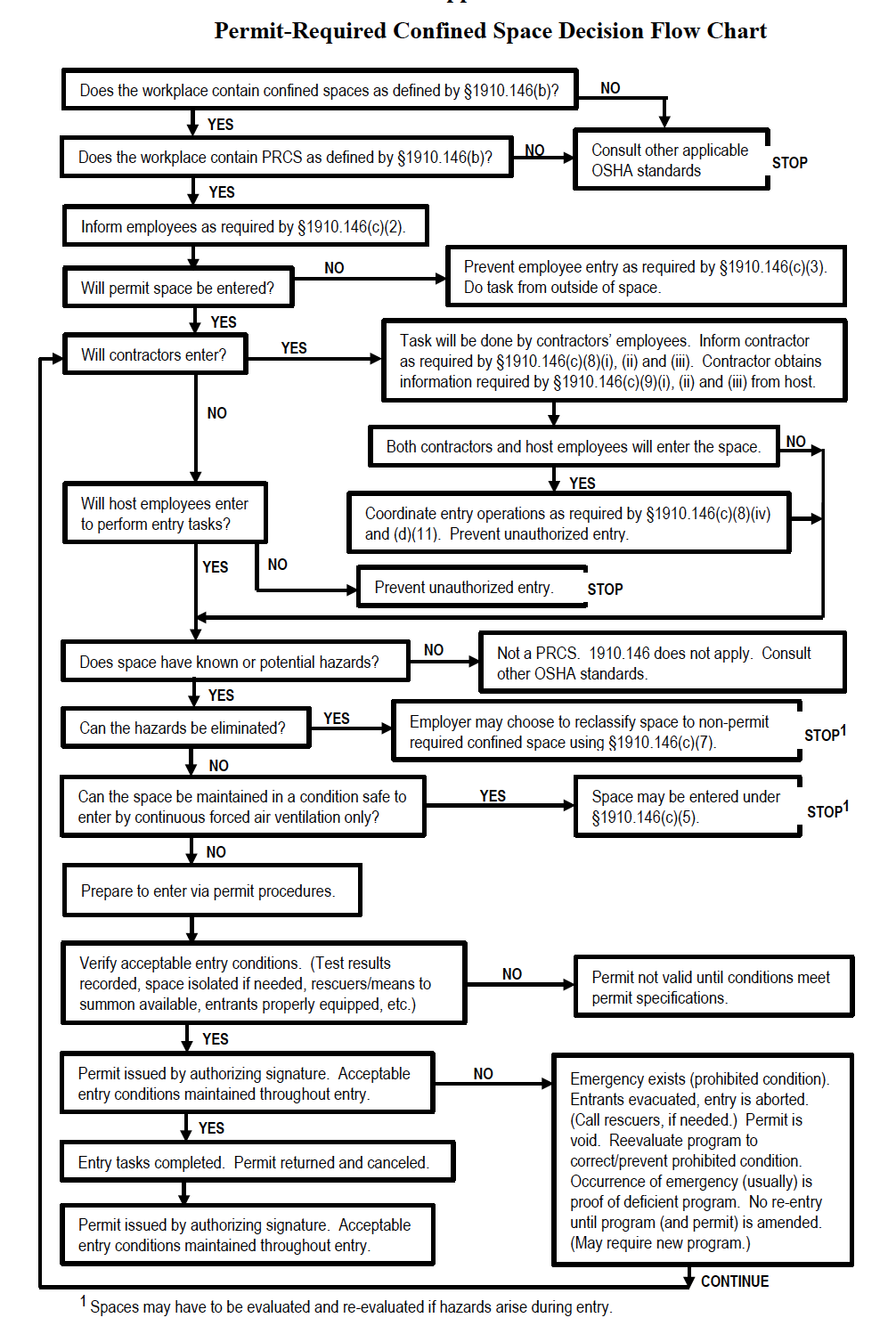
I have written over 180 articles on the topic of Permit-Required Confined Spaces. We can agree there is a lot to write and talk about on this topic. In our travels, we do a lot of work with clients around their PRCS management; most of the time, this work is more “technical.” In this article, I want to explain how we should manage our PRCS Entry programs as a mini “safety management system.” Please remember that much of what I will discuss is NOT an OSHA requirement. However, I will use 1910.146 as the framework for the article.
Any PRCS entry management system begins with the written program. And as I wrote about last week, Is shorter better? (Part II – PRCS Program) the written program is the core of the management system. Every item I will discuss in this article MUST be explained, in detail, how each piece of this pie works together to manage the incredible risks associated with PRCS entry.
After our program is in place, with management approval and support, the next step may be the most critical. Evaluating our facility for Confined Spaces and those that rise to the level of a Permit-Required Confined Space. The evaluation step can be extensive; as I said, it may be the most critical step in the management system. Of course, the permitting and atmospheric sampling are the critical paths in the entry operations.
Who does the evaluations can make or break the entire program. A few years ago, we were part of an investigation involving a PRCS fatality. In that investigation, I was shocked to learn that a college intern performed the facility CS/PRCS evaluations. I am sure this individual did the best they could; however, they did the entire facility with no training on how to perform an evaluation. And they certainly were not “qualified” as a college sophomore to perform this function. On top of this, no one followed up to audit/assess their work to verify the facility evaluation was done correctly. I call this they Quality Assurance Element of the SMS. Some level of followup would have identified that this person was making some critical errors in their evaluations.
Documenting EACH space evaluation is our next step. OSHA has repeatedly said that they do not require the evaluation to be documented. That is a major miss by OSHA, but remember, OSHA compliance is the bottom of the safety barrel. What I am proposing will make our program the cream floating at the top of the safety barrel.
SAFTENG members can download the working copy of my CS/PRCS Evaluation Form from the Document Library.
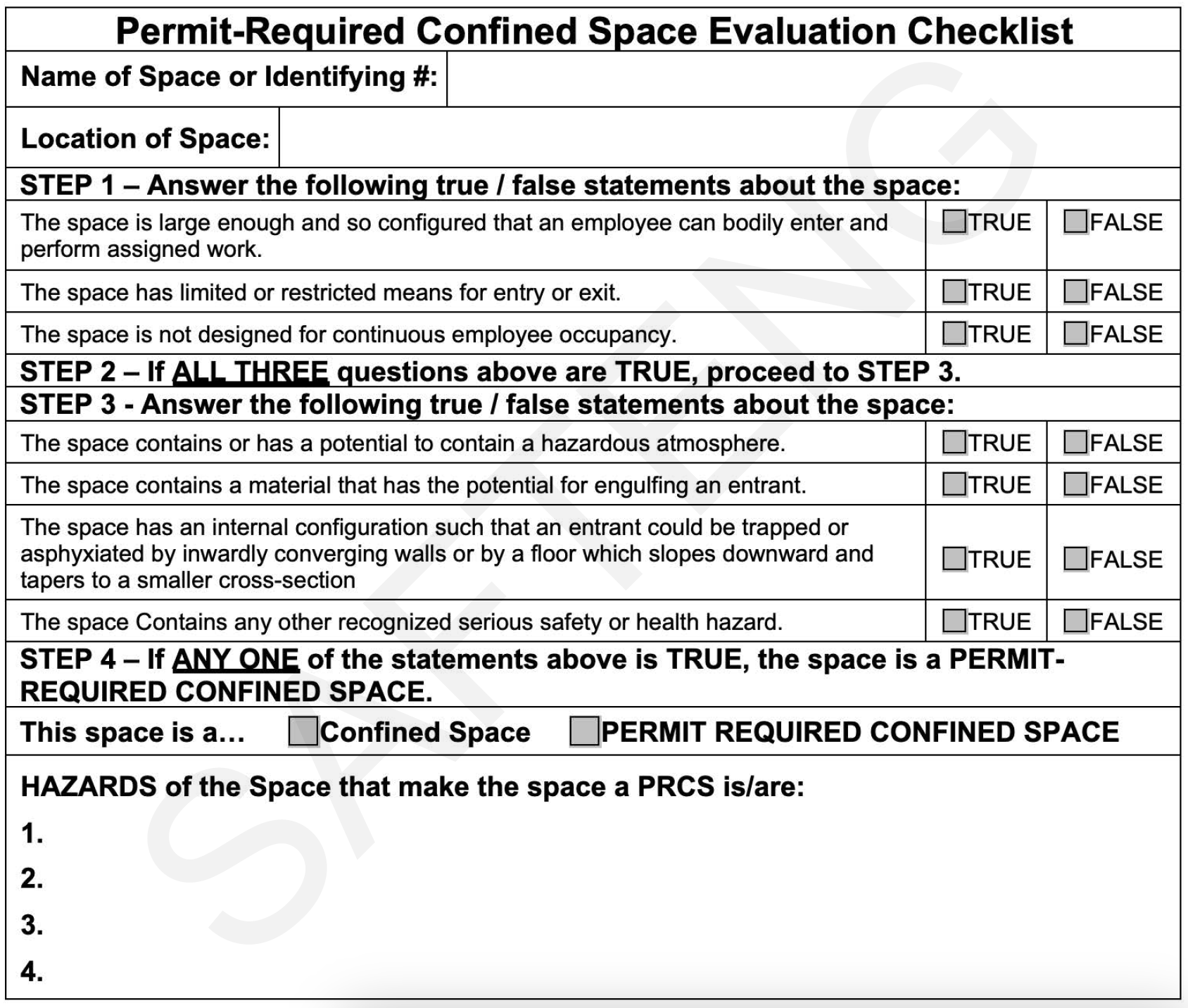
This form documents the name of the space (as well as by Asset #) and the three (3) questions that we ask to determine if the space is a Confined Space.
(1) Is large enough and so configured that an employee can bodily enter and perform assigned work; and
(2) Has limited or restricted means for entry or exit (for example, tanks, vessels, silos, storage bins, hoppers, vaults, and pits are spaces that may have limited means of entry.); and
(3) Is not designed for continuous employee occupancy.
If the space is evaluated as a Confined Space, we move to Part II of the form to determine if it has a hazard that will make it a Permit-Required Confined Space.
By documenting the evaluation for each space, we are creating a database of sorts, which will play a significant role in the job of the entry supervisor. As you may know, OSHA offers us three (3) methods by which we can enter a PRCS. Again, I have written extensively on each of these three (3) methods, so I will be brief here.
Entry Method #1 – (c)(5) (e.g. alternative)
Entry Method #2 – (c)(7) (e.g. reclassification)
Entry Method #3 – (d)-(k) (e.g. entry by permit)
The entry supervisors will use the space’s completed evaluation form to help them understand their entry options. For example, if a HAZ ATM was listed as one of the hazards that made the CS a PRCS, they know that Entry Method # 1 (c)(5) is NOT an option.
Suppose the evaluation did NOT list a HAZ ATM (including the potential for one) as a hazard. In that case, the entry supervisor will have a list of physical hazards on the completed evaluation form that he/she will need to ELIMINATE if they want to use Entry Method #2 (c)(7). Flashing back to our written program, it MUST have procedures for “reclassifying” a PRCS to a Non-PRCS status; this is 2-3 pages in my written program, with the Reclassification Permit being another page in my appendices. However, that procedure depends on the accurate and up-to-date PRCS Evaluation Database.

Training is the next significant SMS element and plays a critical role. CBT or Online methods can NOT accomplish this training because the training is PROGRAM SPECIFIC, and we take a layered approach. By that, I mean we are training as a team. In the first hour, everyone attends, and we cover the program fundamentals, like the definitions and hazards associated with entry into a PRCS. We also touch on the entry options so everyone can understand the options. After that 1st session, we released everyone who would be only an “entrant.” Those who may be called upon to be an “attendant” or an “entry supervisor” will stick around for the next 2-hour session, where we go over the roles and responsibilities of an “attendant.” We even set up the non-entry rescue systems and have hands-on training on these systems. You may be surprised at the number of “attendants” who have never cranked on a 4:1 winch and are surprised at how easy it turns by how slow it cranks the entrant out. SAFTENG members need to read my articles on non-entry rescue methods and the many myths that come with them. After that session, we release those who will never be asked to be an entry supervisor. So we are at 3+ hours of training for the entrants and attendants; the next 4 hours will be for the entry supervisors. In these 4-hrs we will cover the Evaluation Database, decision-making on the best entry method, and all the requirements for each method (a major part of the means and methods we can use to isolate the space). We then get into the Entry Permit and Reclassification forms and how they will be completed, communicated, and posted at the entry portal. A big part of this ES training is the Care, Use, Testing, and limitations of direct-reading atmospheric meters. If the facility has different styles, brands, and models, this aspect of the training can take a couple of hours. Along with the meter management, we must discuss where and how to sample the space and how the space will be continuously monitored. The last part of ES training is the “rescue options” and what is required of them before signing the entry permit! For those who have not read my other articles, look up 1910.145(j)(4) and let that sink in! It is the #1 massive failure of 99% of programs, training, and PRCS practices.
The last SMS element is Auditing. This element can be quite extensive as I believe in doing a lot of Active Permit Audits; those permits we do not audit in the field while they are active will get a “desktop audit,” meaning that 100% of our entry permits will be audited. The field audits are usually around 30 minutes as I expect that the auditor(s) will walk down the energy isolation plan, verify the entrants and attendant(s) are on the Lockbox, wearing the prescribed PPE and that the equipment that is needed to implement the rescue plan documented on the permit is present and has been inspected that day. However, the auditing also covers the annual program review, which in my program also includes a field audit in search of “new” PRCS that were not captured by our Management of Change process. We will also audit the signage on each of our PRCSs annually as part of our annual program review. The facility PRCS rescue team members typically do this part of the auditing; they perform their audit in the unit/department they work in. The safety team will audit the closed permits to ensure that entrants, attendants, and ESs listed on entry permits match up to the training records to ensure that personnel only fulfill the roles they have been trained in. The safety team will also audit the “meter management” to ensure meters are being calibrated on time and bump-tested daily. We also look for sampling data that could be of concern. And the last thing that gets audited is the rescue equipment and personnel training.
And that is my PRCS Management System at the 50,000′ level. I hope it has painted a picture that makes it clear that it takes a village to manage a well-oiled PRCS program.