
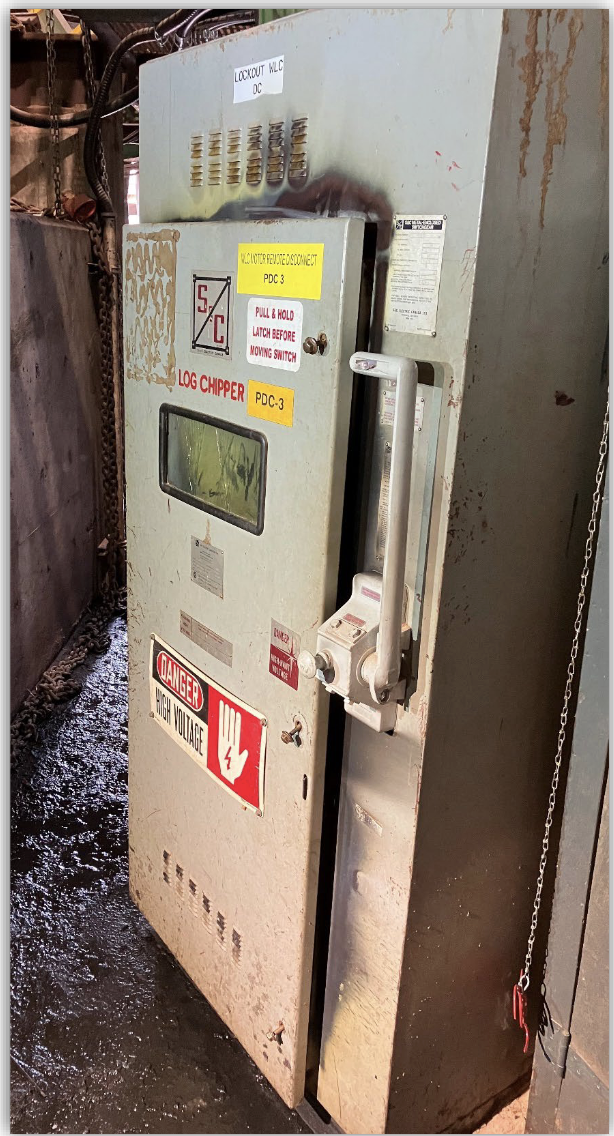
 A cleaning crew member, with no electrical qualifications, switched on a high voltage (2200V 3Ph) electrical switch for a piece of equipment after it had been locked out. The worker’s hand was burnt by escaping arc gasses and flames coming through a damaged door gasket.
- The equipment has a 2100-volt ac synchronous motor that is used for power factor correction. Power factor correction is used to limit power consumption.
- The alternating current control and contactor was located approximately 75 meters away from the incident location in the high voltage vault.
- Over current protection 400 amp 5 KV fuses.
- Local disconnect (unfused) was located beside the WLC motor.
- Stop/Start control station was located on the upper landing, which is not visible from the disconnect location below.
- The direct current field disconnect includes an interlock.
The machine had been turned off and locked out. The site foreman later turned back on the remote contacter to power up the machine but there was still a lock from the clean-up worker on the local disconnect. The clean-up worker without electrical qualifications later removed their own lock from the local disconnect and moved the switch handle upward to power it on. The machine then started up and was drawing load. The clean-up worker panicked and moved the disconnect switch back to the lowered, disconnected position.
The site-specific lock-out procedures were not followed with respect to the reenergization of the equipment.
When the switch was opened under load, the high voltage bridged the gap, and an arc flash occurred. The switch was not designed to be opened under load, and the arc flash exited through the gasket and contacted the clean-up worker resulting in moderate burns.
Field Safety Representative statements
- The safety protocol for the site is that the shift supervisor’s lock is the last one to be removed.
- The site procedure specifies that the first item to be locked out is the direct current (DC) for the machine as it has the control power run through its auxiliary contacts.
- The start button should then be pressed to test the lock out is correct.
- The DC disconnect should also be the last item to remove locks from, so the local disconnect can not be engaged under power.
- The cleanup worker had removed their lock from the DC disconnect first, allowing for the contact to be closed in the HV vault, which turns the control power on.
Injured worker statements
- Took off his own lock and closed the switch.
- The cleanup worker then heard the motor starting, panicked, and then reopened the switch.
- The cleanup worker was then burnt by escaping arc gasses and flames.
- It was normal practice to open the switches himself after removing the lock.
- The control should not be in the on position as it is supposed to be left in the off position.
- Was off work 2.5 weeks due to the arc flash injuries.
Site findings
- The disconnect was damaged while it was being operated under load.
- The switch was designed to be operated in deenergized state only.
- Arc created while the switch was operated burnt the contacts and caused fuses to blow.
- Feeder connections in HV vault also sustained damage.
- The worker operating switch was burnt from escaping arc through the damaged door gasket.
Causes and contributing factors
- A worker without electrical qualifications operating the high-voltage disconnect switch was very likely the cause of the incident.
- Not following the site safety procedure, including not having a qualified person (ex. supervisor) do the final re-energization and not energizing the DC control switch last were contributing factors.
- The start-stop control station being remotely located from the whole log chipper is a plausible contributing factor.
Source: https://assets.contentstack.io/v3/assets/bltdec2ded849740f4d/blt846d23799cddaddc/651f088b7bedef1d2594d607/II-140058-2022-(28573).pdf