
Human failure is a term used to describe ways in which humans in a system deviate from the intended course of action.
As a leader, you must recognize why you and others make errors and mistakes and use this knowledge to prevent this from happening again. A leader also plays an essential role in setting people up for success. While this section will help you understand human failure, in the system’s view, people are not seen as sources of error so much as the creators of safety. This view recognizes that there will always be gaps in any system because designers and rule-makers cannot think of all situations and contingencies. This means that human operators must be given some degree of freedom to cope with the unexpected. In turn, this increases the need for the human operator to identify and manage the risks that arise.
Types of Human Failure
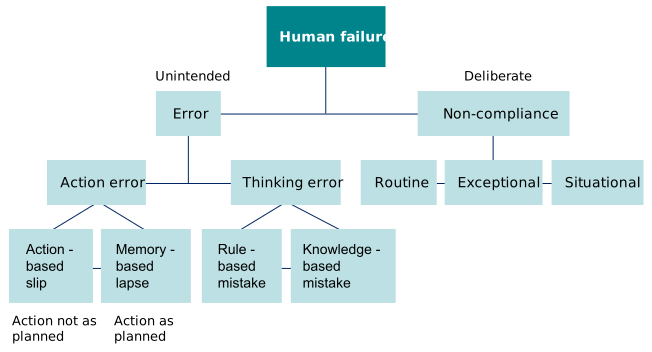
Figure shows there are many types of human failure. These can be classified as either an “unintended error”, which can be an error of action or thinking, and “deliberate non-compliance” where someone chooses not to comply with guidance.
Unintended errors or incorrect actions
Slips – when you intend to do the right thing but get it wrong
For example, moving a switch down instead of up.
Lapses – when you forget to do something or lose your place in the middle of a task
For example, you may lose your place in a safety-critical task.
There are many causes for these errors, including:
- it is a familiar task requiring little conscious thought (system 1 thinking)
- two similar tasks being confused
- tasks being too complicated
- the main task being completed, but details are missed
- distractions
You can reduce these incidents by:
- making staff aware that slips and lapses do occur
- using checklists and flowcharts to ensure tasks have been completed
- ensuring that procedures are clear and logical
- ensuring complicated tasks have checks
- reducing distractions
Mistakes that are failures in decision-making
These can be “rule-based mistakes” when learned procedures or rules are misapplied to a task.
For example, you may follow the procedure correctly but misjudge the speed of the vessel while berthing because you are in an unfamiliar vessel.
There are also “knowledge-based mistakes”.
These are mistakes made because of a lack of knowledge of the task, for example, relying on an out-of-date check to plan an unfamiliar route.
There are many causes for these errors, including:
- trying to accomplish too many tasks at once
- a complicated task
- time pressures and poor work environments.
- social factors, for example, peer pressure or staffing issues
- individual stressors, for example health
- problems with equipment
- organizational factors such as a lack of training and monitoring
You can reduce these incidents by:
- increasing awareness of high-risk situations
- providing procedures for predictable, non-routine, high-risk tasks
- supervising inexperienced workers
- providing aids and diagrams for procedures
A violation
This is a deliberate action or decision to deviate from the rules, regulations, or procedures. These can be “routine violations” – shortcuts to rules or procedures that become a normal way of working. For example, everyone onboard routinely works without personal protective equipment (PPE) because of being under time pressure.
There can also be “situational violations” – when exceptional pressures lead to deviations from rules. An example would be having to take shortcuts or rush through tasks to do everything you need to do in the time you have been given.
“Exceptional violations” are when unusual or emergency situations leads to a deviation from the rules, usually to solve the problem. For example, the Master works during a rest period as they’re needed on the bridge to avoid a collision.
Causes of violations can include:
- being under pressure, including time and manning
- peer pressure
- not understanding the reasons for the rules
- perception that the rules are too strict or that compliance with the rules is not expected
- lack of supervision or perception that there are no repercussions for violations
- wanting to take the easy option – this may be particularly prevalent if workers are stressed
- lack of correct equipment
You can reduce these incidents by:
- setting a good example and encouraging compliance – if the procedure does not make sense, consider changing it
- involving staff in changes to rules to increase buy-in
- explaining the reasons behind rules and procedures and why they’re relevant
- ensuring the work environment is suitable to carry out procedure
- providing appropriate supervision
- ensuring you provide the necessary resources to carry out tasks
- including possibilities of violations when completing risk assessments
- creating a culture where safety is prioritized
Violations are deliberate acts that deviate from the rules or usual procedures; however, the intended outcome is often well-meaning.
A violation intended to cause harm to others or the organization is called sabotage. However, there are many reasons why errors occur, and, in most cases, they’re unintended.
It’s easy to blame someone when something goes wrong, but to stop the same thing happening again, it’s important to look at the reasons why the mistake happened. We have to explore the weaknesses in the whole system and look at the organizational causes of the error, not just on an individual level.
Source: https://www.gov.uk/guidance/leading-for-safety/2-decision-making-and-risk-management