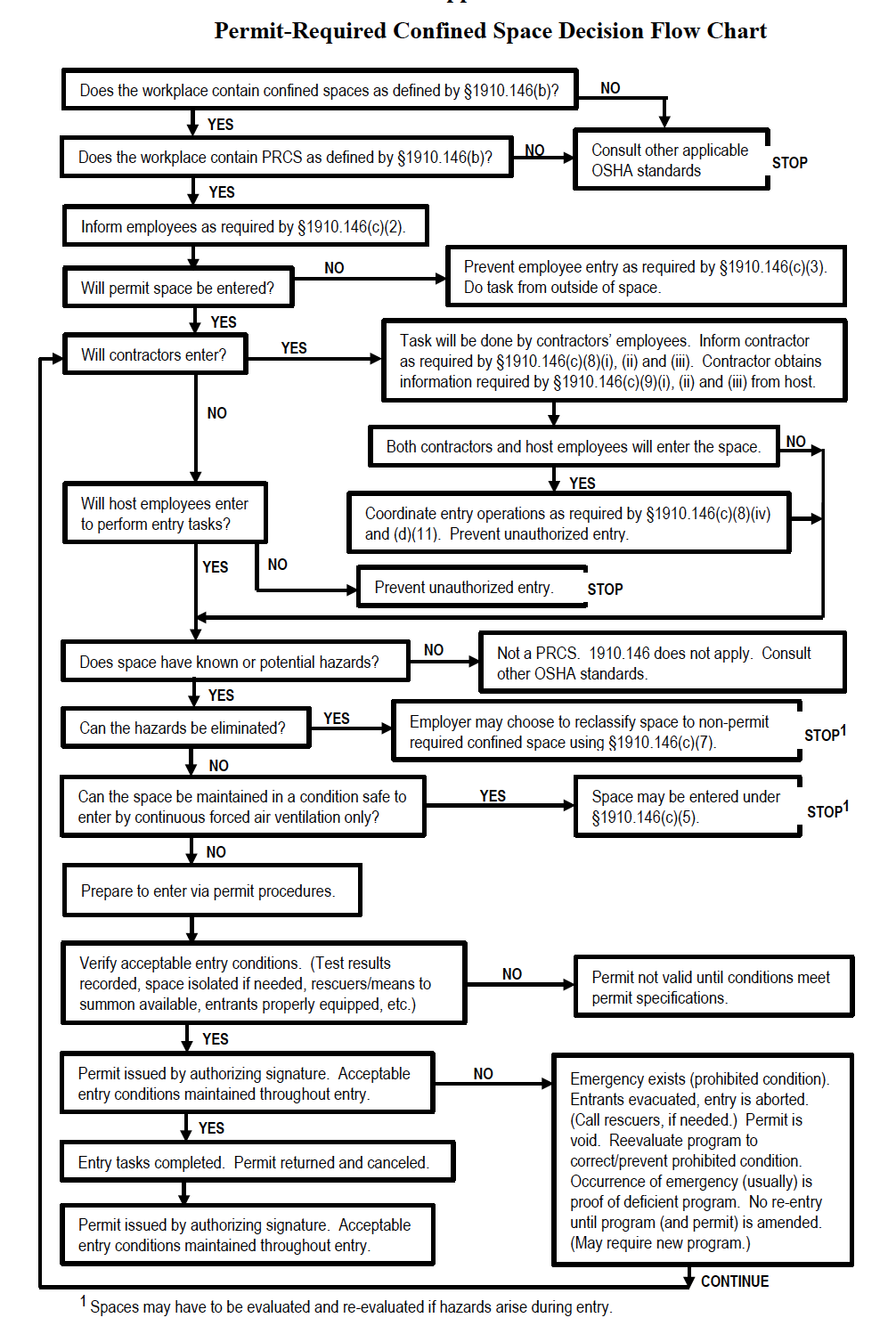
Federal investigators determined a truck washing company failed to protect workers from hydrogen sulfide gas as they entered over-the-road tanker trailers to clean them out, causing one worker’s fatal injuries and hospitalizing two co-workers. OSHA responded to a report of the Sept. 1, 2023, incident and found the business failed to evaluate the tanker trailers for hazardous conditions – including testing the atmosphere – and did not train workers on potential hazards before letting them enter the confined spaces, both violations of OSHA regulations.
Inspectors found multiple violations of OSHA’s confined space regulations. They noted the employer lacked both respiratory and hearing protection programs and exposed workers to fall hazards of up to nine feet while cleaning the trailers.
Citation 1 Item 1
Type of Violation: Serious; $4,839
29 CFR 1910.28(b)(1)(i): The employer did not ensure that each employee on a walking-working surface with an unprotected side or edge that is 4 feet (1.2m) or more above a lower level was protected from falling by guardrail systems, safety net system, or personal fall arrest system:
The employer did not ensure that employees were protected from fall hazards of greater than 4 feet to the ground level below with a guardrail, netting, or other fall protection system.
On September 28, 2023, during truck wash activities, employees were observed standing on the mid rail and top rail of a Ballymore mobile ladder stand to extend their reach, exposing employees to a fall hazard of approximately 9 feet from the top rail and approximately 7 feet from the mid rail to the concrete below.
Citation 1 Item 2
Type of Violation: Serious; $4,839
29 CFR 1910.95(c)(1): The employer did not administer a continuing, effective hearing conservation program as described in 29 CFR 1910.95(c) through (n) whenever employee noise exposures equal or exceed an 8-hour time, weighted average sound level of 85 decibels or the adjusted TWA sound level in dBA for an extended work shift:
An effective hearing conservation program which included noise monitoring, audiometric testing of employees and training of employees as detailed in the standard was not instituted.
Note: The 8-hour TWA sound level of 85 dBA that triggers the requirement for a hearing conservation program (HCP) can be adjusted for work shifts less than or greater than 8 hours. When making the adjustment, the following formula is used: AL= 90 + 16.61 log [50/10 (hours)]. Affected employees were exposed to continuous noise levels over a 10-hour work shift. Therefore, the TWA sound level that triggers the requirement for a HCP is adjusted or reduced for the affected employees to 83.4 dBA.
a) On or about September 28, 2023, an employee who worked in the truck wash bays cleaned trucks with scrubbers and high pressure water. The employee was exposed to continuous noise levels at 70.7% of the allowable 10-hour time-weighted average sound level (83.4 dBA). The equivalent dBA level of70.7% is approximately 87.4 dBA. The
sampling was performed for 587 minutes.
b) On or about September 28, 2023, an employee who worked in the truck wash bays cleaned trucks with scrubbers and high pressure water. The employee was exposed to continuous noise levels at 78.6% of the allowable 10-hour time-weighted average sound level (83.4 dBA). The equivalent dBA level of78.6% is approximately 88.2 dBA. The
sampling was performed for 571 minutes.
c) On or about September 28, 2023, an employee who worked in the truck wash bays cleaned trucks with scrubbers and high pressure water. The employee was exposed to continuous noise levels at 88.8% of the allowable I 0-hour time-weighted average sound level (83.4 dBA). The equivalent dB A level of 88.8% is approximately 89. I dB A. The
sampling was performed for 605 minutes.
Citation 1 Item 3
Type of Violation: Serious; $4,839
29 CFR 1910.134(c)(1): A written respiratory protection program that included the provisions in 29 CFR 1910.134(c)(1)(i) – (ix) with worksite specific procedures was not established and implemented for required respirator use:
On or about September 1, 2023, the employer failed to establish and implement a respiratory protection program. The employer required employees to don tight-fitting, filtering facepiece respirators when performing tank clean-out activities.
Citation 1 Item 4
Type of Violation: Serious; $4,839
29 CFR 1910.134(d)(2)(i): The employer did not provide the following respirators for employee use in IDLH atmospheres:
(A) A full facepiece pressure demand SCBA certified by NIOSH for a minimum service life of thirty minutes, or
(B) A combination full facepiece pressure demand supplied-air respirator (SAR) with auxiliary self-contained air supply.
On or about September 1, 2023, the employer provided tight-fitting, filtering facepiece respirators while performing tank clean-out activities. The respirators failed to provide sufficient protection in atmospheric conditions that were immediately dangerous to life and health due to the volume of hydrogen sulfide gas present inside the tank.
Citation 1 Item 5
Type of Violation: Serious; $4,148
29 CFR 1910.134(e)(1): The employer did not provide a medical evaluation to determine the employee’s ability to use a respirator before the employee was fit tested or required to use the respirator in the workplace:
On or about September 1, 2023, employees engaged in tanker trailer cleaning operations were exposed to respiratory hazards in that the employer did not provide medical evaluations prior to the required use of a 3M half-faced and Radnor N95 respirators.
Citation 1 Item 6
Type of Violation: Serious; $4,148
29 CFR 191O.134(f)(2): The employer did not ensure that an employee using a tight-fitting respirator was fit tested prior to initial use of the respirator, whenever a different respirator facepiece was used, and at least annually thereafter:
On or about September 1, 2023, employees engaged in tanker trailer cleaning operations were exposed to respiratory hazards, in that the employer did not provide a fit test prior to initial use of tight-fitting 3M half-faced and Radnor N95 respirators.
Citation 1 Item 7
Type of Violation: Serious; $2,765
29 CFR 191O.134(h)(2)(i): Respirators were not stored to protect them from damage, contamination, dust, sunlight, extreme temperatures, excessive moisture, and damaging chemicals or were not packed or stored to prevent deformation of the facepiece and exhalation valve:
Employees engaged in tanker trailer cleaning operations were exposed to respiratory hazards, in that the employer did not ensure that half-face respirators were stored or packed when not in use. On or about September 28, 2023, a 3M half-face respirator was observed stored, by hanging the respirator on a fire extinguisher, in wash bay 2 area, and was not protected from damage, contamination, and dust.
Citation 1 Item 8
Type of Violation: Serious; $4,839
29 CFR 1910.134(k)(1): The employer did not provide effective training that covered the required elements in 1910.134(k)(1)(i) through 1910.134(k)(1)(vii):
On or about September 1, 2023, the employer failed to provide respiratory protection training to employees prior to required use of tight-fitting, filtering facepiece respirators during tank cleanout activities.
Citation 1 Item 9
Type of Violation: Serious; $4,839
29 CFR 1910.146(c)(1): The employer did not evaluate the workplace to determine if any spaces were permit-required confined spaces:
On or about September 1, 2023, the employer failed to evaluate the workplace for permit-required confined spaces. Employees were exposed to permit-required confined spaces, including, but not limited to, when employees enter over-the-road tanker trailers to perform clean-out activities.
Employees are exposed to hazardous atmospheric conditions while inside tanker trailers from gases to include, but not limited to, hydrogen sulfide.
Citation 1 Item 10
Type of Violation: Serious; $4,839
29 CFR 1910.146( c)( 4): Employer has not fully developed (all elements), implemented and updated their current confined space program/procedures to protect employees who enter permit spaces and are exposed to potential hazards.
On or about September 1, 2023, at 1200 East Pancake Boulevard in Liberal, Kansas, the employer failed to develop a written permit space entry program. Employees entered over-the-road tanker trailers to perform clean-out activities.
Citation 1 Item 11
Type of Violation: Serious; $4,839
29 CFR 1910.146(d)(3): Under the permit-required confined space program required by 29 CFR 1910.146(c)(4), the employer did not develop and implement the means, procedures, and practices necessary for safe permit space entry operations:
On or about September 1, 2023, the employer failed to protect employees from respiratory hazards associated with performing tanker trailer cleaning activities in a confined space.
The employer did not develop and implement the means, procedures, and practices necessary for safe permit-space entry operations prior to entering a confined space. No procedures existed to specify acceptable entry conditions, provide for an authorized attendant, isolate the permit space, provide methods for purging, inerting, or venting, and provide a verification that conditions in the permit space are acceptable for entry throughout the duration of the entry.
Citation 1 Item 12
Type of Violation: Serious; $4,839
29 CFR 1910.146(d)(4): The employer did not provide the equipment specified in paragraphs (d)(4)(i)-(d)( 4)(ix) of this section at no cost to employees, did not maintain that equipment properly, and/or did not ensure that employees used that equipment properly:
On or about September 1, 2023, the employer failed to provide employees with necessary equipment prior to permit-required confined space entry. This was observed in the
following instances:
1. Employees were not provided with atmospheric monitoring and testing equipment;
2. Employees were not provided with ventilating equipment needed to obtain acceptable entry conditions;
3. Employees were not provided with communication equipment; and
4. Employees were not provided with rescue and emergency equipment.
Citation 1 Item 13
Type of Violation: Serious; $4,839
29 CFR 191O.146(d)(5)(i): The employer did not evaluate permit space conditions when entry operations were conducted by testing conditions in the permit space to determine if acceptable entry conditions existed before entry was authorized to begin:
At 1200 East Pancake Blvd Liberal, Kansas, on or about September 1, 2023, the employer failed to protect employees from respiratory hazards in permit-required confined spaces. The employer failed to evaluate or otherwise test conditions prior to permitting entry, to determine if conditions were safe to enter and conduct work.
Citation 1 Item 14
Type of Violation: Serious; $4,839
29 CFR 191O.146(d)(6): The employer did not provide at least one attendant outside the permit space into which entry was authorized for the duration of entry operations:
At 1200 East Pancake Blvd Liberal, Kansas, on or about September l, 2023, the employer failed to protect
employees working in a permit-required confined space by providing at least one qualified attendant outside the
space, in that the observer did not have knowledge of potential hazards that entrants might face, such as signs and symptoms and consequences of exposure to hydrogen sulfide, nor was the observer aware of their responsibility to alert entrants to warning signs or symptoms of over-exposure to a dangerous situation and/or communicate the need to evacuate the space.
Citation 1 Item 15
Type of Violation: Serious; $4,839
29 CPR 1910.146(d)(8): Under the permit-required confined space program required by 29 CFR 1910.146(c)(4), the employer did not designate the persons who were to have active roles in entry operations, identify the duties of each such employee:
On or about September 1, 2023, the employer failed to protect employees working in a permit-required confined space by not designating persons to have active roles prior to entering a confined space. Active roles not assigned include attendants and entry supervisors.
Citation 1 Item 16
Type of Violation: Serious; $4,839
29 CFR I910,146(d)(9): The employer did not develop and implement procedures for summoning rescue and emergency services, for rescuing entrants from permit spaces, for providing necessary emergency services to rescued employees, and/or for preventing unauthorized entry.
On or about September 1, 2023, the employer failed to develop procedures to summon emergency services. Employees routinely perform over-the-road tanker trailer cleanout services. The work activity required employees to enter and work inside permit-required confined spaces where the entrant is exposed to hazardous atmospheric conditions.
Citation 1 Item 17
Type of Violation: Serious; $4,839
29 CFR 1910.146(d)(10): The employer did not develop and implement a system for the preparation, issuance, use, and cancellation of entry permits as required by this section.
On or about September l, 2023, the employer failed to develop permit-required confined space entry permits for employees who performed over-the-road tanker trailer cleanout services. The work activity required employees to work inside permit-required confined spaces.
Citation 1 Item 18
Type of Violation: Serious; $4,839
29 CFR 1910.146(g)(1): The employer did not provide training so that all employees whose work was regulated by 29 CFR 1910.146 (permit required confined spaces) acquired the understanding, knowledge, and skills necessary for the safe performance of the duties assigned under 29 CFR 1910.146:
On or about September 11, 2023, the employer failed to provide training such that the entrant employee acquired the understanding, knowledge, and skills necessary for safe entry operations. The entrant employee routinely entered over-the-road tanker trailers that previously contained decomposing animal wastes which exposed the entrant to hazardous atmospheric conditions due to hydrogen sulfide gas.
Citation 1 Item 19
Type of Violation: Serious; $4,839
29 CFR 1910.146(g)(1): The employer did not provide training so that all employees whose work was regulated by 29 CFR 1910.146 (permit required confined spaces) acquired the understanding, knowledge, and skills necessary for the safe performance of the duties assigned under 29 CFR 1910.146:
On or about September 1, 2023, the employer failed to provide training such that the attendant employee acquired the understanding, knowledge, and skills necessary for safe entry operations. The attendant employee routinely observed over-the-road tanker trailers entry that previously contained decomposing animal wastes which exposed the entrant to hazardous atmospheric conditions due to hydrogen sulfide gas.
Citation 1 Item 20
Type of Violation: Serious; $4,839
29 CFR 1910.146(g)(1): The employer did not provide training so that all employees whose work was regulated by 29 CFR 1910.146 (permit required confined spaces) acquired the understanding, knowledge, and skills necessary for the safe performance of the duties assigned under 29 CFR 19!0.146:
On or about September I, 2023, at 1200 East Pancake Blvd, Liberal, Kansas, the employer failed to provide training such that an effected employee acquired the understanding, knowledge, and skills necessary for safe entry operations. The effected employee routinely assists in the cleaning of over-the-road tanker trailers entry that previously contained decomposing animal wastes which exposed the entrant to hazardous atmospheric conditions due to hydrogen sulfide gas, 29 CFR 1903.19(d)(l) requires certification and documentation that the abatement of the above violation is complete.
Citation 1 Item 21
Type of Violation: Serious; $4,148
29 CFR 1910.151(c): Where employees were exposed to injurious corrosive materials, suitable facilities for quick drenching or flushing of the eyes and body were not provided within the work area for immediate emergency use:
On or about September 1, 2023, at 1200 East Pancake Blvd, in Liberal, Kansas, the employer failed to ensure that employees were provided with a suitable eyewash station. Employees were routinely exposed to corrosive chemicals when conducting over-the-road trailer cleaning to include but not limited to Chem Station 5456, which contains sodium hydroxide, and ChemStation 9450, which contains hydrochloric acid which are corrosive.
Citation 1 Item 22
Type of Violation: Serious; $4,148
29 CFR 1910.1200(e)(1): The employer did not develop, implement, and/or maintain at the workplace, a written hazard communication program which describes how the criteria specified in 29 CFR 191O.1200(f), (g), and (h) will be met:
On or about September 1, 2023, at 1200 East Pancake Blvd, in Liberal, Kansas, the employer did not implement and establish a hazard communication program. Employees routinely use cleaning chemicals to include, but not limited to, ChemStation 5456 that contains sodium hydroxide, which is corrosive, ChemStation 9450 that contains hydrochloric acid which is corrosive, ChemStation 9575 that contains phosphoric acid and citric acid, which are irritants , and ChemStation 45642 that contains 2-butoxy-ethanol which is an irritant , when performing daily cleaning tasks.
Citation 1 Item 23
Type of Violation: Serious; $2,765
29 CFR 1910.1200(g)(8): The employer shall maintain in the workplace copies of the required safety data sheets for each hazardous chemical, and shall ensure that they are readily accessible during each work shift to employees when they are in their work area(s). (Electronic access and other alternatives to maintaining paper copies of the safety data sheets are permitted as long as no barriers to immediate employee access in each workplace are created by such options.)
On or about September 1, 2023, at 1200 East Pancake Blvd, in Liberal, Kansas, the employer did not ensure that employees were provided with access to safety data sheets (SDS’s). Hazardous chemicals used in the workplace include, but are not limited to Chem Station 5456 that contains sodium hydroxide which is corrosive , ChemStation
9450 that contains hydrochloric acid which is corrosive, ChemStation 9575 that contains phosphoric acid and citric acid which are irritants, ChemStation 45642 that contains 2 butoxy-ethanol which is an irritant, and ZAP RTU31 that contains sulfuric acid, phosphoric acid, and ammonium bifluoride which are corrosive.
Citation 1 Item 24
Type of Violation: Serious; $2,765
29 CFR 1910.1200(h)(l ): Employees were not provided effective information and training on hazardous chemicals in their work area at the time of !’heir initial assignment and whenever a new hazard that the employees had not been previously trained about was introduced into their work area:
On or about September 1, 2023, at 1200 East Pancake Blvd, in Liberal, Kansas, the employer failed to provide hazard communication training. Employees routinely used cleaning chemicals to include, but not limited to sodium hydroxide, hydrochloric, phosphoric acid, 2-butoxy-ethanol, and citric acid which are corrosive and skin and eye
irritants, when performing daily cleaning tasks.
Citation 2 Item 1
Type of Violation: Willful – Serious; $32,265
29 CFR 1910.146(d)(2): Under the permit-required confined space program required by 29 CFR 1910.146(c)(4), the employer did not identify and evaluate the hazards of permit spaces before employees entered:
At 1200 East Pancake Blvd Liberal, Kansas, on or about November 3, 2023, the employer failed to protect employees from hazards associated with performing tanker trailer cleaning activities in a confined space. The employer did not identify and evaluate the hazards associated with truck tank trailer prior entering a confined space to conduct cleaning operations.
Citation 2 Item 2
Type of Violation: Willful – Serious; $32,265
29 CFR 1910.146(g)(1): The employer did not provide training so that all employees whose work was regulated by 29 CFR 1910.146 (permit required confined spaces) acquired the understanding, knowledge, and skills necessary for the safe performance of the duties assigned under 29 CFR 1910.146:
On or about November 3, 2023, the employer failed to protect employees from hazards associated with tanker trailer cleaning operations inside a confined space, in that the employer did not provide employees with training to address physical hazards, such as limited entry/egress, 220 degree water used to flush the tank, atmospheric hazards such as oxygen deficiency/enrichment, flammable environments, and toxic environments.
CLICK HERE for the citations