
Which establishments are covered by the update to the HCS?
The scope and framework of the HCS have not changed with this rulemaking. Chemical manufacturers and importers are still responsible for providing information about the hazards of chemicals they produce or import. All employers with hazardous chemicals in their workplaces continue to be required to have a hazard communication program and to provide information to employees about these hazards and associated protective measures.
Why is OSHA updating the HCS now?
OSHA is updating the HCS to improve dissemination of information about chemical hazards by: improving and streamlining precautionary statements, providing additional clarification of existing regulatory requirements, incorporating new hazard classes and categories, increasing alignment with other U.S. agencies, and international trading partner.
What are some of the key changes in the update to the HCS and how do they align with international trading partners and other U.S. agencies?
Most of the key changes in this update fall under one of the following themes:
1. Maintaining alignment with the GHS (primarily Rev. 7) and U.S. trading partners (including Health Canada’s WHMIS)
Paragraph (f)(12) – small packages. Updates include special labelling provisions for 3 ml and 100 ml containers similar to Health Canada’s WHMIS requirements.
Paragraph (i) – trade secrets. Updates include mandatory use of prescribed concentration ranges when exact percentages or percentage ranges of materials are claimed as a trade secret. The prescribed concentration ranges align with those used by Health Canada’s WHMIS.
Appendix A (health hazards) updates align primarily with revised health hazard definitions and general updates to hazard classes in GHS Rev. 7. Updates include, but are not limited to, the Skin corrosion/irritation and Serious eye damage/eye irritation chapters, with non-animal test methods from Rev. 8 added to skin corrosion/irritation to promote use of alternative methods.
Appendix B (physical hazards) updates align primarily with Rev. 7 and include, but are not limited to, Flammable gases (expanding hazard categories), Desensitized explosives, and Aerosols (including additional hazard category).
Appendix C (label elements) updates align primarily with Rev. 7 and include new or updated hazards, updated guidance, and precautionary statements.
Appendix D (SDS) updates align primarily with Rev. 7 and include revisions to SDS Sections 2, 3, 9, and 11.
2. Addressing issues identified during implementation of the 2012 update to the HCS
Paragraph (d)(1) – hazard classification. The final rule clarifies which hazards must be evaluated and the hazard information required on the label versus the SDS.
Paragraph (f)(11) – labels. The final rule adds flexibility for label updates on packages that have been released for shipment.
Paragraph (f)(12) – labels. The final rule clarifies labeling requirements for small packages.
3. Improving alignment/coordination with other U.S. agencies
Paragraph (f)(5) – bulk shipment. The final rule provides increased coordination with DOT.
Paragraph (c) released for shipment definition – The final rule aligns with EPA.
What are some benefits of this update to the HCS?
OSHA believes this update to the HCS will improve worker protections by clarifying existing regulatory requirements, incorporating new hazard classes and categories, and improving and streamlining precautionary statements. In addition, updates that increase alignment with key trading partners will facilitate international trade.
How will this rule affect State Plans?
Those State Plans that have their own hazard communication standards must adopt provisions that are at least as effective as the final rule. OSHA will evaluate those State Plans to ensure that any updates do not unduly burden interstate commerce. (OSH Act section 18(c), 29 U.S.C. 667(c)(2)).
What are the expected economic impacts of this update to the HCS?
OSHA estimates that the final rule will affect 111,223 firms, 147,832 establishments, and 1,530,476 employees and, for each affected industry, will either provide cost savings or the costs would be less than one percent of revenues or ten percent of profits. The net cost savings of the final rule are expected to be $29.8 million per year (seven percent discount rate). For more information on OSHA’s economic analysis of this rule please see Section VI. Final Economic Analysis and Regulatory Flexibility Analysis of the final rule.
When does the final rule go into effect?
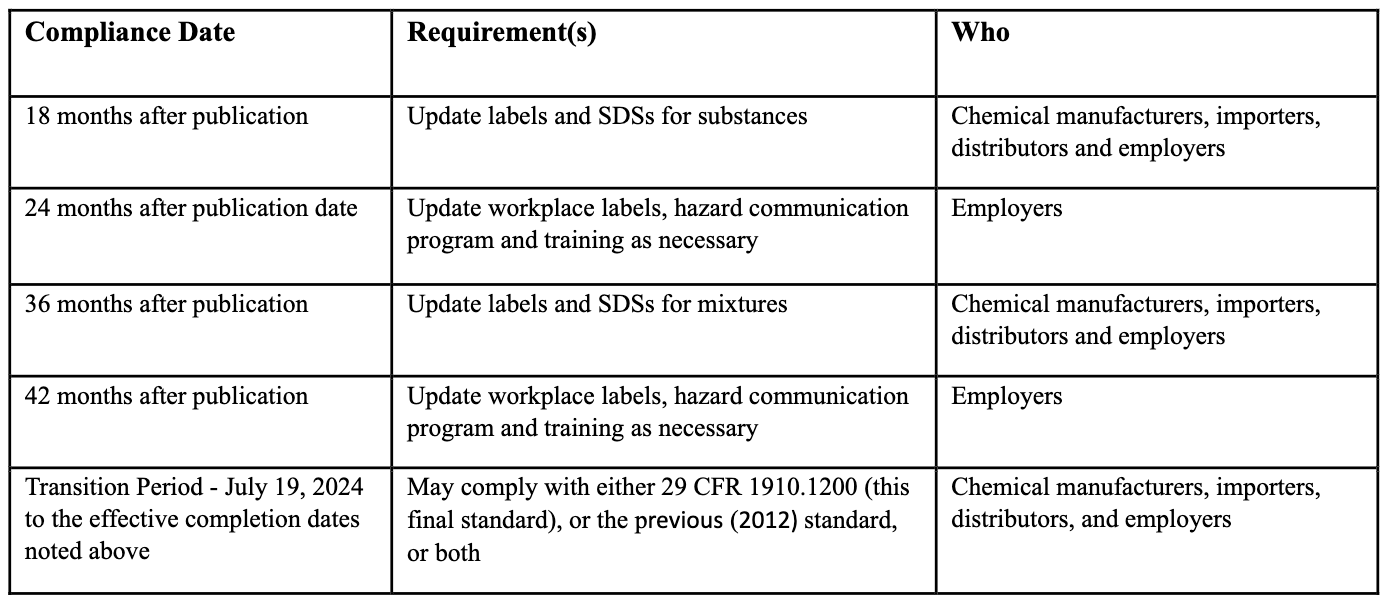
OSHA has developed a tiered approach for establishments to come into compliance with the HCS. The table highlights those dates:
Does OSHA provide additional resources to help workers, employers, and other stakeholders understand the changes to the HCS?
OSHA has developed a redline strikeout version of the regulatory text and appendices to help workers, employers, and other stakeholders understand the changes to the HCS. In addition, OSHA is updating existing guidance and developing new guidance to help stakeholders comply with the updated standard. The redline strikeout and guidance materials can be found on the OSHA Hazard Communication safety and health topics page (https://www.osha.gov/hazcom).
Source: https://www.osha.gov/sites/default/files/HCS_Q-and-As.pdf