

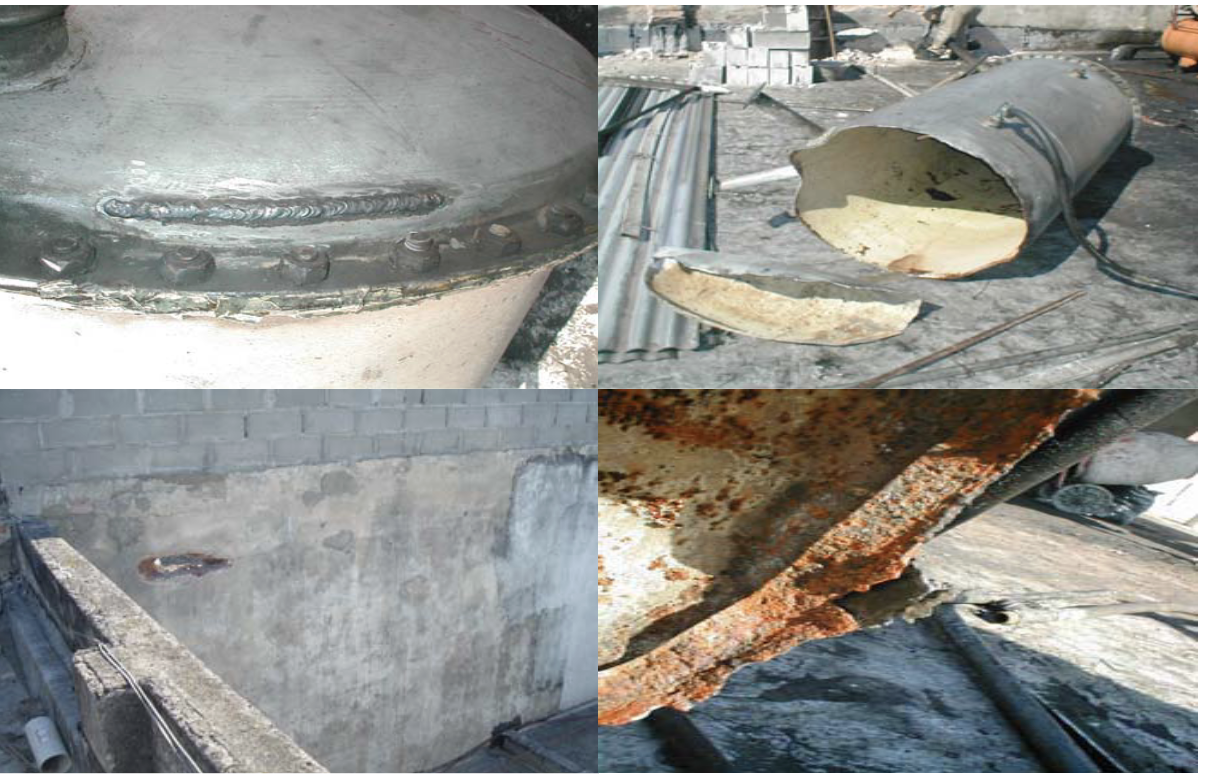
In May 2009, a compressed air tank failed, blowing the bottom off of the tank and sending fragments flying into a concrete wall, puncturing the wall. The investigation following the incident
revealed several serious problems with the condition of the tank, including severe corrosion and rust at the bottom of the tank, where it failed, and an improper weld repair which had been made to the tank at some time in the past. Although the weld repair did not contribute to this incident, it is a symptom of improper maintenance and inspection and could have caused a tank failure.
Fortunately, nobody was in the area when the tank failed, and there were no injuries.
Pictures below
Lessons Learned
- Visually inspect vessels, piping, and other equipment as you walk through your plant, and report anything which appears to be corroded or improperly maintained. Follow up and
make sure that problems are corrected. - Understand the equipment inspection and maintenance program in your plant, and understand your role in ensuring that all activities are completed as required.
- When you do mechanical work that requires removal of insulation from equipment, take the opportunity to look at the condition of the equipment and report any corrosion or other problems that you observe. Corrosion under insulation may be hidden.
- Make sure that all welds and other repairs follow all required standards, and meet the original design specifications for the equipment.
- Assure that all pressure vessels in your plant, including portable tanks and tanks which are a part of “packaged systems” (for example, compressors, refrigeration units, compressed air systems, etc.), are included in the plant mechanical integrity inspection program and are being inspected by qualified pressure vessel inspectors.
- Make sure that compressed air tanks and other portable compressed gas cylinders are stored in dry locations to prevent external rust and corrosion.
Source: http://www.sache.org/beacon/files/2009/05/en/read/2009-05-Beacon-s.pdf