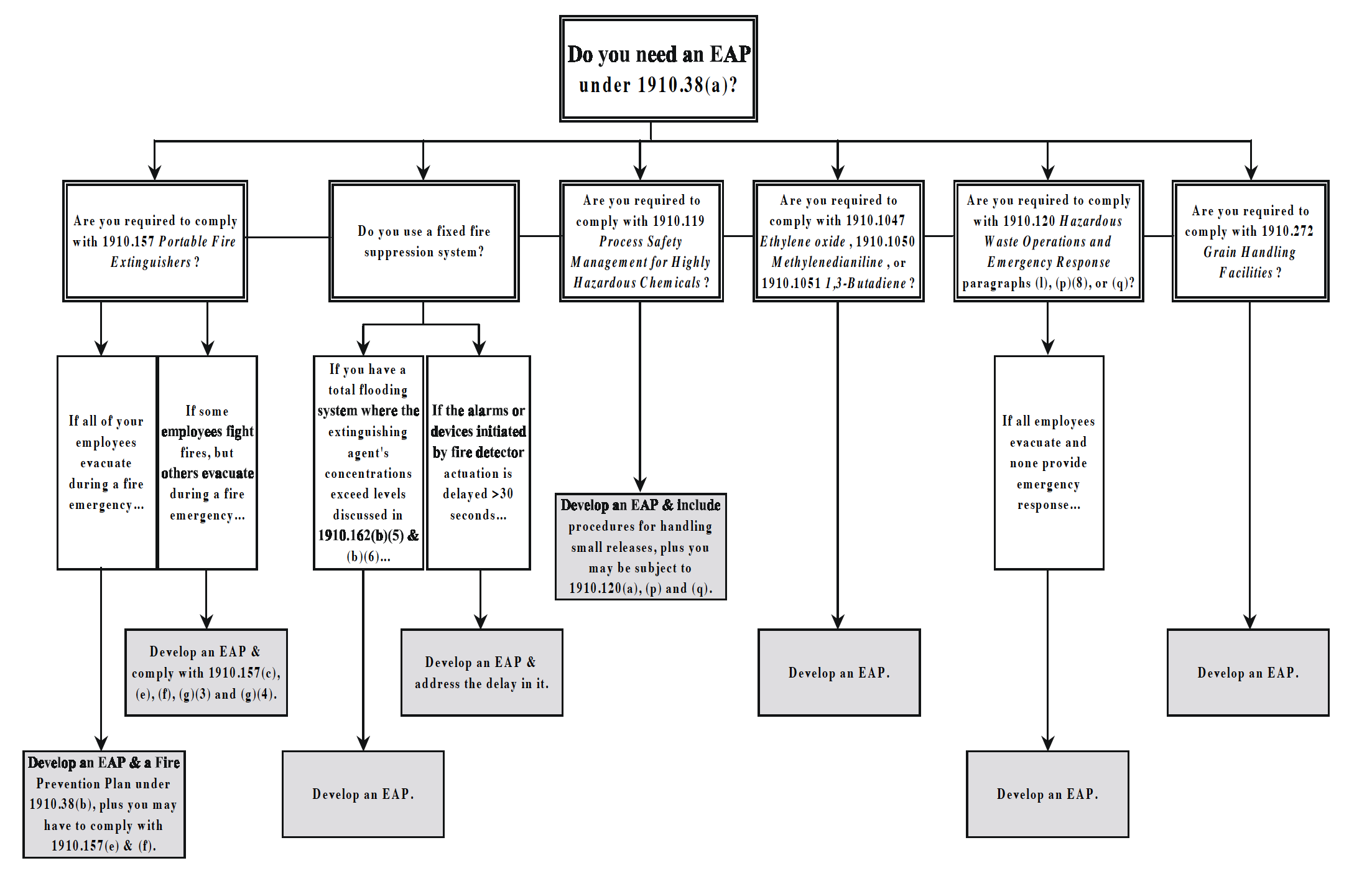
In most circumstances, immediate evacuation is the best policy, especially if professional firefighting services are available to respond quickly.
There may be situations where employee firefighting is warranted to give other workers time to escape or to prevent danger to others by the spread of a fire. In this case, you as the employer are still required to have an EAP.
To help you decide whether to have employees evacuate or fight fires, see the Fight or Flee? post in the Emergency Response Section.
Still unsure about whether you are required to have an EAP??? Use OSHA’s Expert System to help you determine whether you are required to have an EAP.
Standards that require EAPs include:
- Process Safety Management of Highly Hazardous Chemicals – 1910.119
- Fixed Extinguishing Systems, General – 1910.160
- Fire Detection Systems, 1910.164
- Grain Handling – 1910.272
- Ethylene Oxide – 1910.1047
- Methylenedianiline – 1910.1050
- 1,3-Butadiene – 1910.1051
NOTE: The 1910.38 provisions are applicable and may be referenced only when another OSHA standard requires an EAP or FPP. The above standards require an EAP.
Employers are generally required by 29 CFR 1910 to provide portable fire extinguishing equipment for use in fighting incipient stage fires in the workplace. 29 CFR 1910.157, however, provides alternatives for employers who do not want their employees to fight incipient stage fires in the workplace. Employers who opt for the evacuation of all or most employees to a safe area do not have to comply with certain requirements of 1910.157, depending on the option chosen. These options are:
- The employer evacuates all employees to safety when a fire occurs [1910.157(b)(1)]: Employers who select this option are relieved from compliance with 1910.157 unless a specific standard in part 1910 requires that portable fire extinguishers be provided. If the employer selects this option, compliance with 1910.38(a) and (b) is required through 1910.157(b)(1).
- The employer evacuates all employees except those designated to use portable fire extinguishers [1910.157(b)(2)]: Employers who select this option need not comply with the distribution requirements of 1910.157(d). This option allows for the employer to distribute extinguishers in a manner such that they are available to the employees designated to fight incipient stage fires. If the employer selects this option, compliance with 1910.38(a) is required through 1910.157(b)(2).
- The employer keeps portable fire extinguishers in the workplace but does not want employees fighting fires and therefore evacuates the employees to safety [1910.157(a)]: OSHA recognizes that portable fire extinguishers may be required in the workplace by other organizations (e.g., insurance companies, local fire departments, etc.). Portable fire extinguishers that are not intended for employee use may still pose a hazard if they are not properly maintained. Employers who select this option must comply only with the maintenance, inspection, and testing requirements in paragraphs (e) and (f) of 1910.157.
Employers who do not select any of these options but instead provide portable fire extinguishers for use by any employee to use in fighting incipient stage fires must comply with 1910.157 in its entirety. Employees who provide portable fire extinguishers for employee use must provide an educational program to familiarize all employees with the general principles of fire extinguisher use [1910.157(g)(1) and (g)(2)]. Employees who are expected to use portable fire extinguishers must be provided with “hands on” training in the use of the fire extinguishing equipment [1910.157(g)(3)]. If the employer chooses to comply with all of 1910.157, there is no requirement to comply with 1910.38.