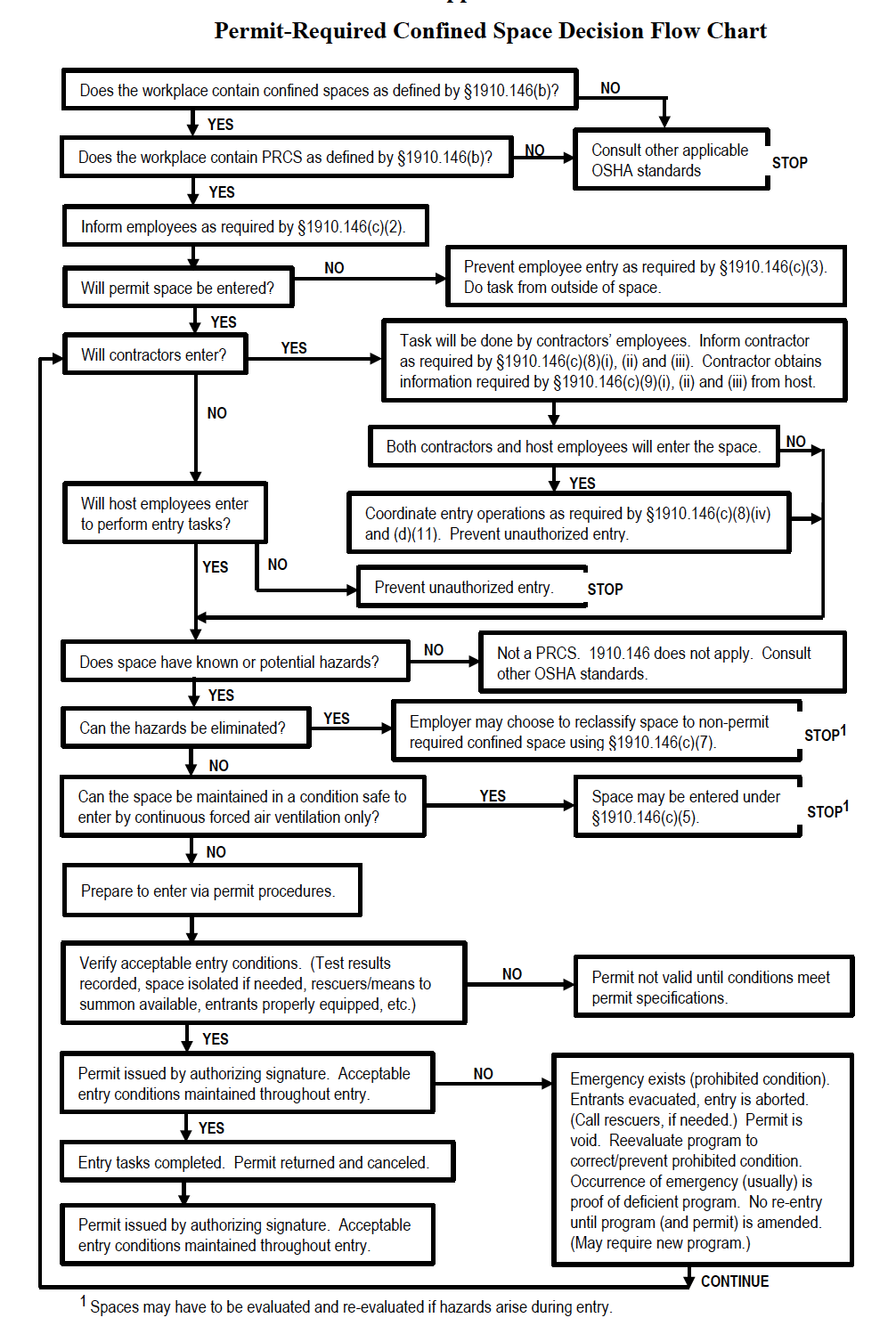
There is a lot of confusion on reclassifying Permit-Required Confined Spaces to Non-Permit Spaces, which is allowed on spaces with NO KNOWN or POTENTIAL hazardous atmospheres. 1910.146(c)(7) covers this practice. The key DIFFERENCE between “reclassifying” a space using section (c)(7) and using “alternative entry methods,” which is covered under section (c)(5) is ELIMINATION vs. CONTROL.
(c)(7) REQUIRES ELIMINATION of ALL PRCS hazards, and (c)(5) states you can CONTROL the hazardous atmosphere with FORCED AIR VENTILATION as long as you can show the forced-air blower can maintain a safe atmosphere.
So, how does OSHA consider when a PRCS hazard has been ELIMINATED?
We look to the most recent LOTO CPL, in which OSHA discusses energy isolation methods for reclassifying PRCSs. On pages 3-10, OSHA states the following as it relates to energy isolation for all hazardous energy forms to and from a PRCS:
Relationship between the Control of hazardous energy (LOTO) standard and the Permit-required confined spaces (PRCS), 29 CFR §1910.146, standard.
The PRCS and the LOTO standards are generic and interrelated standards, and both standards may, depending upon the circumstances, apply to the isolation of hazardous energy for a PRCS. The application of the LOTO standard, with respect to PRCS, is governed by §1910.147(a)(3)(ii), which provides that, when other standards require LOTO, the procedural and training provisions of the LOTO standard shall be used and supplemented to effectively control hazardous energy. Therefore, for any particular PRCS, the question will be whether the 1910.146 standard requires LOTO to isolate hazardous energy. The answer to this question depends on the type(s) of hazardous energy that must be isolated, whether LOTO provides isolation (offering complete employee protection), and whether the §1910.146 requires the use of LOTO. Pursuant to the §1910.146 standard (including its final rule preamble), electromechanical types of hazards, associated with a PRCS, must be isolated in accordance with the LOTO standard (or guarded in accordance with Machine guarding, Subpart O, requirements). Failure to follow the procedural and training requirements of the LOTO standard should be cited as §1910.147 violations related to the isolation of electro-mechanical hazards. The PRCS standard does not, however, allow LOTO for flowable material isolation. This is because compliance with §1910.147 does not, in all cases, adequately isolate hazards created by materials such as steam, flammable gases, flammable and combustible liquids. In a permit-required confined space, hazards associated with flowable materials will be considered isolated only by the use of the following techniques: blanking or blinding; misaligning or removing sections of lines, pipes or duct; and use of a double block and bleed system. A double block and bleed isolation system, for example, usually utilizes the closure of two valves, the opening of a bleeder valve, and the application of LOTO devices (offering complete employee protection); whereas an employer can comply with §§ 1910.147(d)(3) and 1910.147(d)(4) of the LOTO standard by simply closing and LOTO of a single valve (which could create atmospheric hazards due to the leakage of a single valve).
The other aspect of PRCS isolation that confuses is “what constitutes hazardous energy that must be isolated in one of the above-mentioned methods”?
Let me be very clear here…ISOLATE EVERY LINE/PIPE/HOSE/TUBE/DUCT attached to the space. I like to see a space that has been 100% isolated (i.e., imagine the space is suspended in the air with nothing connected to it). My programs EVEN REQUIRED UNUSED nozzles/connections to be isolated to ensure someone does not remove them and hook something up to the blank nozzle. This really comes into play with spaces that transcend multiple facility levels. The ONLY thing that can get into the space is what the entry supervisor allows by listing it on the entry permit or reclassification documentation.
Here is a little piece from my PRCS Training (members can download a copy in the Document Library)
- Don’t be fooled by “drain lines” and “discharge lines” – these lines MUST be isolated too
- “ALL lines/pipes/ducts/tubing” means even those unused nozzles
- If they are ALREADY blanked off, we must ensure the blank is in good repair and that we identify this blank as an isolation device per our LOTO SOP
Blanking/Blinding
- Blank the flange CLOSEST to the space
- Leave the valve(s) used for isolation when installing blank/blind LOTO’ed CLOSED
- Any blinds already in place (e.g., process flow control or QC) MUST be pulled and INSPECTED BEFORE being used as an isolation device for CSE
- LOCK blinds in place with a chain and lock if possible; if not, tag it out
- If blinds/blanks are used, the facility should utilize some type of system (e.g., blinding log, PSSR, etc.) to ensure all blinds/blanks have been pulled BEFORE the space is returned to service
Double Block & Bleed
- Lock (or tag) the bleed OPEN as part of the isolation
- Make sure there are no tie-ins or connections between the block valves
- The risk for this type of isolation method increases the further the distance between the valves
- ALL connections between the valves MUST be locked/tagged either OPEN or CLOSED – one MUST be locked OPEN to satisfy DB&B
Disconnect & Misalign
- When removing a spool piece, place a lock through the nozzle/flange bolt opening as a means to “lockout” this “energy isolating device”
- When removing hoses and tubing, be sure to lock (or tag) the vessel connection and not the end of the hose or tube that was removed
- Set a minimum distance (e.g., 2’) for “disconnect & misalignment” (e.g., removing an 8” long valve from a 3” line is NOT acceptable)
- This method is used for hoses & tubing and not fixed piping