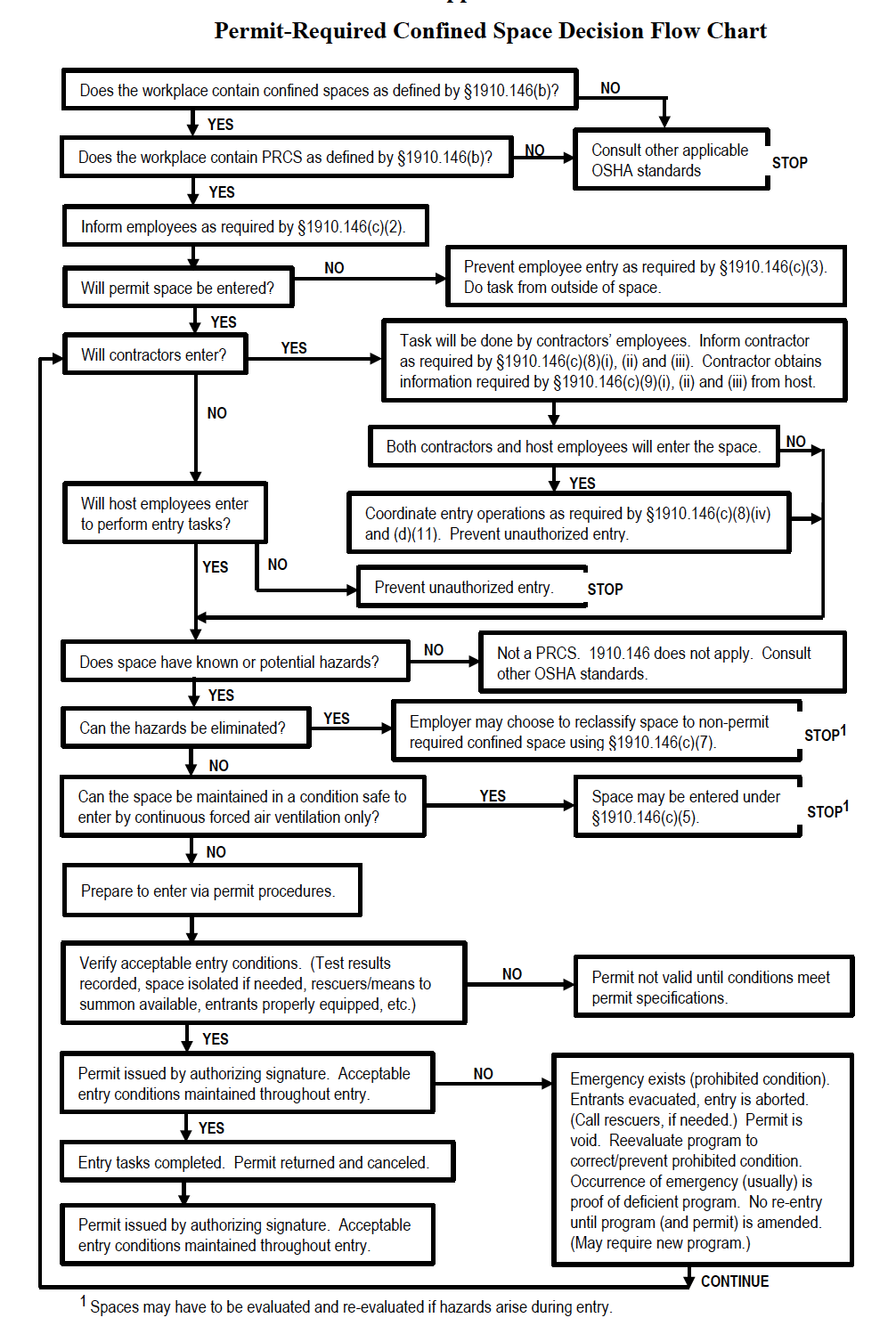
Nowadays, we see a lot of Confined Space (CS) incidents caused by the work that is taking place inside the space rather than the actual process hazards that made the Confined Space a Permit-Required Confined Space (PRCS). I had an incident when I was an S&H Manager in the process chemical industry that was one nobody thought of until it was too late. I want to share this incident with you and demonstrate how workers can create a permit-required confined space (PRCS) by changing the “configuration of the space” and/or by doing work inside the space that creates a PRCS a hazardous atmosphere. Please keep in mind that this facility was trying to enter OSHA’s VPP and had MANY safeguards in place, including all types of work permits. In this incident, the contractors worked under three (3) permits: Contractor Work Permit, Hotwork Permit, and Crane Permit. Here is how it happened…
We had three contractors installing a Fiberglass Re-enforced Plastic (FRP) Tank. They do this in sections, one ring at a time. Each ring is about 4′ tall. They walk the base ring in using a crane, set it in place, and anchor it to the pad. For the next ring, they walk-in with a crane and set it on top of the base ring, but for this one, they have to install a rubber seal at the seam, then apply an epoxy coating to the rubber seal to hold it in place. This particular FRP tank was 15′ in diameter, so a large amount of epoxy was used at each seam. The epoxy was made with SOLVENT (Flammable!!!). With each ring being 4′ tall, by the time they were installing the 1st ring on top of the base ring, they had, in fact, created an 8′ deep CS. Also, using epoxy, they created a PRCS due to the flammability and toxicity of the atmosphere within the newly created space. However, the department supervisor had only issued a Contractor Work Permit and Hot Work permit, as he had done many days prior, as the contractor(s) did not explain to him how they were going to install the tank and the supervisor issuing the permit did not ask for details in how the work was going to be done!!!!. The supervisor thought the tank was already built and that they would just need a crane permit from engineering. So the contractor foreman went to engineering for their crane permit. After assessing each ring’s area, crane size, and weight, engineering issued their crane permit. That is TWO OPPORTUNITIES to stop these dominoes from falling, but we missed each opportunity. We also had a section in our PRCS Program where we talked about “new tanks” (Greenfield projects) that have NOT been hooked up to any process lines and how they MAY BECOME PRCS by changing their configuration or intended use. Many plants forget about this little stand-alone section of OSHA’s PRCS standard, but it is very important!!!
1910.146(c)(6) When there are changes in the use or configuration of a non-permit confined space that might increase the hazards to entrants, the employer shall reevaluate that space and, if necessary, reclassify it as a permit-required confined space.
To the contractors, they had installed hundreds of these tanks in hundreds of chemical plants and never once had an issue. BUT THERE WAS ONE BIG DIFFERENCE in our tank and its installation. We specifically called for the man-way to be on the top rather than on the bottom, as is the case in their original design, and apparently, we were the first to have this configuration on this size tank. ANOTHER Domino is in place for this accident. The contract company did not even think this project through as they quickly realized that once they got the first ring in place on top of the base, how would they get out from inside the tank once they had it built!?!?! This, too was an opportunity to catch these mistakes and STOP the work, but they missed it and literally decided they would ride the crane ball through the 36″ top manway once they were finished.
Now remember, the contractors had a hotwork permit for their tools (grinder, heat gun, glue gun, etc.). This required the area to be checked for flammable vapors, which was done outside of the space and on two separate occasions! But NEVER inside the space!
Around 1:00 pm (five hours after work began), the contractors had gotten the last ring in place (3 rings, plus the base ring, 16′ high). Now they had to go back to engineering and the department supervisor and get NEW WORK permits, as the plan was to install the roof ring from the second rather than the first floor. New permits meant a new INSPECTION of the work area and a NEW review of the proposed work. Neither the supervisor nor the process engineer considered the scope of work had changed and was now taking place within a confined space (keep in mind this was now a PERC!). In preparation for installing the roof ring, the contractor took some lights into the space, as they knew from experience that once the roof ring was in place, things were going to get really dark really fast. They used the same lighting that they had on all their other installations. It was just a nickel-and-dime store lighting system like what we would buy at home. Although their system had one more MINOR difference, one of the light stands was missing the wire guard over the lens. As the contractors were setting up their lights, the department supervisor was present and observed the contractors daisy-chaining several extension cords together to have enough length so the light stands could reach the bottom of the tank. Yet the supervisor said nothing nor took any actions to correct the unsafe use of cords. The contractor work permit did list lighting as an approved tool, but since the building they were in was not a Hazardous Location building, the supervisor did NOT require intrinsically safe lighting (still not realizing the lighting was going to be used inside a PRCS the contractor just created and the atmosphere was flammable due to the epoxy they were using).
About 10 minutes into their work under their new permits, one of the workers trip over a cord, pulling over the light stand (the one missing the wire guard). When the light shattered, a flash fire occurred within the flammable atmosphere created by using 30+ tubes of epoxy throughout the day. With the only opening to the tank being the open top, all the vapors had collected at the bottom.
We were lucky! ONLY minor injuries, and after a free ride to the local Emergency Room, they were treated and released. But this was a learning experience that I will never forget, and I am pretty sure all those involved will never forget (or at least I’d like to think they will not).
Even though we had several layers of protection, multiple eyes on the task, project briefings, and daily safety talks with the contractors (on top of permit reviews), the incident still occurred! Most facilities (unfortunately, NOT ALL facilities) have the traditional confined space safety efforts down pat, but so many still struggle with the “changing of the configuration” or the “use” of the space that often these go unrecognized until an accident occurs. I will never forget the day I go the page on my ERT pager that we had a PRCS Rescue on site, yet we had no record of any active entries taking place. It took us all of 15 minutes into the investigation to understand what and how it all happened!
I hope this article will help facilities understand how easily and quickly a PRCS can be created out of thin air and include this example in future training so that workers can identify these situations before tragedy strikes.