
A flammable storage cabinet is much different from a regular office cabinet! They may look similar in size and shape, but that is where their similarity ends. A flammable storage cabinet MUST have special features to comply with NFPA 30 and/or 1910.106(d)(3).
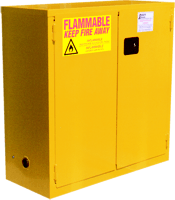
1) The door (s) MUST have three-point latching: one at the top of the door, one on the side/midway on the door, and one at the bottom of the door. This is usually the first thing to go bad on a cabinet, but it is the MOST CRITICAL function of any moving parts on the cabinet. Without adequate latching at the three points, the heat the cabinet could be exposed to will warp the door and open a crease that allows the heat inside the cabinet, thus rendering the cabinet useless.
2) The bottom, top, door(s), and sides of the cabinet must be at least No. 18 gage sheet iron and double walled with 1.5″ air space. This is what separates these cabinets from the “office type” cabinet and what makes them “fire safe” cabinets.
3) The door sill MUST be raised at least 2″ above the bottom of the cabinet. This 2″ raised sill acts as a secondary containment for any spills inside the cabinet, preventing the formation of a “fuse.” Without this secondary containment, any spill inside the cabinet could run outside the cabinet and act like a fuse, allowing the fire to burn the spilled material and enter the cabinet.
4) Cabinets MUST be labeled in conspicuous lettering, “Flammable – Keep Fire Away.” Labeling is a REQUIREMENT that is often overlooked. We have seen cabinets that meet the construction requirements but had their original labeling painted over or removed. 1910.106(d)(3) does not have a size requirement, but NFPA 30 does. NFPA 30-9.5.5 states, “Storage cabinets shall be marked in lettering that is at least 2 in. (50 mm) high as follows:WARNING: FLAMMABLE — KEEP FIRE AWAY.”
5) To vent or not to vent. Cabinets are NOT required to be vented. In fact, NFPA 30 suggest that cabinets should NOT be vented, but they MUST BE VENTED properly if they are vented. This means that the storage cabinet vent openings shall be ducted directly to outdoors in such a manner that will not compromise the specified performance of the cabinet and in a manner that is acceptable to the authority having jurisdiction. Here is what NFPA 30 states about venting cabinets…
“Venting of storage cabinets has not been demonstrated to be necessary for fire protection purposes. Additionally, venting a cabinet could compromise the ability of the cabinet to adequately protect its contents from involvement in a fire, because cabinets are not generally tested with any venting. Therefore, venting of storage cabinets is not recommended. However, it is recognized that some jurisdictions might require storage cabinets to be vented and that venting can also be desirable for other reasons, such as health and safety. In such cases, the venting system should be installed so as to not affect substantially the desired performance of the cabinet during a fire. Means of accomplishing this can include thermally actuated dampers on the vent openings or sufficiently insulating the vent piping system to prevent the internal temperature of the cabinet from rising above that specified. Any make-up air to the cabinet should also be arranged in a similar manner. If vented, the cabinet should be vented from the bottom with make-up air supplied to the top. Also, mechanical exhaust ventilation is preferred and should comply with NFPA 91, Standard for Exhaust Systems for Air Conveying of Vapors, Gases, Mists, and Noncombustible Particulate Solids. Manifolding the vents of multiple storage cabinets should be avoided.”
6) Can I put my cabinet on wheels or set it on a pallet? We see this increasingly with all the 5-S-type housekeeping and organizing efforts, but is it safe to put wheels on a cabinet or sit it on a pallet for easy moving with a forklift? A big NO is the answer, and here is why. Installing wheels on the bottom of the cabinet requires drilling into the cabinet, which will hamper its fire rating. Setting the cabinet on a wheeled cart is a bad idea, making it unstable. Setting the cabinet on a wooden or plastic pallet is a bad idea as the pallet can weaken in a fire and cause the cabinet to fall over, causing a large flammable liquid spill in the middle of a fire. The idea that setting the cabinet on a pallet makes it easy to move also makes it prone to falling over and creating a flammable liquid spill. PLEASE DO NOT use employees to hold onto the cabinet as the PIT moves it. You should ALWAYS EMPTY the cabinet before it is MOVED.
7) Do I need to ground my cabinets? Grounding cabinets certainly does not hurt but is NOT required when storing individual containers in small quantities. Suppose your cabinet stores containers, and workers will transfer OUT of or INTO the container(s) inside the cabinet. In that case, the cabinet MUST BE GROUNDED properly (see the picture below for the type of cabinet that needs grounding).
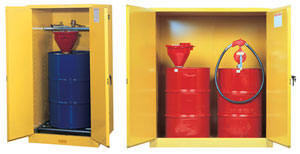
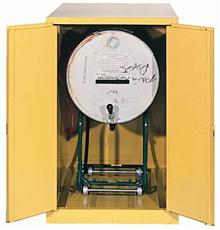
The entire ground path needs to be verified it is effective as some of these cabinets and their drum carriages require some basic assembly. If instructions are not followed to the letter, we have found some drums within the cabinets NOT grounded, even though the cabinet was grounded. Do you see anything wrong with the drum grounding in the picture below? This “commercially available” system can be bought from a reputable vendor. Still, if this system is NOT set up and tested for grounding correctly, there could be some SERIOUS flammable liquid issues!
See the cabinet below, sitting inside a PLASTIC secondary containment basin! That cabinet would need to be grounded using a ground cable attached to a ground.
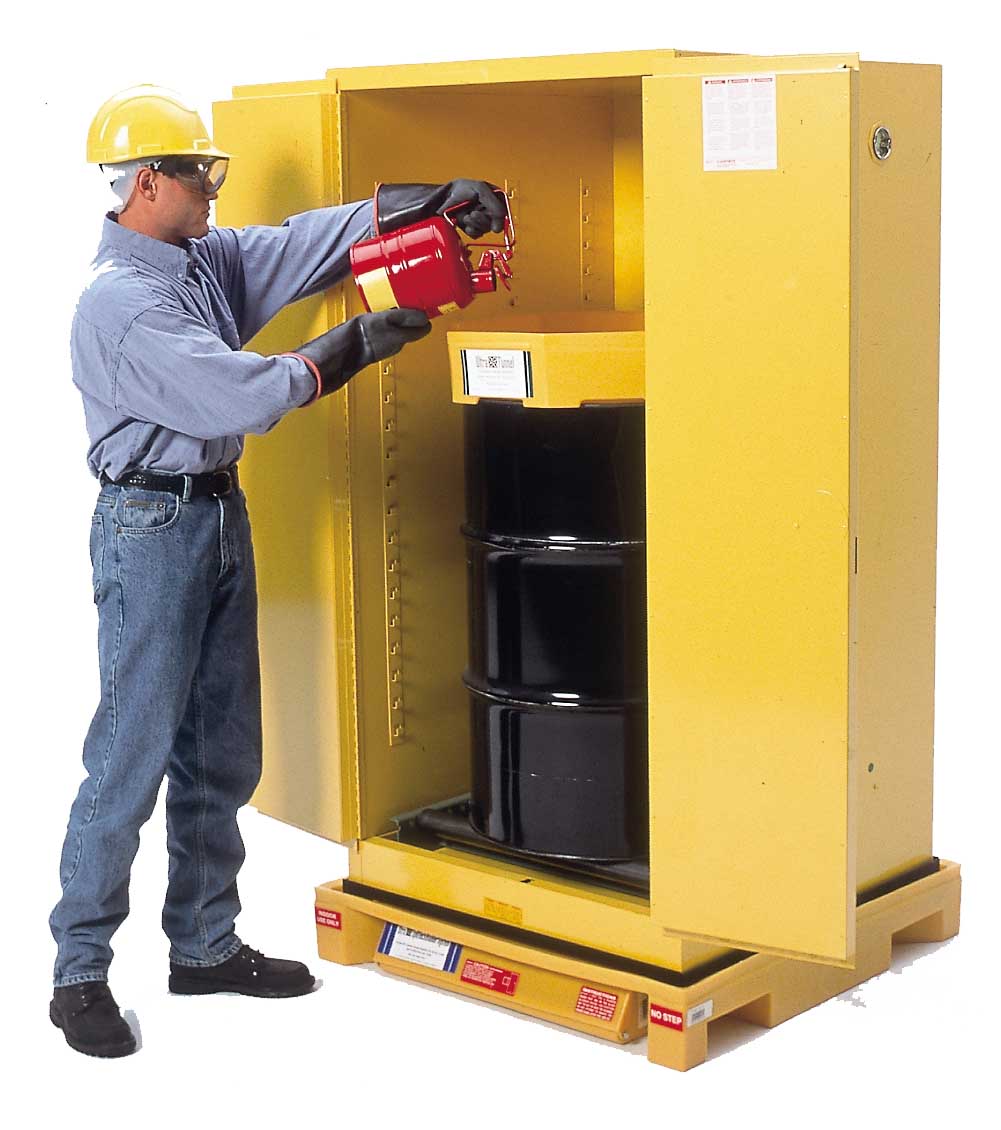
By the way, the drums in these cabinets MUST be equipped with “dead man” (e.g., spring-loaded) valves made of a compatible metal and NOT plastic!